Scroll down to visit contributors’ work
EDITORIAL
Voices That Vanish: On the Disappeared and the Silenced
I was fourteen when I noticed that my aunt's clock didn't work. I was an adult when I learned why.
I visited her almost every day. At first I thought the clock just needed a battery. It sat there collecting dust, and I assumed she was waiting for one of the taller nephews to come change it for her, since she's short and the clock hangs high on the wall.
I remember asking about it. I remember the adults shushing me. I never understood the fuss over a stupid, dusty clock stuck at 10:10.
Nearly a decade later I learned that my aunt had stopped that clock the day her husband disappeared.
I still don't know the rest of the story. Like many Lebanese, I grew up inside the exploding sound of war and the louder silence that came after it, the silence of adults who had seen too much and said too little.
My story isn't unique. Many of us in Lebanon carry the disappeared: the kidnapped of the civil war, the tortured of Syrian, Iranian, and Israeli prisons. To this day we don't know their fate, and we carry them like a wound that won't close. Every Lebanese I know knows someone who vanished. Like my aunt, each honors the dead quietly, with a prayer, a photograph, a clock stopped at the hour it happened, but none speaks it aloud.
This issue exists because that silence has to break somewhere. Poets, artists, essayists, filmmakers, storytellers, and photographers answered our call and gave us their work, in word, sound, and image, to say the names the world keeps trying to forget.
"The Celery Saga," a poetry film by Alexis Krasilovsky, sets dark humor against images of human-like vegetables to confront the disappearance of the deported at the hands of ICE. Migrant workers, asylum seekers, refugees, and dreamers are left without water in the unforgiving heat of Texas. "Off with their heads" is all we're allowed to read on the censored internet. In today's United States there's no shame anymore in calling, out loud, for the disappearance of the most vulnerable among us.
Hilmi Zawati's poem "Ṭāhā, Lover of the Sea and Olives" tells the true story of Taha, the only child of a Palestinian family who fled to Beirut after the Nakba, the dispossession of 1948. Taha was killed in Lebanon's civil war in 1976, and with him died his mother's dream of a better future. His story doesn't belong to the past. Taha is in every Palestinian child killed today, for "we are still as we were. Nothing in us has changed except killing and the slaughter of the human being."
In "Geography of Loss," Jeff Larason shows how a place can carry the shape of what it lost. His images gather the objects left behind by those who died suddenly on the road, a cross, a blue toy truck, flowers, hearts, framed in a stillness that argues back. Where words fail to hold the dead, these images hold them instead.
In "My Grandfather and His McCarthy Period," John Whalen-Bridge follows his family from Italy to the United States and back through memory. His grandfather resisted fascism in Italy and was persecuted for it in America, and never spoke of either. Shame did that, probably, or humiliation. Ironically, the author notes, his own generation "take[s] offense at the fall of a sparrow" and calls posting about it activism.
Laura Ann Reed's anger in these pages is righteous and earned. In "To Paul Celan," she speaks to the Romanian-born poet and Holocaust survivor who drowned himself in the Seine in 1970, and commands him to spit in God's face. What god allows millions to become ash while the rest of us watch? How does a person carry an "immutable wound"? That same fury returns in "Shame: An Inquiry," where she studies a da Vinci sketch of a bear that hides, faintly, the outline of a woman's body. Did he fail to see her shame, or refuse to?
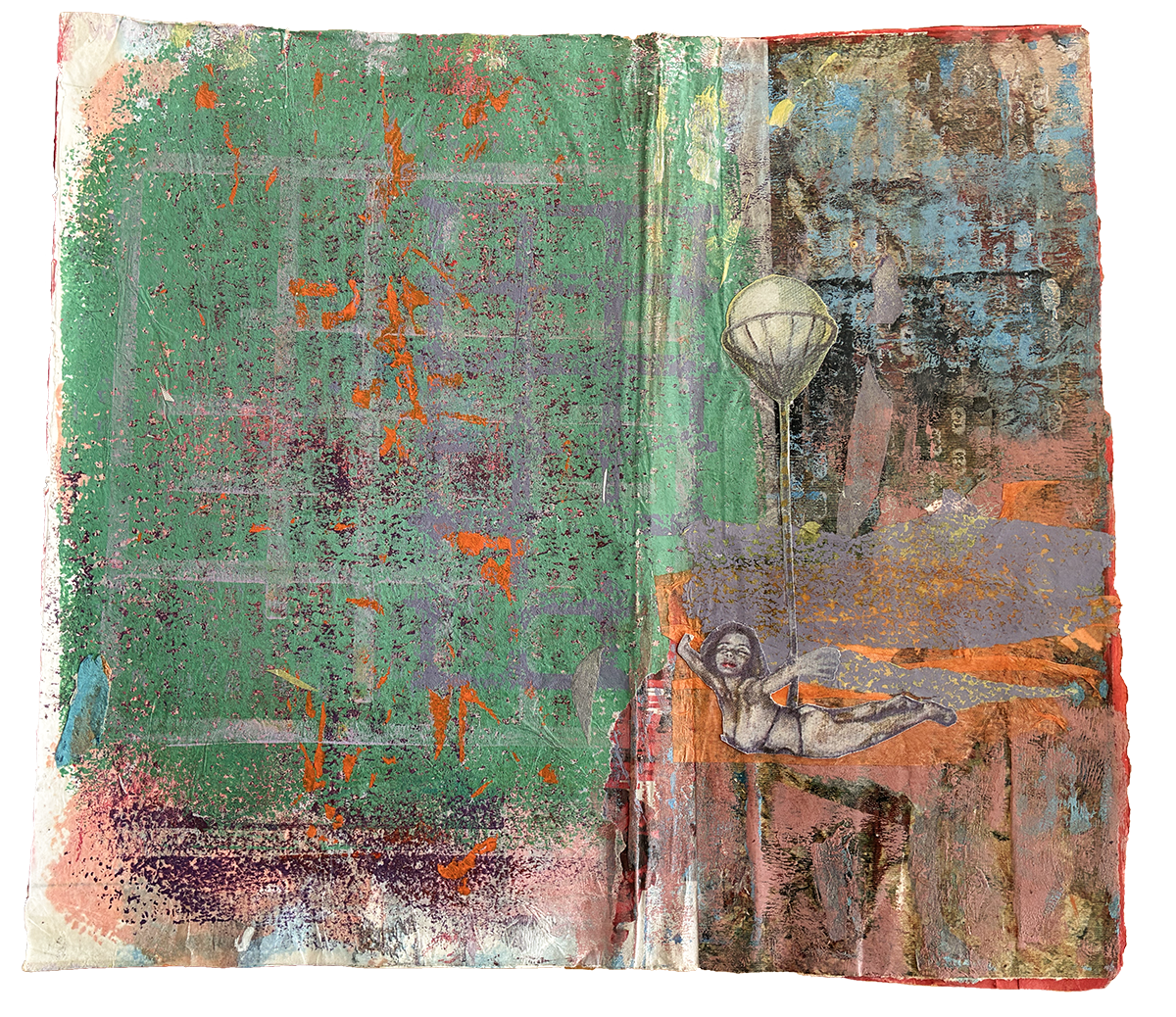
Liliana Mercau builds her images out of other people's pictures, layering memory, history, and imagination into a single frame. Her subject is the disappearance of women's voices: red lips sealed under rouge, a life bent under expectation, hands, always male, closing around her. Only childhood seems to hold any freedom in it.
In "Counting the Dead," Lisa Suhair Majaj names the Palestinians killed by Israel, the ones with names and the ones too young to have earned one yet. Like stars, they shine, and we count them the way we count the dead: knowing the number will rise before it falls. In "Notes on the Map of Survival," Majaj turns to Gaza directly, its fathers, its children, its journalists. What she mourns isn't only their disappearance. It's the disappearance of compassion itself.
Michael Roberts photographs two peoples who survived persecution, dispossession, and exile. In "Canyon de Chelly Carved Hand and Foot Holes for Climbing," he honors the Navajo Nation and their resistance, first to the Spanish, then to the U.S. Army; the red rock still stands for that resilience. In "Remembrance of Resistance," he turns to the Kraków ghetto uprising. An empty chair holds the place of someone lost but not forgotten.
Nathaniel Lachenmeyer's three poems, "We Arrived This Afternoon," "Loss and Other Accidents," and "Certainty No," speak of different kinds of vanishing: a mother who used to cook a feast for her family, a self that got lost and misled others along with it, the homeless who die forgotten in shelters. Every poem carries the same roving loneliness, one soul looking for another it will not find.
Susanna Fiona Murray's photographs sit alongside six poems by Jorge R. G. Sagastume in this issue, drawn from two of her ongoing series. After Us (2025) came out of a residency at the Archaeological Section of the Oliveriani Museums in Pesaro, where Murray set contemporary loss beside Picene funerary custom, the dead of one age keeping company with the dead of another. The Dianara (2022) returns to the Janara, the folk witch of central Italy, and asks what in her still moves through us, what gets inherited, what gets concealed. Across both series one gesture recurs. A woman's own hair falls over her face, closing it like a veil she's built herself. She isn't hiding. She's marking the place where someone used to be.
Velibor Baćo's poems "A Letter to the Dead" and "I Died" pull the dead back into the world of the living through language alone. He refuses to let the vanished of Bosnia and Herzegovina go, because the disappeared are not, and must never become, a footnote in someone else's history.
Every contributor found a different way into the same silence. What moves through this issue is a full register of what silence costs: humiliation, shame, righteous anger, guilt, and, underneath all of it, grief that never got to finish its work.
Silence like this doesn't break all at once. But it can be worn down, gradually, by soft and stubborn things: a word, an image, a sound.
Mireille Rebeiz, PhD, SJD
Associate Editor, The Pasticheur
Voices That Vanish: On the Disappeared and the Silenced
In This Issue:
Velibor Baćo
Alexis Krasilovsky
Nathaniel Lachenmeyer
Jeff Larason
Lisa Suhair Majaj
Liliana Mercau
Susanna Fiona Murray
Laura Ann Reed
Michael Roberts
John Whalen-Bridge
Hilmi M. Zawati
