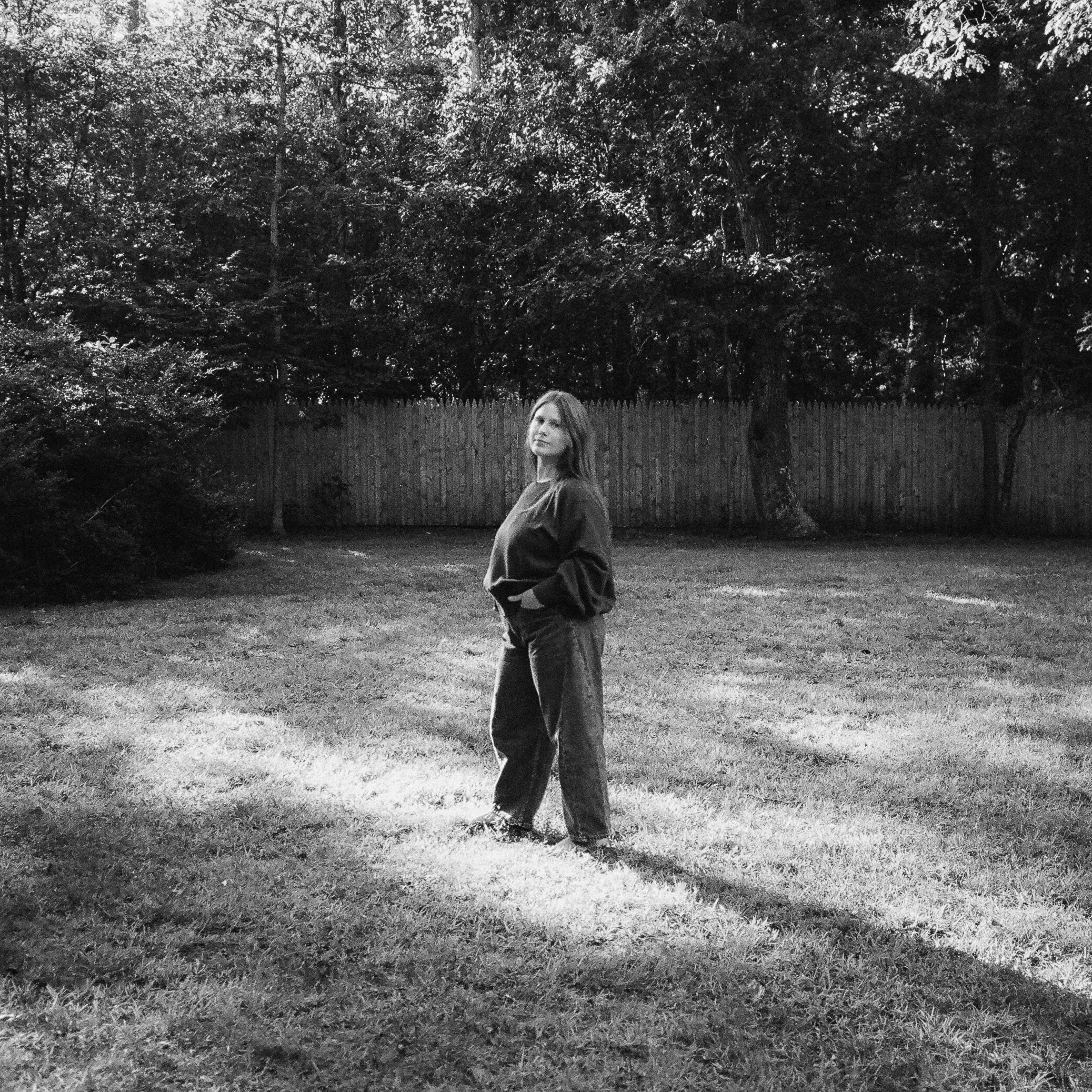
JENNY WOODS uses self-portraiture as a method rather than a mirror. Working with film, she accepts delay, loss, and misalignment as part of the image’s meaning. Each photograph records an encounter between the self that stages the image and the self that later confronts what remains. Moving through solitude, performance, and motherhood, her work refuses resolution. The self appears, recedes, and changes without being fixed. What matters here is not identity but duration: the self attended to across time, honored without being solved.
More of her work may be appreciated on her website.
In Conversation
A self-portrait is not a mirror. A mirror reverses what it shows and flattens depth into surface. A self-portrait works differently. It stages a relation between the body and its own persistence across time.
Jenny Woods understands this distinction. Her photographs don’t attempt to resolve the question of the self. They remain inside its instability. The body appears as both material and confession, the image as both preservation and loss, the camera as the site where recognition becomes possible and provisional.
Working with film, Woods accepts delay as a condition of meaning. Between pressing the shutter and later seeing what survives, a gap opens. In that interval, the self divides: the woman who staged the image and the woman who later confronts what remains. Sometimes they meet. Sometimes they don’t. The photographs that endure are not answers but records of inquiry, each frame testing the continuity of the self that produced it.
The images gathered here span years, geographies, and emotional registers. Solitude, performance, intimacy, and motherhood enter the frame without resolving it. Woods describes these photographs as a diary, but they function more precisely as a method of knowing: a way of attending to the self through its appearances, its refusals, and its willingness to be seen.
What follows is a conversation about recognition and its limits, about the self as something held and something released. The work is confessional, but not naive. It is constructed, intuitive, and attentive. Life is bottled, as Woods says, but the container remains transparent. We see what is preserved. We also see the cost of preservation.
Q&A
1. When you look at a self-portrait you made years ago, do you recognize the person in it? Or has she become someone else, a stranger you once had access to?
I like to think of her as an old friend. Someone I once knew very well but now feels distant. It really is like looking back through a diary of sorts. I can remember so vividly what I was feeling at the time I created certain images, or what I was going through at that period of my life. For example, the image of me curled up on the bed - I went through a really bad break up and was living on my own for the first time in years. It was such a cold February that year and I stayed in bed most of that winter, listening to my Jeff Buckley record on repeat. It ended up being such a formative year - it was the year I really started to grow into myself.
2. Cindy Sherman insists her photographs are not self-portraits. She uses her body as material, not as confession. Where do you stand? Is your body in these images you, or is it something you use?
The body is most definitely me. I don’t feel I’m separate from the images I’ve created; self-portraiture has really been me accessing different parts of myself. In a way, I would say it is a lot like confession and as I mentioned previously, like keeping a diary.
3. There's a paradox in self-portraiture: you can never see yourself the way others see you. The mirror reverses, the camera flattens, the image fixes what was fluid. Do you think the self-portrait brings you closer to yourself or confirms that the self is unreachable?
Self-portraiture has always made me feel closer to myself. It has been the only way I’ve truly recognized myself - I often shy away from the mirror but never the camera. I think it’s helped me to understand and process so much about myself.
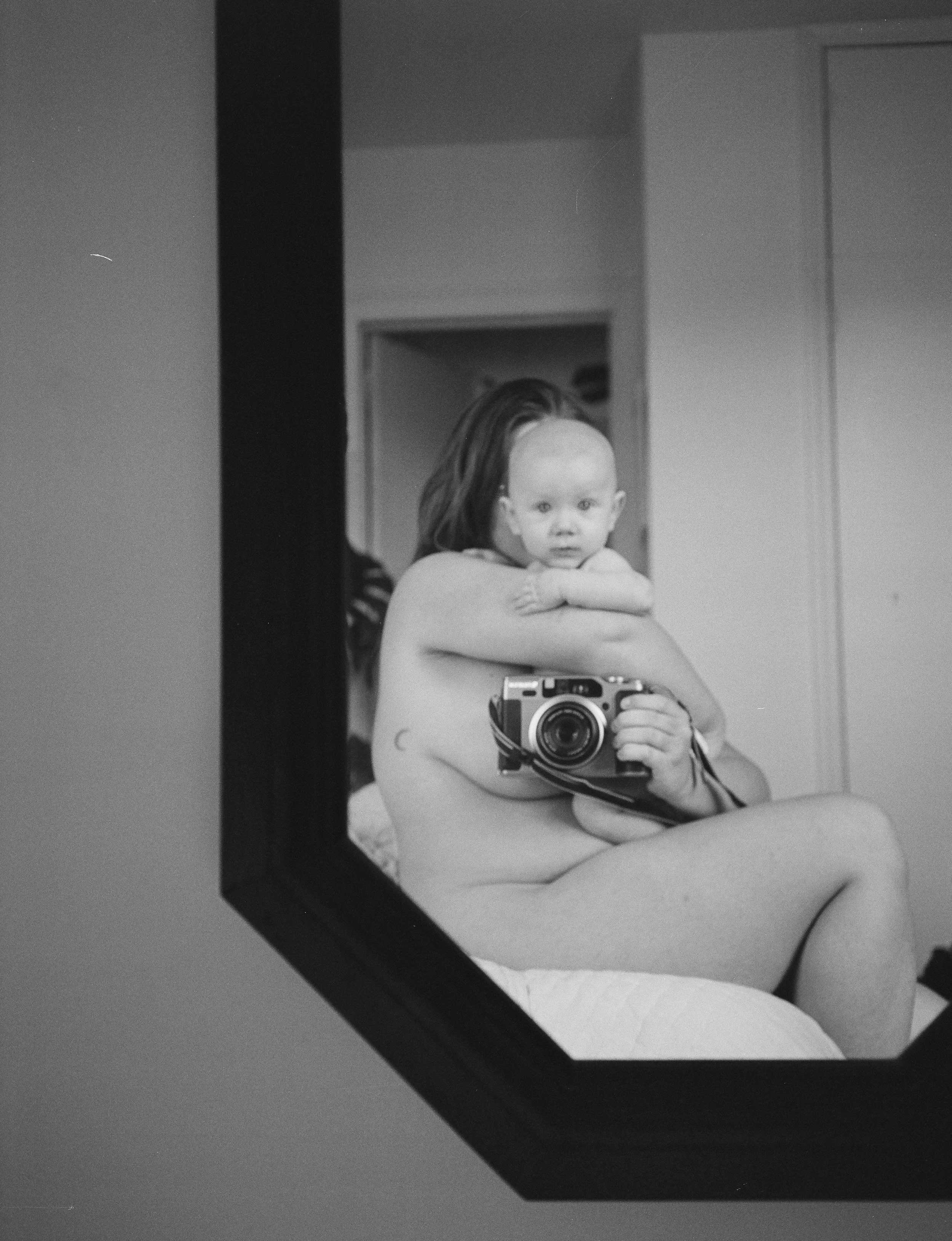
5. Many of your images include your child. When the infant appears, whose self-portrait is it? Does motherhood dissolve the boundary of the self, or does it sharpen it?
This is such a great question and one I don’t really have the answer to. Motherhood has been like splitting myself into two - two versions exist inside of me and I do think it’s a constant battle of trying to keep in touch with the version of myself before becoming a mother and the version of me now that is forever changed because I’ve shared my body with another human. When I take portraits with Ellis, I feel like I’m preserving the memory of him. We recently found out he has an incurable, fatal genetic disease and this has only made me want to photograph him even more to make sure I never, ever forget all of these moments I shared with him. To encapsulate what he was like at every stage of his life.
6. You work with film, which means you don't see the image until later. In that gap between pressing the shutter and seeing the result, who is the author? The woman who posed, or the woman who later looks at what was captured?
I think it’s a little of both. When I’m creating in the moment, it feels like I have to connect to something deep inside of me, and sometimes it’s extremely exhausting. I’ve had experiences where I’ve dived fully into self-portraiture on film and nothing came out right, either by technical failure or it wasn’t what I imagined in my head. I grieve the loss and sometimes I try again, anew, or I move on entirely. I always hope that the two connect, but it’s not always the case.
7. Some of your photographs feel confessional; others feel theatrical, constructed. Is there a version of yourself that only exists inside the staged image, a self that has no life outside the frame?
There was a period of a few years where I was creating different “characters”, trying different wigs and outfits and those versions of me feel like they only exist inside the images I created. It definitely was born from boredom of looking at my face over and over again so it was my way of making myself brand new, different. There was a lot of freedom in trying on different faces.
9. You've spoken of photography as bottling life. But a bottle also seals things off, removes them from circulation. Is the self-portrait a way of holding onto the self or a way of letting it go?
For me, it’s always been a way to hold onto myself. To honor each self in time. Again, it’s been sort of like keeping a diary and I’ve trapped different versions of myself in photographs - it really feels like a gift.
10. Your images move between exposure and concealment: a face cropped, a body half in shadow. What are you protecting? Is there a self behind the image that refuses to appear?
My work is very intuitive - I don’t really put much thought into what I want to create beforehand. It’s very in the moment, how I am feeling that day: am I feeling too much, a little sad, maybe I’m more confident in myself than usual. It truly depends on the moment whether I want to hide or become something larger than myself.
11. In assembling this issue, I found that women are far more willing to engage in self-portraiture than men. Many male artists I approached declined. Why do you think that is? Is there something about the female gaze turned inward that men resist or cannot access?
I can’t speak on all men but I think there’s a fear of being truly vulnerable and tapping into the femininity which I think is necessary to capturing the self.
12. If self-portraiture is a form of inquiry, what question are you trying to answer? Or has the question changed over the years?
If the ultimate question is “who am I?” then it’s not really something that I’m trying to answer. Self-portraiture is exploration and being as we are in a constant stage of change, you can spend your whole life searching but never really find the end-all be-all answer.
Near the end of our exchange, Woods says something that clarifies the entire project: If the ultimate question is “who am I?”, then it’s not really something I’m trying to answer. The refusal matters. Self-portraiture, for Woods, is not oriented toward resolution. It stays with the question.
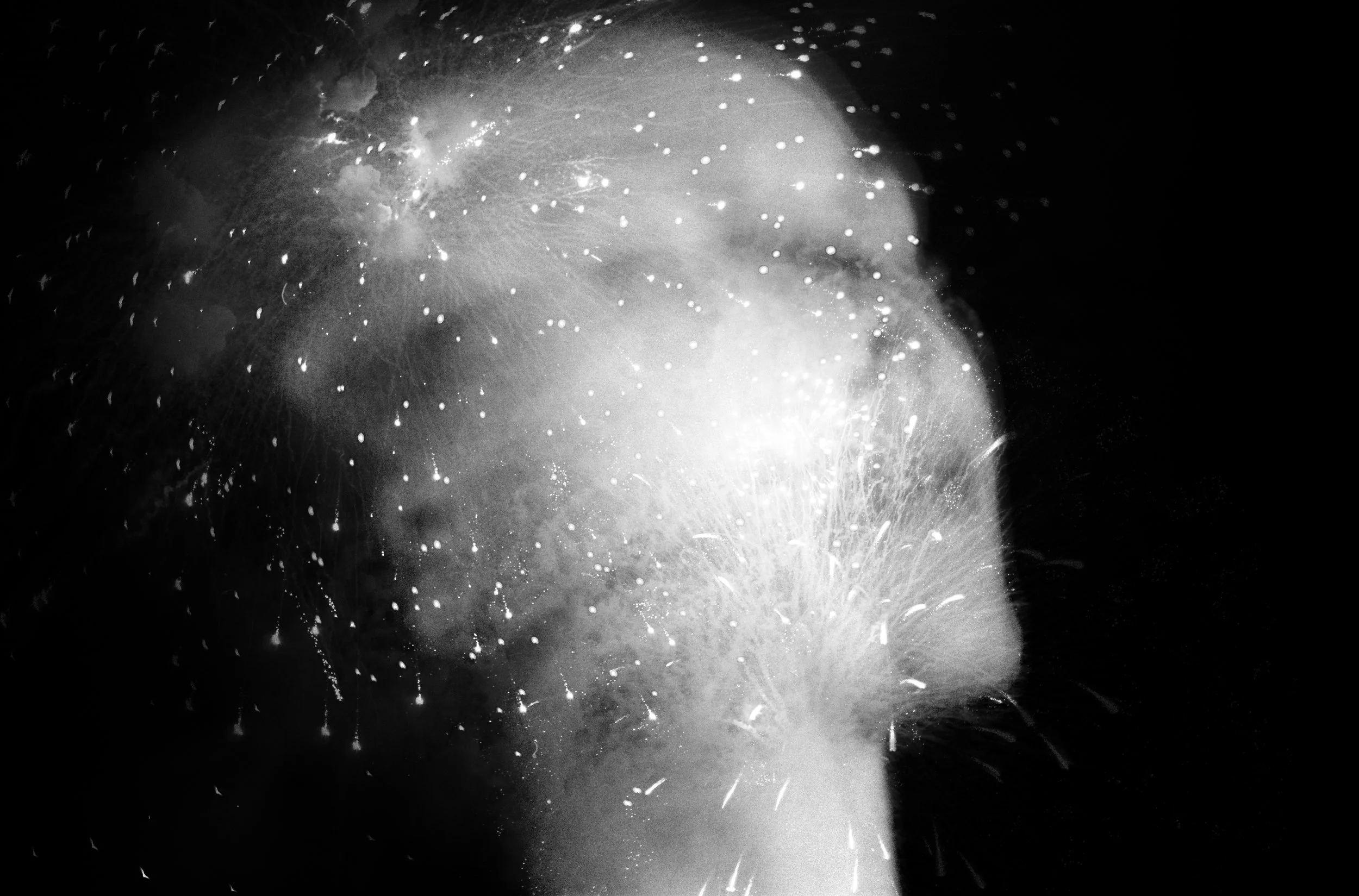
This is why the images remain open rather than fixed. A woman runs down a fog-soaked road in a bridal costume. A pregnant body is suspended in color. A mother and child lie tangled in afternoon light, the child facing a future the photograph cannot reach. Woods recently learned that her son has a fatal genetic disease. Each image now carries double weight. It preserves memory and prepares for absence. The photographs hold both without collapse.
The self-portrait, then, does not capture the self. It attends to it across time. Woods speaks of old images as old friends, familiar and distant at once. The metaphor holds. Friendship requires recognition and distance together. It does not demand continuity or closure.
What Woods offers is not an answer to identity but a method for living inside its duration. The photographs let the self accumulate, change, recede, and return. They show that the self is not a fixed point but a process, and that the camera can bear witness to that process without claiming to exhaust it.
Jorge R. G. Sagastume
To view the gallery of works, please click below on A Time Capsule
Artists & Writers in This Issue
In alphabetical order by the first name
