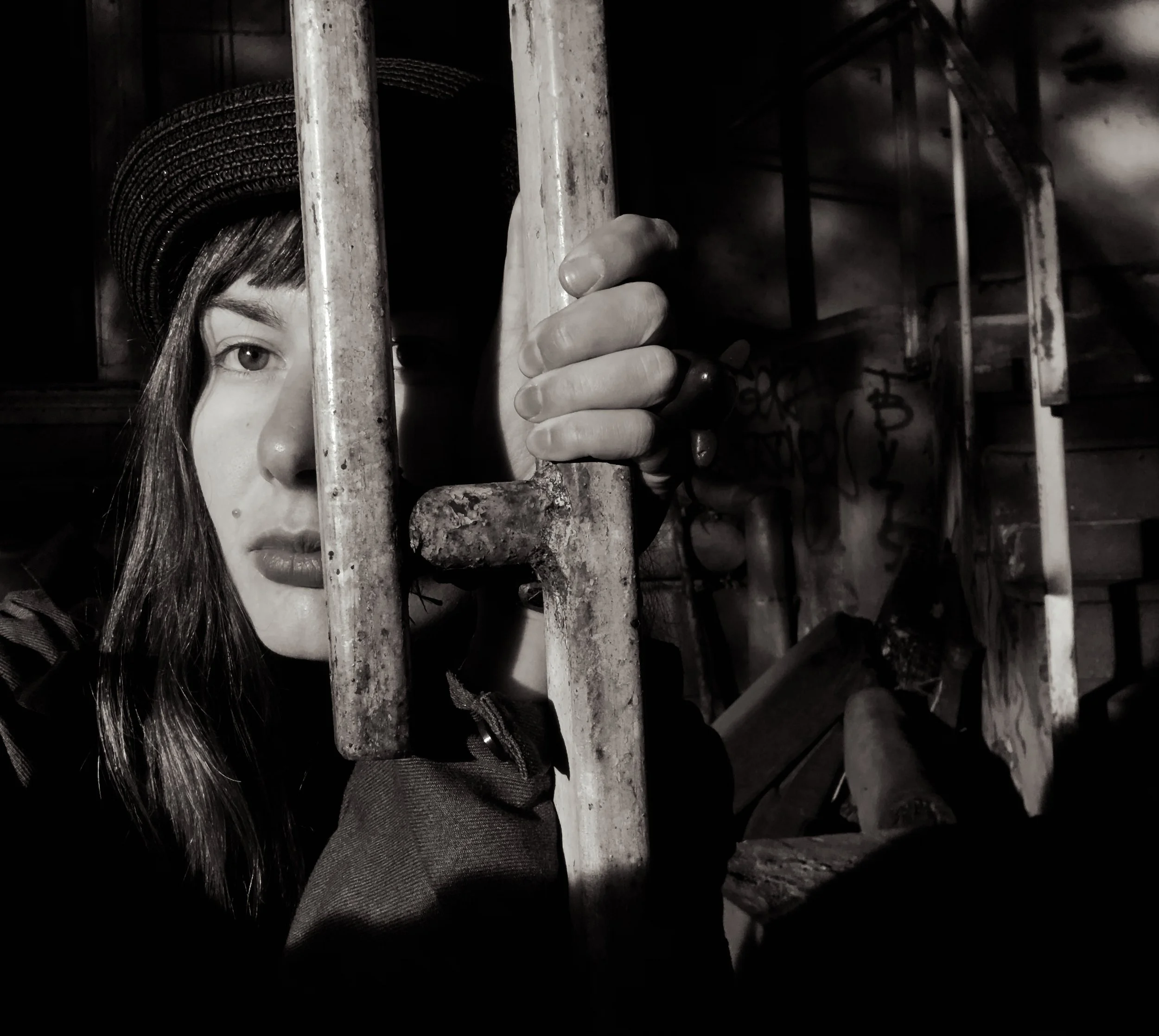
ANNA ZHUK was born in Belarus and now lives in Georgia. She is a self-taught photographer who works in black and white photography and video performance, using her own body and image as both material and mirror. Her practice turns around questions of emotion, identity, and the slow excavation of the self. At its center is the attempt to inhabit one’s interior life with honesty and without apology.
Poetry is part of her creative method. Alongside her visual work she writes short diary-like texts and autobiographical fragments that consider memory, desire, and self-awareness. Image and language speak to each other. Where one falls silent, the other continues.
Zhuk’s visual vocabulary rests on metaphor. Motifs of time, distance, and disappearance appear throughout her work, as do gestures of concealment and exposure. Through these she studies the fragile border between what can be shown and what can only be sensed. Her photographs are not concerned with theatrical revelation. They search instead for the quieter truth of how a self becomes itself across moments, seasons, and shifting states of feeling.
Her recent work combines performance, photography, and writing in a layered conversation with the viewer. The work asks how identity forms and dissolves in the presence of attention. At its core is a question that returns in different forms: what does it mean to be oneself, and to know it. In this special issue of The Pasticheur, we are proud to introduce her poetry.
Her visual projects may be appreciated on her website.
Editor’s Introduction
Anna Zhuk arrives through poems that behave like questions rather than declarations. Each piece inventories a life not by tracing its outline, but by gathering the small things that compose it: bread and cinnamon, crooked bangs, a pimple at the nose, a sparrow, a bag of nails, a glass door at the entrance of a church. From these fragments a self appears, not finished, not final, but in formation.
Her poems work in versions. There is the twelve-year-old in flowered overalls. There is the fearless self who can do anything. There is the self who speaks with God and discovers that becoming someone is not about choosing a role, but about recognizing there is no role at all. There is the self who dreams, answers job postings, and negotiates desire with the patience of someone hammering nails at dawn. What binds these versions is attention that refuses to settle.
Self-portraiture, in the spirit of this issue, is less about likeness than about inquiry. These poems are attuned to that. They ask what personhood means when the interior is restless, when the world speaks in riddles, when the only strong thing is the heart. They ask whether the self is something that arrives or something that is built.
Zhuk's visual work in photography and video performance extends this search. She uses image the way she uses language: not to explain, but to listen. Her metaphors are tactile. Time passes through her work in seasons and errands and fleeting encounters. Instead of revelation she gives us recognition: the shock of seeing oneself not as an identity, but as a field of desires, refusals, and questions.
The poems collected here speak to the heart of the February issue, which asks Who is that? The answer is never singular. It is a chorus of selves, each in motion. To read these poems is to watch the self assemble, dissolve, and return. It is to glimpse the quiet labor of becoming.
Я — почти всё
Штанишки в цветочек, будто я всё время стою в поле.
Птица, клюква-кислюга, грушевое дерево в цвету,
лошадь и ветерок с песком в глаза — жмурься!
Пакетик с собой — три печеньки, пахну печкой, двенадцать лет.
Плавленный сырок, кривая чёлка, хурма и яблоки мутсу.
Булка, хлеб, корица, тоска дурацкая, сломанный кран,
электрический неудачник, везунчик, дурачок, красавчик, мечтатель,
словолюб, времяблудчик, девочка, подруга, художник.
Рыба, индюк, бродяга, батон, бог, птица.
Влюбись в меня — ну!
Большая я
Это я, когда не страшно —
потому что это большая я, которая может всё.
Она никогда не боится.
А я — немного её.
Потому что когда ничего не страшно —
может случиться и смерть.
И любовь.
Воробей и открытые двери
Снились сны. Утро — горькое, как жжёное.
События полугода складываются в карту — тревожно.
Мир кричит — я не понимаю, нужен переводчик.
Вчера к моему столику ворвался воробей,
бился в стекло, потом сел на балку, усталый.
Когда открыли окна и двери — он не вылетел,
будто слишком устал биться.
Я подумала: легко упустить открытые двери.
Как повреждено крыло.
Как сложно лететь туда, где нужны сильные крылья,
когда из сильного — только сердце.
Можно ли взлететь сердцем?
Позволить быть
Мне подарили кулёк гвоздей.
Второе утро забиваю гвозди и выбегаю за сливками,
оставляя открытые вкладки с поиском работы.
Отзываюсь на всё — сердце не откликается.
Кладу в сердце обещание «всё будет хорошо» и булочку с корицей.
Вчера Л. написала про позволить чему-то быть.
Она так умеет — скажет и чувствуешь.
Заснула с этими словами.
Проснулась и обнаружила:
иногда позволять чему-то быть —
это позволять чему-то не быть.
Разговор в пустой церкви
Вчера говорила с Богом.
Зашла в храм — никого. Он ждал.
Разрыдалась — как дурак с кофе из магазина.
Сказала: «Если бы я была гора — я бы…»
А Он смеётся: «Горы стоят. Может, лучше птицей?»
Я плачу: «Да, птицей — парить, летать, не привязываться».
А Он смеётся: «Какая из тебя птица — платья, бусинки, чемоданы.
Не взлететь».
Я — ни рыба, ни мясо, ни гора, ни птица. Расстроилась.
Хочу стать хоть кем-то — понимаешь?
Может, рекой? Может, ветром?
А Он показывает на вход — стеклянная дверь.
Смотрю — отражение: дурак с кофе, кеды в траве, прыщ у носа.
Ни рыба, ни мясо, ни птица, ни гора.
А Бог смеётся, гладит макушку: «Ты».
А смех — как солнце, вращающееся вокруг своей оси.
© Anna Zhuk
Everything I Am (Almost)
Overalls with a flower print, as if I’m always standing in a field.
A bird, a sour cranberry a pear tree in bloom,
a horse and a gust of sand in the eyes — squint.
A paper bag to go — three cookies, the smell of a stove, my twelve-year-old self.
String cheese, crooked bangs, persimmon and Mutsu apples.
Sweet pastry, loaf of bread, cinnamon, foolish longing, a broken faucet,
electrical looser, lucky fool, jester, heartthrob, dreamer, lover of words, timewaster, girl, friend, artist.
Fish, turkey, vagabond, baguette, god, bird.
Fall in love with me — will you?
Fearless Version of Me
This is me when nothing scares me —
the larger self who can do anything.
She is never afraid of anyone,
But I am – slightly of her.
Because when nothing frightens,
death can happen.
And love, too.
A Sparrow and Open Doors
Dreams came. Morning tasted bitter, burnt.
Six months of events fold into a map — uneasy.
The world is shouting — I don’t understand, I need a translator.
Yesterday a sparrow burst into the café by my table,
beat itself against glass, then perched on a beam, exhausted.
When windows and doors were opened — he didn’t fly out,
as if too tired from fighting.
I thought: how easy it is to miss open doors.
How damaged a wing can be.
How hard it is to fly where strong wings are required
when the only strong thing is the heart.
Can the heart lift a body into flight?
Letting Be
I was given a bag of nails as a present.
Two mornings in a row I am hammering nails and popping out for cream,
leaving job searches open in browser tabs.
I respond to everything — my heart does not.
I slip into it a promise: everything will be fine, and top it with a cinnamon bun.
Yesterday L. wrote about allowing something to be.
She has that gift — she says it and you feel it.
I fell asleep with those words.
Woke up and realized:
sometimes allowing something to be
means allowing something not to be.
Conversation in an Empty Church
Yesterday I spoke with God.
Entered the church — no one there. He was waiting.
I burst into tears — like a fool with store-bought coffee.
I said, “If I were a mountain — I would…”
He laughed: “Mountains stand still. Maybe a bird instead?”
I cried, “Yes, a bird — to soar, to fly, unattached”.
He laughed: “What bird? You’ve got dresses, beads, suitcases. That doesn’t fly”.
I was neither fish nor meat, neither mountain nor bird. I was upset.
I want to become someone — do you understand?
Maybe a river? Maybe wind?
And He points to the entrance — a glass door.
I look: a reflection — a fool with coffee, grass-stained sneakers, a pimple on the nose.
Neither fish nor meat, neither bird nor mountain.
God laughs patting my head: “You are”.
And His laughter — like the sun spinning on its axis.
(All translations from the Russian by © Nadezda P. Ivanova)
Artists & Writers in This Issue
In alphabetical order by the first name
