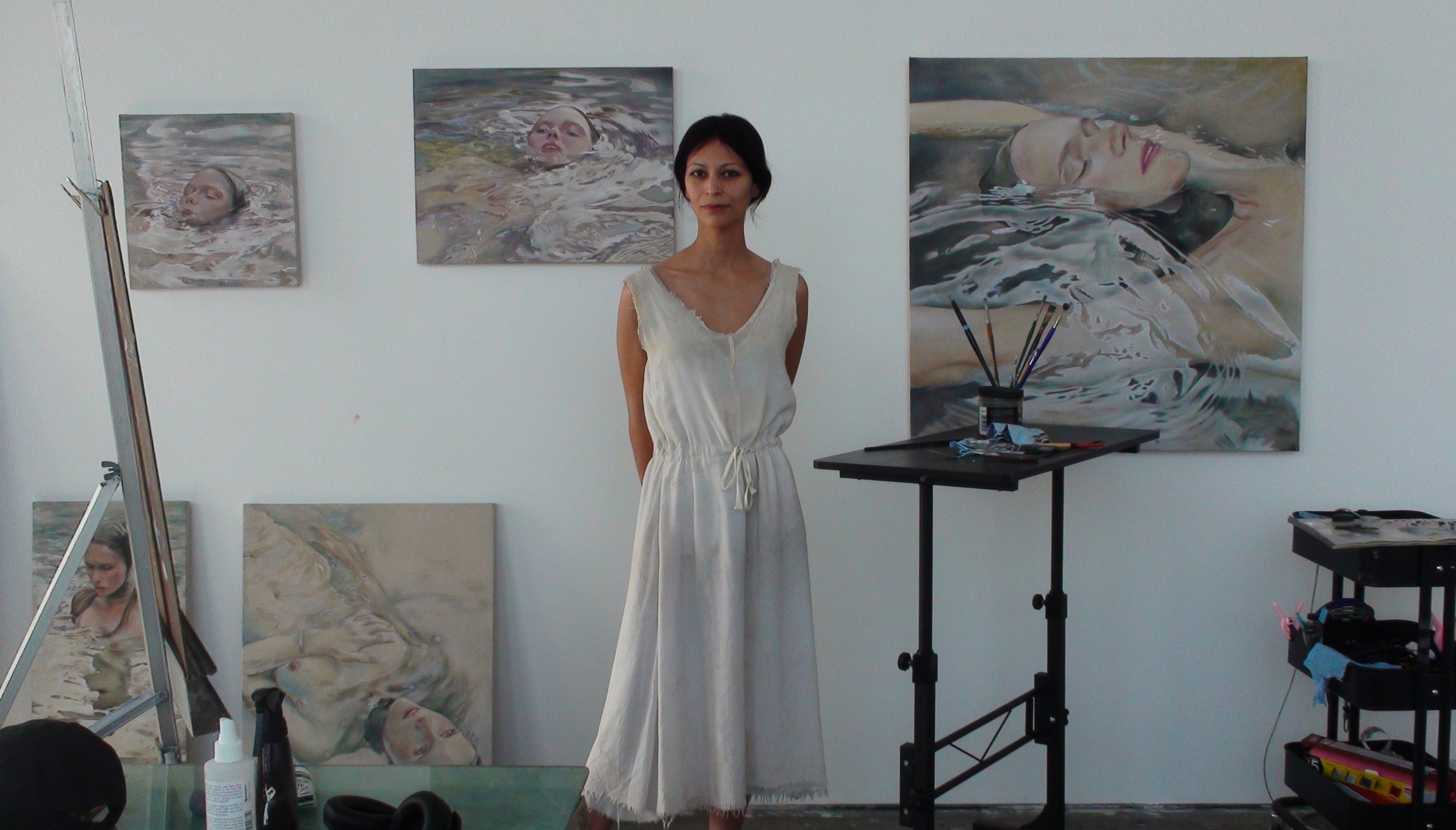
NICOLETTE MISHKAN is a first-generation Iranian American painter who lives and works in Los Angeles. She graduated from Otis College of Art and Design in 2008. Her paintings are portals into a utopia where land legs and sea legs are equally unnecessary, where men do not appear, and where violence exists only as ritual or as the pleasure of bondage. The mermaid swims through the symbolic order, and Mishkan lets her exploit her duality to entangle the world she was told to inhabit.
The siren has been her recurring figure since Permaid, the persona she introduced in the mid-2010s. Sirens (Shoot The Lobster, 2020) gave her a first solo exhibition around the figure, and Lethe's Tavern (Megan Mulrooney, 2025) extends her into a cycle of fifteen paintings that braid the Greek river of forgetting, the Sufi tavern, and the Lurianic breaking of the vessels into a single descent.
On Nicolette Mishkan's Lethe's Tavern
Jorge R. G. Sagastume, Editor
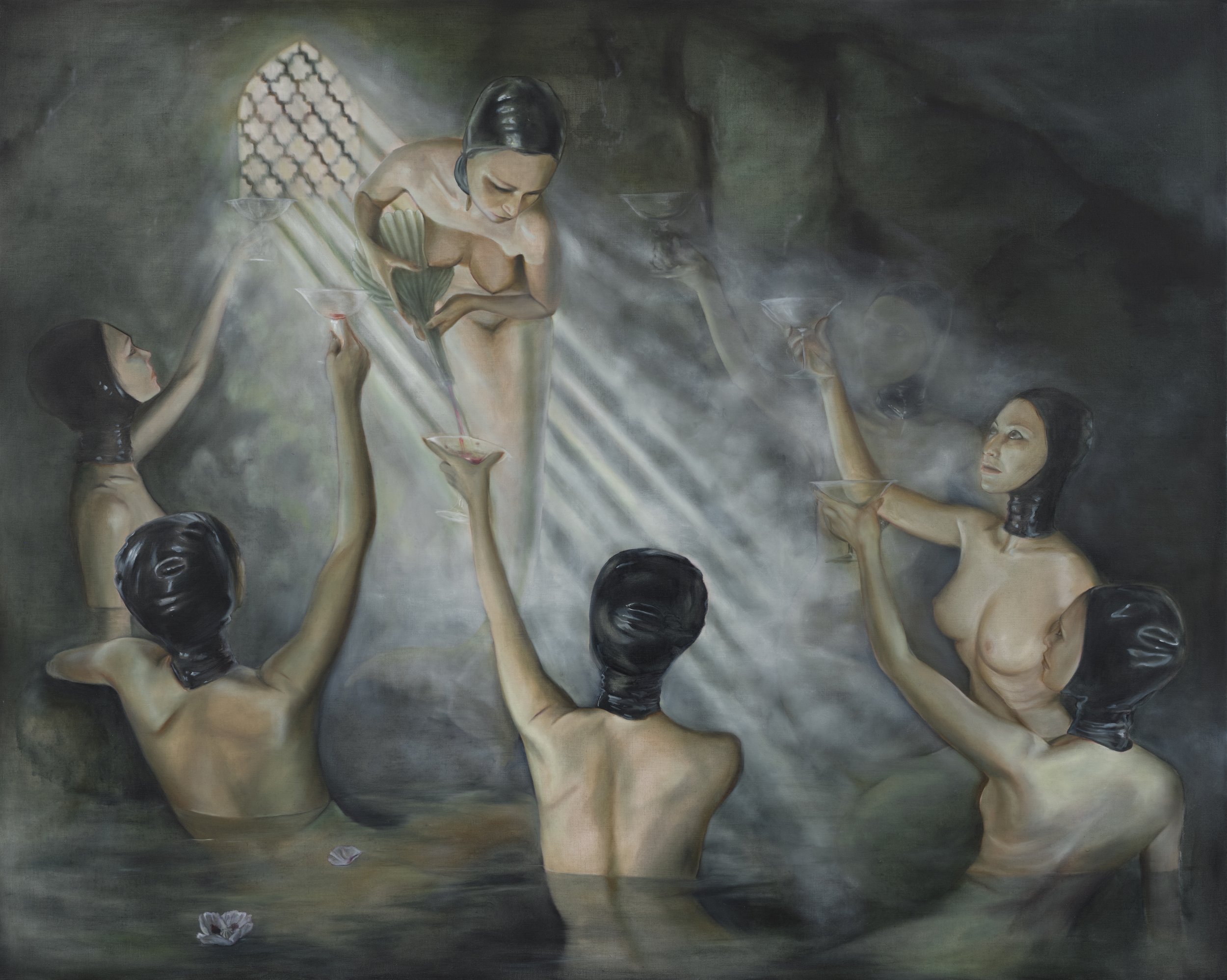
A cycle of paintings is also a question. Lethe's Tavern, the fifteen-painting cycle Nicolette Mishkan completed and exhibited at Megan Mulrooney in the spring of 2025, looks at first like a question about forgetting. Hooded figures in a bath. Wine spilled down a sternum. A jar with an owl and lions, a toppled glass, poppies scattered on the tablecloth. A swimmer surfacing into daylight. The arc moves through descent, a still life that breaks the spell, and a body returning to water it no longer needs a costume to enter.
Almost a year after the cycle closed, I asked Nicolette what it looked like to her now. Her answer surprised me. The work, she said, was less concerned with forgetting than with the discomfort that arises when certainty is unavailable. The impulse to know, to define, to reach for an answer. The descent in these paintings is not into Lethe's waters. It is into the unknown itself, and the figures who emerge are those who've learned to stay.
To me, this is the question the cycle is actually asking. What does it mean to live without arriving at a self?
Nicolette braids three traditions. Lethe, the river of forgetting at the edge of the underworld, whose waters strip the soul of its previous attachments. The Sufi tavern, where wine names divine intoxication, the dissolution of ego in the presence of the Beloved. And Lurianic Kabbalah: the breaking of the vessels, shevirat ha-kelim, and the slow work of tikkun, gathering scattered light. Three descents, three insistences that the descent is necessary. The cycle holds them together without collapsing them into one.
She puts it this way in our conversation: "Sufi wine symbolizes ecstatic remembrance of the divine through the dissolution of the ego; Lethe symbolizes the erasure of memory and the severing of ties to previous existence. One points toward mystical union and heightened spiritual awareness, the other toward oblivion, rebirth, and the limits of human memory. But both serve to annihilate the ego". The Lurianic strand, which has not surfaced in the earlier writing on her work, gives the cycle its theological scaffolding. The body is a kelim, a vessel broken by the very light it was made to hold, and gradually restored to a larger shape than the one it began with.
A reader fluent in any of these traditions will notice that Nicolette's engagement comes through devotional and contemporary channels. Her Hafez she remembers and adapts. Her Kabbalah she has from teachers like Adin Steinsaltz, David Aaron, and Simon Jacobson, popularizers and translators rather than medieval primary sources. This is the route most living artists take into ancient traditions, and it isn't a deficiency. The traditions live in the paintings, where they meet and braid in ways the texts alone would not have produced.
The deepest question the cycle asks isn't about descent or restoration. It is about the self. Painting herself fifteen times, each figure a fragment of psyche, Nicolette argues that the self isn't fixed in any single image but is, in her phrase, "continually assembled from many internal states and experiences as we move forward".
The claim has a long history. In literature, its deepest argument may be Borges's. "El inmortal", published in El Aleph in 1949, is written as the literal translation of a manuscript found in the last volume of Pope's Iliad. Borges warns us in the opening that the Spanish version is shot through with Latinisms and Hellenisms, the prose refusing to settle into a single language even as it claims to be faithful. Cervantes had already used this conceit: the Quijote published as a translation from the Arabic of Cide Hamete Benengeli, the original always elsewhere, the self of the text always inherited. Borges braids the gesture with another. His Roman tribune, Marco Flaminio Rufo, drinks from a river that grants immortality, only to discover that the immortals are Homer, have always been Homer, that to live long enough is to become every author who has ever lived. "I have been Homer; soon I will be Nobody, like Ulysses; soon I will be everyone, I will be dead". The self isn't erased in immortality. It is multiplied through it.
Borges turns the whole architecture inside out in a postscript. A critic has proven the manuscript apocryphal, interpolated from Pliny, De Quincey, Descartes, Shaw. The narrator doesn't protest. When the end approaches, he writes, only words remain, words displaced and mutilated, words of others, the poor alms the hours and the centuries have left him. The self the story has been pursuing is a "coat of many colours", stitched from the lives of those who came before. The wandering Jew of Christian legend, the eternal traveler in Sufi and Kabbalistic thought, the immortal who has been Homer and Ulysses and Nobody, wear the same figure under different costumes. To live is to inherit the selves of others. To paint, or to write, is to add another panel.
This is the company Nicolette's cycle joins. Painting herself fifteen times, in the hood and out of it, at the bath and at the surface, she does in oil what Borges did in prose. Painting had understood the claim even earlier. Velázquez in Las Meninas placed himself inside the canvas with his brush, and put the king and queen only in a small mirror at the back of the room, the self displaced, present as reflection. Picasso took Las Meninas apart fifty-eight times in his Cannes studio in 1957, multiplying it the way Nicolette multiplies herself into fifteen. The thought is older still, as old as the Buddhist tradition that gave her the image of the finger and the moon, as old as the Sufi fana, as old as the Lurianic teaching that the vessel must break before it can hold what it was made for. Nicolette adds a contemporary form to an ancient claim.
What follows below is our conversation about the cycle. Her answers run long and warm. She names the teachers and texts that shaped her thinking. She holds her positions, including her position that the Persian inheritance needn't be made explicit to be present in the work, which is itself a Sufi position: the finger pointing to the moon isn't the moon. The paintings are the moon. This conversation is one finger among many.
A cycle like this one closes a circle by opening another. The painted selves Nicolette gathers in Lethe's Tavern invite a continuation, the way Borges's narrator invites the critic Cordovero, who invites the reader, who invites the next reading. Prose or poetry might walk into the bath beside the hooded figures, listen to the wine spill, watch the swimmer surface. This is how the coat grows another panel. It is how any of us grows.
I'm grateful to Nicolette for the time and care of her answers, and for the rare permission to publish her thinking alongside her work.
In Conversation
Featured Artist: Nicolette Mishkan On Lethe's Tavern
1. (Editor) Lurianic Kabbalah is the thread that hasn't surfaced yet in any writing on the cycle, and I want to give it real room. My instinct, hearing you name it alongside Lethe and Sufism, is that the descent toward rebirth points toward something like the Shekhinah in exile, or the Lurianic narrative of breaking and gathering (shevirah and tikkun). But those are my guesses, not your work. Tell me what Lurianic Kabbalah names for you here, and correct whatever I'm getting wrong. If there are specific texts, teachers, or traditions that have shaped this thread, name them.
(Nicolette Mishkan) With Lethe's Tavern, my entry point into Kabbalah has been through the Lurianic teaching of the human body as a vessel, where the body is not a mere container for the soul but a crucial site where divine light becomes manifest. Isaac Luria describes divine reality as or (light), while created beings are described as kelim (vessels). Light without a vessel remains unformed and inaccessible; a vessel without light is empty. According to his teachings, development involves refining the vessel so it can receive and express greater degrees of divine presence. The descent into an "underworld" becomes a symbolic movement toward dissolution, fragmentation, suffering, limitation, or confrontation with mortality.
In Luria's teaching, one of the central myths is the breaking of the vessels (shevirat ha-kelim). Divine light overflowed the primordial vessels, causing them to shatter and scattering sparks of holiness into the lower worlds. Human existence unfolds within this fractured condition. The spiritual task is not to escape the broken world but to descend into it, recover the sparks, and participate in tikkun (restoration). From this perspective, descent is not failure or punishment but a necessary stage in transformation. Many Kabbalistic teachers speak of the principle that there is no ascent without a prior descent: Rabbi Adin Steinsaltz, Rabbi David Aaron, and Rabbi Simon Jacobson among them.
This idea also appears in contemporary psychological and esoteric writing. I was deeply inspired by Maureen Murdock on the heroine's journey, and by Carl Jung. The idea that one encounters darkness, limitation, grief, ego death, or a literal death, and that this encounter exposes the inadequacy of the old self. The identity one has been can no longer contain what is emerging. In a psychological reading, the underworld journey corresponds to confronting the shadow aspects of the self. The ego experiences this as a kind of death. Old identities, attachments, and certainties dissolve. Yet this dissolution creates space. The vessel is emptied. What once seemed like annihilation becomes a preparation for receiving a deeper form of light.
Lurianic Kabbalah expresses this paradox through the idea that hidden sparks are often found in the lowest places. The descent toward death is not the opposite of spiritual realization. It may be the very route through which divine light is encountered. The soul discovers light not despite the darkness but through entering it.
The theme culminates in rebirth. After descent and symbolic death, the vessel has changed. It is larger, more resilient, and capable of receiving light that would previously have shattered it. Rebirth is not a return to an earlier state. It is a new integration in which body and soul, matter and spirit, darkness and illumination are reconciled at a higher level. In a Kabbalistic framework, the body becomes a vessel for light through a process that often includes descent into hiddenness, confrontation with mortality, and the breaking down of former structures. The "underworld" is not just a realm of death but also an incubating womb of transformation.
2. Lethe and the Sufi tavern come from different worlds: one Greek and underworld, the other Persian and devotional. In the cycle they meet. What does each do that the other can't, and what does the friction between them produce that neither would alone? I'm interested in what's at stake in braiding them rather than choosing one.
My idea of Lethe is that it is a pathway toward the womb, where the self becomes stripped of its identity, attachments, and meaning. The persona's memory is wiped clean so that it doesn't carry the burdens of its previous existence into the next. Lethe is part of our unconscious longing for transcendence. Her waters disperse determinations and discriminations, leading to forgetting and oblivion.
As the heroine, or heroines, navigate down the river, they are drinking red wine. In Sufi poetry, wine and intoxication are metaphors for being mystically inebriated by God's presence. Wine is the object of a spiritual love, allowing the Sufi to inhabit the higher realms of existence. Llewellyn Vaughan-Lee describes the traditional Sufi path as "hammering the mind into the heart": the mind is battered into submission to the greater power of love so it can work with the higher consciousness held there. Reason and theology, creed and ritual, law and commandment all give way, in the soul of the enlightened person, to the supreme virtue, which is love.
Oh, limitation of the mind!
With you I find no bliss,
That only wine could grant.
Hafiz
Dye the prayer mat with wine if the Magi elder tells you.
For the spiritual traveler knows each stage of the way.
Hafiz
In my series, wine becomes a catalyst for growth, death, and rebirth, because I believe our biggest motivating factor in life is love (or lack thereof). It is the driving force behind our existence: what we do, what we want, and ultimately who we become. In Lethe's Tavern, there is crossover between Lethe and the Persian devotional symbolism of wine. Both involve altered states of consciousness. However, Lethe does not contain love. It is merely a means to reorient toward it. Lethe represents times in our life when we feel lost, confused, or simply unaware, whereas Sufi wine symbolism can represent forgetting the self as a step toward remembering the divine. Sufi wine symbolizes ecstatic remembrance of the divine through the dissolution of the ego; Lethe symbolizes the erasure of memory and the severing of ties to previous existence. One points toward mystical union and heightened spiritual awareness, the other toward oblivion, rebirth, and the limits of human memory. But both serve to annihilate the ego.
3. You've spoken about the Iranian inheritance biographically, as something you carry without having written about it critically. I'd like to ask it as a critical position rather than a biographical fact. What does it mean to paint inside the Persian poetic tradition (Hafez, Ibn 'Arabi, the wine of the Sufis) without writing it explicitly, and what would change if you did write it explicitly?
I wouldn't change anything. While I believe that many truths can exist at once, I don't think it needs to be stated explicitly. The underlying structure of Sufi poetry discloses a deeper reality without using literal symbols, which lends it a language rich in meaning. It's emotional and sensual in a way that reminds me of the Buddhist proverb that says, "the finger pointing to the moon is not the real moon".
Sufi poetry mostly transcends gender, since it speaks to a universal human experience rather than a specifically male or female one. The "Beloved" is ultimately God, and the lover-beloved relationship is a metaphor for the soul's longing for the Divine. The Sufi seeks union with the divine in a way that is structured around ecstasy, beauty, longing, and the dissolution of boundaries. I find this timeless and universal. I think the beauty of Sufi poetry is that a lot of it reads as very contemporary despite being hundreds of years old. I love how it highlights the continuity of the human experience: that despite all our technological advances and progress, people across the centuries have wrestled with the same fears, hopes, and dreams.
The only thing I would like to change is the hardcore dogmatic interpretations, which limit the rich meaning.
4. The dark feminine is a phrase that carries a lot of weight and gets used a lot of ways. What does it mean inside your practice, specifically, that it can't mean outside it? And when the heroine descends, what does she actually meet down there: a self, a god, a void, an inheritance, something else?
In the context of my practice, the dark feminine starts with the siren archetype. She is feminine, wild, seductive, and unpredictable. I come to her through a particular set of inheritances: Persian, Jewish, raised in LA, formed by fashion. My visual vocabulary is informed by classical and contemporary movements (baroque, pre-Raphaelite, art nouveau, surrealism, impressionism) and my technique by old-school marker and pencil fashion illustration. I'm drawn to mythology, psychology, and S&M.
Within the dark feminine, the inclusion of S&M adds further layers, particularly through its exploration of the relationship between pleasure and pain. This relationship is not a universal truth or experience; it is deeply personal, and it can manifest differently for each individual.
When the heroine descends, she meets herself, her past selves, and her potential futures. She merges back into the collective consciousness, which holds all the different possibilities and timelines. All the different versions of herself that have existed, never happened, and could become.
5. The cycle is built from self-portraits, but the public framing has emphasized self-imaging as a contemporary disorientation. I want to come at it from a different angle. What does painting yourself fifteen times do that one self-portrait can't, theologically rather than psychologically? I'm asking whether the multiplication is closer to icon-writing, or to fana, or to something else again.
For me, the repetition is inspired by theological traditions such as icon-writing and fana, and is also about giving form to a state of being. Painting myself fifteen times allowed me to express a feeling of overwhelm: of being consumed by a moment, an emotion, or a series of experiences that could not be contained within a single image.
Each portrait becomes a fragment of the psyche, holding a different aspect of the self: uncertainty, resilience, vulnerability, memory, transformation. Rather than depicting a fractured identity, the accumulation of these self-images speaks to a process of integration. The repetition creates a space where the fragments can coexist, interact, and ultimately come together.
In that sense, the work is not only about losing the self but also about gathering and recollecting it. The multiple portraits trace a movement through overwhelm toward wholeness, suggesting that the self is not fixed in any single image but is continually assembled from many internal states and experiences as we move forward.
6. Finally, the work after the work. Lethe's Tavern closed in June. You've had almost a year of distance from it. What does the cycle look like to you now that it didn't look like when you were inside it? And where is the work moving next, if anywhere?
With some distance from the work, I can see more clearly that the cycle was investigating uncertainty and the emotional and psychological desire to know. At the time, I was very interested in themes of forgetting and losing control. Now I see its connection to how we seek certainty as a way of escaping the fear of the unknown. What I couldn't fully see while making the work was how much it was revealing my own relationship to power. The impulse to know, to define, to arrive at an answer was present throughout the cycle. In retrospect, the work seems less concerned with forgetting than with the discomfort that arises when certainty is unavailable.
Since then, I've become increasingly interested in what it means not to overcome the unknown but to surrender to it. I've come to see faith and trust less as sources of certainty and more as practices of remaining honest, present, and open when answers do not arrive. Rather than reaching for explanations that soothe, I'm more interested in staying with the uncertainty itself and allowing it to illuminate what it can.
As the work continues to unfold, I find myself thinking more about faith as an orientation: how we live when we don't know what's going to happen next. It's no longer about doing what elicits a specific response, but living with integrity and doing what is right because what's right is what's needed.
What Follows is Nicolette’s Latest Series