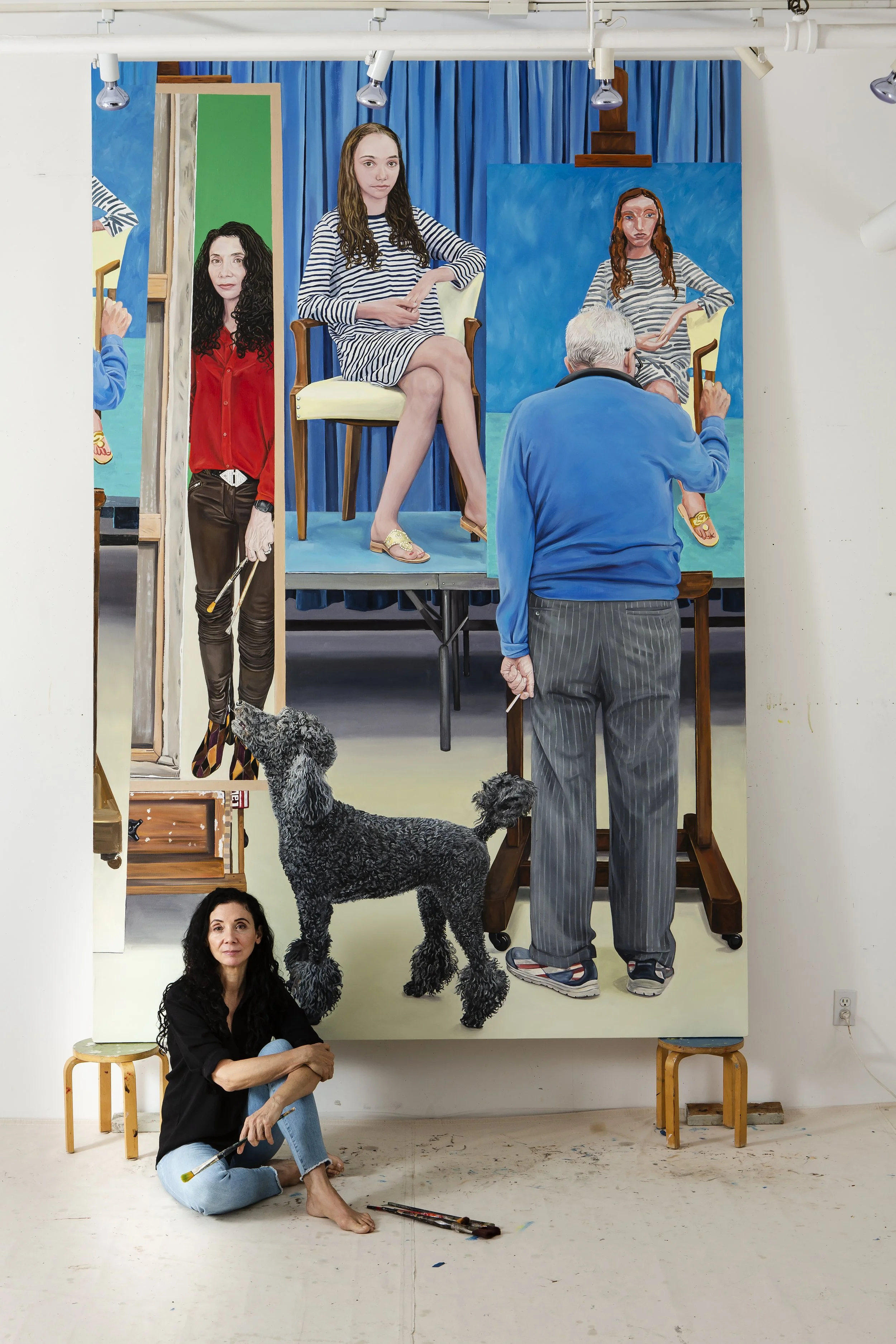
BRENDA ZLAMANY is a Brooklyn-based painter whose practice has unfolded over more than three decades, grounded in portraiture as an act of attention and encounter. Since 1990, her work has appeared in solo and group exhibitions across the United States, Europe, Asia, and the Middle East. Museums that have presented her paintings include the Brooklyn Museum, the National Portrait Gallery of the Smithsonian Institution, the National Portrait Gallery in London, the New-York Historical Society, the Museum of Contemporary Art Taipei, and the National Museum in Gdańsk.
Her paintings are held in public and private collections including the Cincinnati Art Museum, the Virginia Museum of Fine Arts, the Neuberger Museum, Deutsche Bank, the World Bank, Yale University, and The Rockefeller University. She has collaborated with The New York Times Magazine, and her work has been written about in The New York Times, The New Yorker, Artforum, among other publications.
Zlamany has received a Fulbright Fellowship, a Pollock-Krasner Foundation grant, a NYFA Artist Fellowship, and awards from the Peter S. Reed and Jerome Foundations. She has completed major institutional commissions for Yale University and The Rockefeller University, and has participated in residencies at Yaddo, MacDowell, the American Academy in Rome, and at Denali and Glacier National Parks. In 2024, her portrait of philanthropist Ruth Gottesman marked Gottesman’s historic one-billion-dollar gift to Montefiore.
Since 2011, Zlamany has sustained The Itinerant Portraitist, an ongoing project through which she has created more than three thousand portraits worldwide. Rooted in direct engagement and shared time, the project reflects her long-standing commitment to portraiture as a practice of presence, reciprocity, and lived encounter.
More of her work may be appreciated on her website.
To go directly to the self-portraits, please scroll down and click on Brenda & Brenda
In Conversation
Brenda Zlamany doesn't paint herself to discover who she is. She paints herself because the image has always been more real than the mirror, because childhood taught her that a drawing could override lived experience, and because the act of making a perfect picture before sleep was a form of magic that promised transformation. The self-portrait, for Zlamany, is construction, control, and sometimes camouflage.
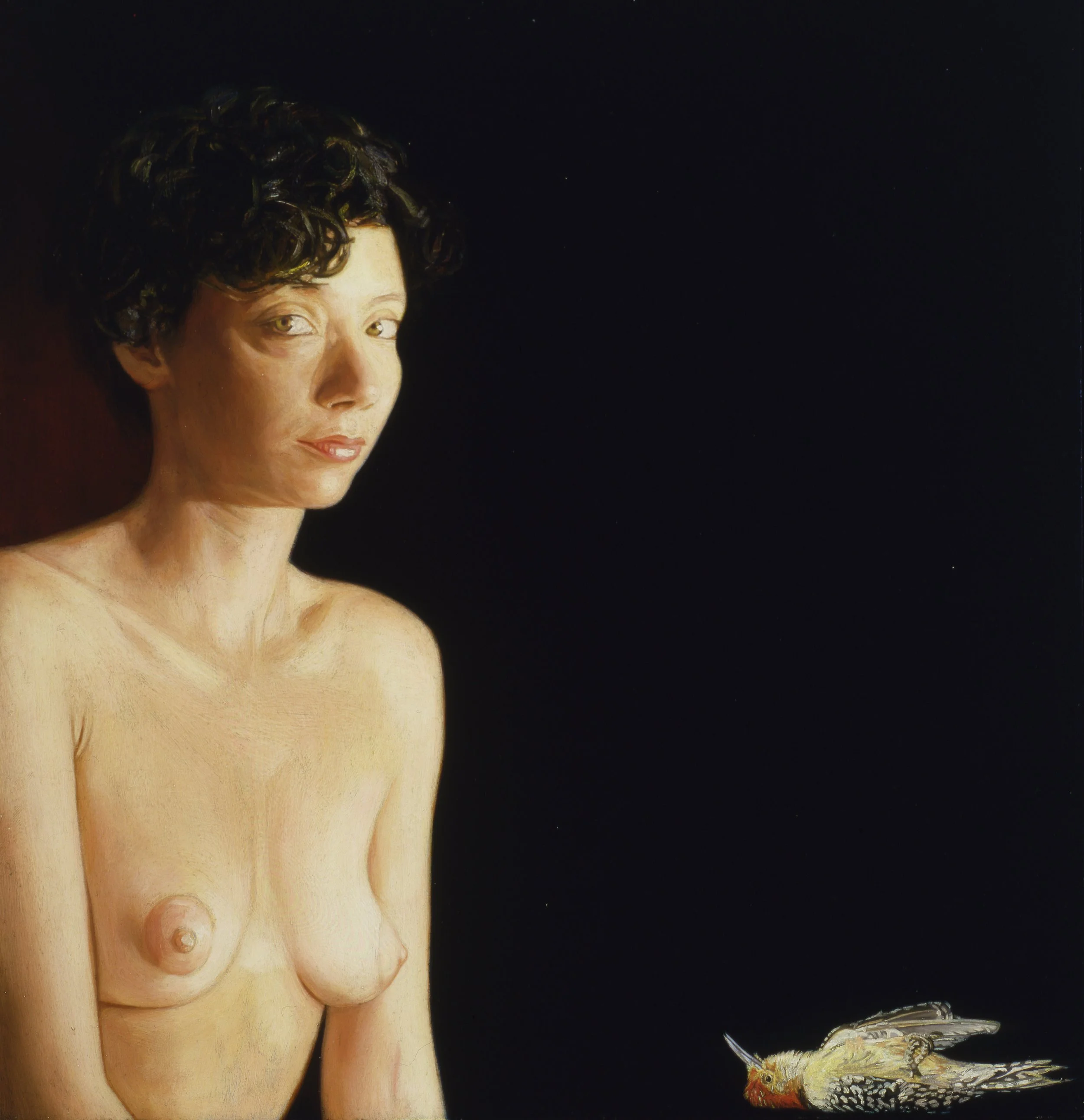
The paintings gathered here span decades. A young woman holds a dead bird against black. A pregnant body appears, then a nursing one. Bright saturated colors (red, magenta, orange, yellow) frame the aging face. Allegorical figures in costume populate large canvases where Zlamany stands among stilt walkers, falconers, and commedia characters. The self changes, but the method remains constant: between what she sees and what she says, between what she says and what she keeps silent, a space opens. That's where the painting happens.
Zlamany's biography shapes the work without determining it. A difficult childhood in a strict Catholic school where left-handedness was punished as sinister, where dyslexia delayed reading until age eight, where survival required keen observation of unpredictable faces. Drawing became the language she could excel in, the place where she had control, where she could construct a reality that overrode the unsafe one. Art wasn't metaphor. It was rescue.
Later came the old masters: Rembrandt, Velázquez, Holbein, Beckmann, who became her peers, her contemporaries, the artists she paints alongside rather than the living ones. When she stands in front of Rembrandt's self-portrait at the Frick and says under her breath, "Hello, old friend," she means it literally. Paintings are alive for her. They exist outside linear time. The self-portrait, then, is a contribution to that conversation, a way of speaking to the canon while also testing what it means to appear inside it as a woman who has never felt like a "female artist" but like one of the guys.
The images here offer versions, roles, costumes, moods, or formal experiments. Zlamany treats her face and body as material, yes, but also as a site where multiple forces converge: the childhood ritual of perfection, the discipline of observation learned for survival, the technical demands of oil versus watercolor, the symbolic language of objects (birds, snakes, children), and the pressure of being seen while trying to control what the viewer sees. She's aware of the viewer in every frame. The self-portrait is never just for herself, it's a performance, a decision, a negotiation between intimacy and distance.
What follows is a conversation about attention, vulnerability, and the ethics of looking. Zlamany has painted over 3,000 portraits through her global project The Itinerant Portraitist, and she approaches her own image with the same rigor she brings to strangers. She asks what portraiture means before she paints, because depiction is responsibility. When she turns the gaze inward, the stakes are different but no less serious. The self-portrait tests the consequences of visibility for the artist herself.
Q&A
1. You've said that portraiture is a form of attention. When the subject is yourself, what does careful attention reveal that might stay hidden in daily life?
The person I see when I look in the mirror is not the person I feel like in my skin, and that tension is revealed—even struggled with—in a self-portrait. A self-portrait, like any portrait, is a construct—as much about the person being seen as the person doing the seeing. When I'm the one on both ends of the fork, I'm in control, balancing what I see with what I want to see, what I feel with what I want the world to see.
Octavio Paz wrote: "Between what I see and what I say, between what I say and what I keep silent, between what I keep silent and what I dream, between what I dream and what I forget: poetry." When I paint myself, I'm working in those same gaps—those spaces between seeing, knowing, wanting, and revealing. It's emotionally difficult because you're balancing all these simultaneous views of yourself, and ultimately you have to make a decision.
2. In your self-portraits, the body sometimes appears in direct light and sometimes inside a staged, symbolic world. What does symbolism allow you to say about the self that naturalism cannot?
I don't think in terms of symbolism versus naturalism—for me, all paintings are both simultaneously. Yes, it's true that sometimes I position myself in invented settings with symbolic objects, but color is symbolic, composition is symbolic, even the shape of the rectangle is symbolic. A double square has certain properties and will do specific things; a Fibonacci rectangle will do others. A self-portrait in a square creates a completely different experience than one in a vertical format.
I think the variety you see across my self-portraits over the years has less to do with choosing between symbolism and naturalism and more to do with where I am in my work at that particular moment. What am I focused on? Am I doing big compositions with multiple figures in invented settings, or am I thinking about Renaissance windows, or am I obsessed with the color red and its properties?
For instance, during COVID I painted very large paintings—I was obsessed with Goya and I filled my studio with tons of characters from my travels to combat the loneliness and isolation of the lockdown. In one 10-foot-tall painting with stilt walkers, I'm the small awkward figure in the center, completely paralyzed, unable to figure out how to even get up on my stilts, while my daughter is functional, striding away. That's me, stuck in New York City during that period. Each self-portrait exists in a specific moment where I have particular interests—things I'm looking at in art history, things I'm trying to accomplish in my studio practice, and how I see myself in relationship to what's going on in the world. The painting reflects all of that.
3. Your biography includes a childhood shaped by decoding faces for safety and a young adulthood shaped by studying the old masters. How do those two forms of looking come together when you paint your own image?
Images have always been as real to me as lived experience—sometimes more real. I had a difficult childhood, and to deal with that, very early on (maybe at 4 or 5 years old) I created a 'religion' or ritual where every night I had to make a perfect drawing that included myself as who I wanted to be, in the perfect life, often in a setting with other figures, sometimes even a dog. I couldn't go to bed until the drawing was perfect. It was like creating a positive image that overrode the negative, and it became the greater reality. In my religion, if I slipped away—died in my sleep—I would be reincarnated as the girl in the drawing.
I am dyslexic, left-handed, and I was a mirror writer in a Catholic school that forbade the left hand because it was 'sinister'. I couldn't read until I was eight, and because of my handedness I was constantly punished—not allowed to sing in the choir, for instance, or have the privileges other kids had. Because I was alienated, outside most activities, I became a keen observer. I studied faces because people were not predictable, not safe, so I was always one step ahead, training my eye.
Drawing was the place I could excel. And on Christmas and Easter I was suddenly in demand to decorate the church. Art was a way of communicating and getting approval, and everything I created was real.
I feel that same way about the old masters. Paintings are alive for me—they exist as presences, as relationships, outside of linear time. When the Frick reopened this spring, I immediately dashed over there, and while standing in front of Rembrandt's self-portrait I said under my breath, "Hello, old friend"—meaning I hadn't seen that painting in a long time and I was very happy to greet it. A stranger standing next to me said, "I can't believe you said that. That's exactly how I feel." Those two forms of looking—the childhood survival practice and studying the old masters—come together when I paint my own image. There's a kind of magic to creating an image of the self that I learned in childhood.
4. You've worked in cultures where portraiture carries different spiritual, social, and historical meanings. Have those encounters changed the way you conceive of the Western self-portrait? Do you see your own image through multiple cultural lenses now?
When I think of Gertrude Stein, I don't think of photographs of her—I think of Picasso's portrait. Painted portraits outlive us, so depiction is a huge responsibility no matter what part of the world you're in.
I've painted over 3,000 portraits from direct observation through my global project The Itinerant Portraitist. What I've learned is that you need to understand what a portrait means to someone before you depict them, because portraiture carries very different spiritual, social, aesthetic, and historical meanings across cultures.
Sitting for a portrait is an act of trust, often breaking cultural taboos. In southern Italian culture, there's mal occhio—the evil eye. Growing up, I was taught never to look directly at elders because they could curse you. I would cover my eyes passing my great-grandparents. In Saudi Arabia, the cultural norms around eye contact between men and women are completely different from the West. When Saudi men sat for me, I would see their eyes dancing away every time I looked up to observe how an eyebrow sat on a face or to find more detail.
I also painted Saudi women in burqa and niqab—I could only see their eyes. It was fascinating because they were the most critical about likeness, even though I was painting just the eyes. Eventually I realized that if I gave them more mascara and darker eyeliner, they were happy with the portrait. What's really interesting is that now when I look at all these paintings of just eyes, I can tell who's who. There's so much information in the eyes alone.
When I painted 100 people in a nursing home—most of them close to 100 years old—I wore my cornicello and sat looking directly into their eyes, breaking my childhood taboo. But I also discovered something unexpected. At first I tried to flatter them, but my daughter visited and said, "Paint what you see." And that's exactly what they wanted—to be seen with all their flaws, the drool, the breathing tubes, their numerous chins, because they wanted affirmation that I saw them and wasn't afraid.
In Saudi Arabia, I painted the Syrian man who picked up camel shit (the lowest job) at the camel festival alongside another painting of a nomadic billionaire whose beautiful camels competed in it. When Saudi people asked, "Why did you paint this Syrian guy?" I answered: "I painted him because he is important to me." It was a quiet political act, but very strong.
Now that I have a house in Calabria and I'm living part-time with my ancestral family—remote mountain people—I'm thinking very carefully about how to paint them, how to see myself. Do I paint them as other but also as self? How do I show who they are without romanticizing them? These cross-cultural encounters have made me aware that the Western self-portrait's assumption of sustained direct gaze is itself a cultural choice. When I paint my own image now, I see myself through multiple lenses.
5. Your paintings often lean into the tension between intimacy and distance. When the sitter is yourself, do you try to close that distance or keep it present?
When I paint myself, a certain amount of distance is inevitable. Sometimes I feel like a fraud in the sense that I'm very much seeing the viewer seeing me. It's hard to subtract the viewer and paint myself only for myself.
I love Max Beckmann's self-portraits, particularly Self-Portrait in Tuxedo. In all his self-portraits he's an actor in his own life—and we see him how he wants us to see him. All self-portraits are decisions. But what about Rembrandt? His self-portraits feel more internal—you have the sense of him looking deeply into the mirror at himself. But Rembrandt also does this interesting trick with the eyes where one eye is looking out and one eye is looking in. So even with Rembrandt, there's that awareness of the viewer. Was he painting his self-portraits for himself, or was he more skilled at creating the illusion of intimacy?
I think I've done a little of both, actually—sometimes performing like Beckmann, sometimes trying for Rembrandt's inwardness. But I can never fully escape the sense that someone will be looking.
6. Literature appears throughout your interviews as a quiet influence. Are there writers who've shaped the way you think about identity, character, memory, or the way a self might be constructed on the page? Do they shape how you construct yourself on canvas?
The Story of O was important to me early on—a book about identity constructed entirely through the gaze of another.
7. You've studied famous portraits across centuries. When you paint yourself, do you feel the presence of artists like Velázquez or Rembrandt behind you, not as authorities but as witnesses to the long history of looking?
Absolutely. They are my peers. I'm painting alongside them more than I'm painting alongside anyone who is alive. I often find myself asking, what would Rembrandt do? How would Velázquez turn this edge? But it's not just the obvious people. I'll look at African sculpture and see how the body is seen, or James Turrell to get that sense of surprise. I cast a very wide net of art and objects, music, poetry, and literature that I'm constantly in dialogue with.
8. Some of your early self-portraits appear with birds or snakes, or your child, as if the self needs a companion symbol to become visible. What do these living selves express about vulnerability, transformation, or the internal logic of your images?
These were the important things in my life at the time, so they snuck into the paintings. For instance, I used to breed canaries, and at one point I had 36 of them flying around the studio. When I painted the self-portrait with the snake, I had just painted an entire show called Snakes—twelve paintings for Jessica Fredericks Gallery—and I was working with live snakes for that exhibition. But yes, when you put things together, there is gravitational glue and meaning occurs. Sometimes it's intended and sometimes I'm setting up a place where the viewer can make their own conclusions, in the same way that poetry does.
9. "The Itinerant Portraitist" is built on real-time conversation. When you paint yourself, is there an internal dialogue that mirrors those exchanges?
In The Itinerant Portraitist project, I interview my subjects while I paint them as a means of seeing them more clearly. When I paint myself, the conversation is different—it's with the history of self-portraiture, the entire canon. I'm very aware of that dialogue. It's me talking to art history, making decisions about how this image relates to all the self-portraits that came before me.
10. You've portrayed high-profile figures and people from marginalized communities. When you turn the gaze inward, do you feel that you're another subject among many, or does the self occupy a different ethical position?
It's much more complicated when I turn the gaze inward. There's a certain amount of dread. In every phase of my life, I've had a hard time looking in the mirror. Burroughs called it the "naked lunch" moment—seeing what's really on the end of the fork.
But there's also something fun in deciding what I want to say about myself. When I painted my self-portrait after Beckmann's Self-Portrait in Tuxedo, I wanted to say that I actually feel like him when I look in the mirror. I'm surprised when I see me instead of him. I've always identified with the old masters (who are for the most part men)—Rembrandt, Velázquez, Vermeer, Holbein... That's who my peers are. There was no they/them language when I was growing up, but I never felt like a female artist. I felt like one of the guys. So there's this disconnect between what I see and how I feel.
11. Your work suggests that the act of being seen, or choosing to be seen, alters identity. Does the self-portrait become a way to test the consequences of visibility for yourself?
Yes, I think self-portraiture is a way to test that. I've painted myself in ways not everyone would choose—pregnant, nursing, aging... I'm putting myself in the same vulnerable position I ask of my subjects. If I'm going to ask people to be truly seen, then I have to be willing to show myself.
12. You've worked in watercolors that capture immediacy and in oils that unfold slowly through layered time. How do these different temporal rhythms affect the way you think about your own face and body as material?
Working in watercolor is about spontaneity and efficiency—seeing quickly. Actually the more time you put in, the worse it's going to be. You need to make decisions and be clear. When I do a watercolor portrait, I'm looking for six or seven lines that quickly tell the story.
With oil painting, I'm looking for a thousand different tiny moves that create the personality. Oil is about planning, destroying and resurrecting. I do extensive sketching, I use collage, photos, art historical references and use the watercolors as studies. It's an intellectual process that involves a lot of control and then eventually it doesn't—you can destroy and save and destroy and save and finally find your way there. Eventually, you go somewhere you hadn't thought of in advance.
I've only painted myself in watercolors a couple of times because when I'm working with myself, I'm not interested in a spontaneous moment. It's never really quite a quick look in the mirror, is it?
13. Much of your practice concerns who appears in public space and under what conditions. Do you think of your self-portraits as private meditations or as contributions to the public iconography of women and artists?
Both. I think about the canon—and most of the self-portraits in that canon are by men. But I'm also doing work to change who appears in public space. A lot of my institutional commissions are portraits of underrepresented historical women and people of color. In a way, my self-portraits are part of that project.
14. Across the images you shared for this issue of the journal, the self changes profoundly. There is youth, motherhood, costume, aging, and even role play. What does this long arc teach you about continuity and reinvention in a life?
The work equally reflects changes in the self—not just my appearance, but also how I think, what's important to me—and changes in studio practice. For instance, as I'm doing more complicated large-scale public works with multiple figures, my paintings have become more complex, more narrative, more inventive. When I go to do a self-portrait, these larger ambitions inform what I do. The self-portraits evolve with the rest of my practice.
15. If you were to describe the self not as a fixed entity but as a process, what part of that process does the self-portrait reveal most clearly? What remains unknowable, even after decades of looking?
I often feel that self-portraiture is as much about what you're trying to hide as what you're trying to reveal.
Near the end of our exchange, Zlamany says something that clarifies the entire project: "I often feel that self-portraiture is as much about what you're trying to hide as what you're trying to reveal". The statement is exact. The paintings don't unmask the self; they construct it, stage it, protect it, and sometimes obscure it. This is not evasion. It's precision.
Zlamany's self-portraits operate in the gaps Octavio Paz described: between seeing and saying, between saying and silence, between silence and dream. The painting exists in that space, neither purely confession nor purely performance, but something that holds both possibilities without collapsing into either one. She paints herself the way she paints everyone else: with attention, with respect for what the image can and can't do, with awareness that the portrait will outlive the person and carry meanings the artist didn't intend.
The long arc of images here, from the early bird paintings to the recent bright-color portraits, shows formal evolution, yes, but also the self as process rather than fixed entity. Zlamany changes across decades, but she also returns. The same face appears in profile, in direct gaze, clothed in allegory, stripped bare in pregnancy, framed by saturated color. Each version is true, but none is complete.
This is what self-portraiture teaches when practiced over a lifetime: that the self is multiple, that continuity and reinvention aren't opposed but entwined, that the image can override reality without denying it. Zlamany learned this as a child when she drew herself into the life she wanted, and she practices it now as an artist who paints herself into the canon she already inhabits. The self-portrait isn't discovery; it's decision. And the decision, repeated across decades, becomes a form of knowledge that can't be spoken but can be seen.
Jorge R. G. Sagastume
To go directly to the self-portraits, please scroll down and click on Brenda & Brenda
Artists & Writers in This Issue
In alphabetical order by the first name
