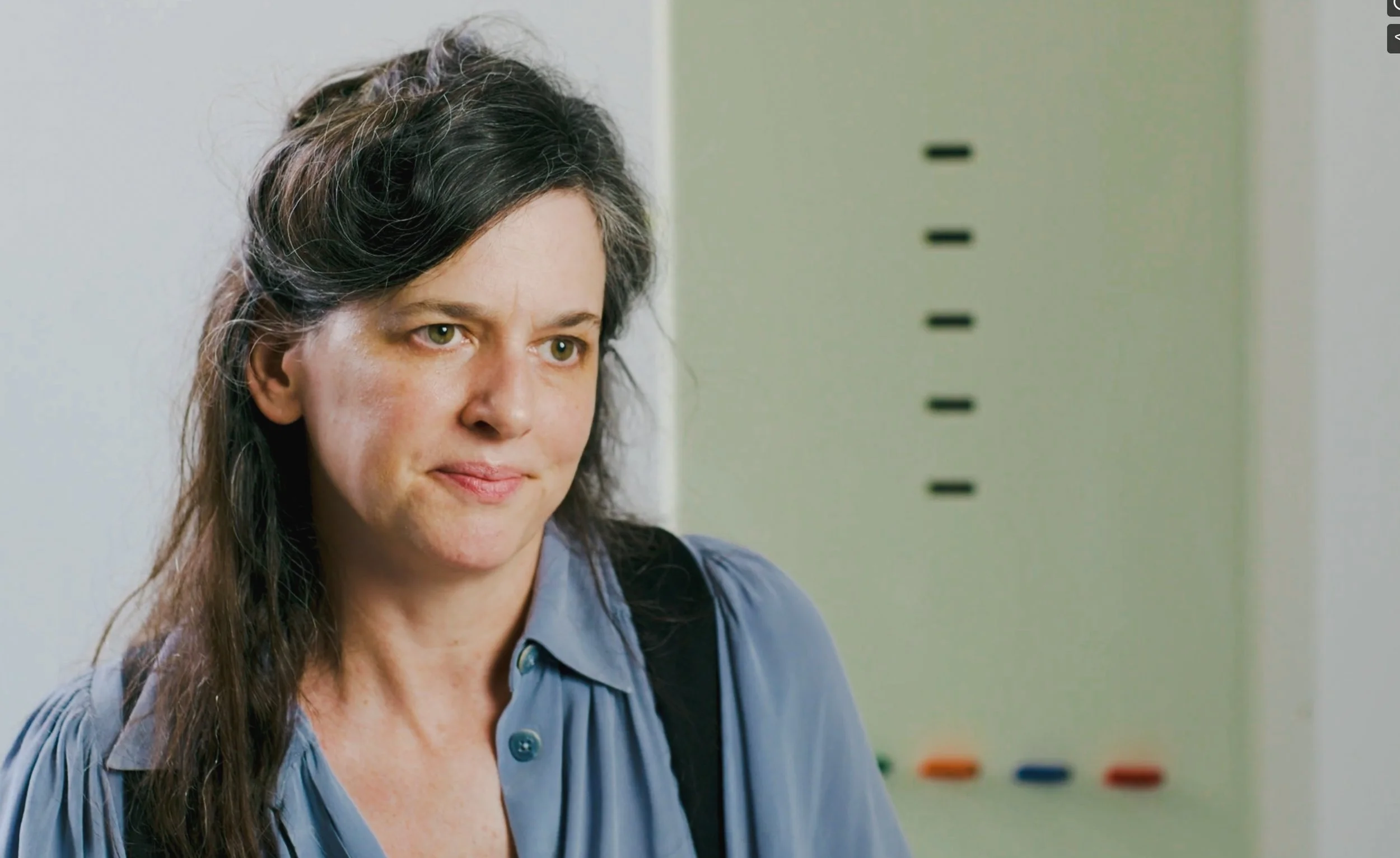
TARYN SIMON is an American multidisciplinary artist whose work interrogates the structures through which knowledge, power, and belief are organized and made visible. Working across photography, text, sculpture, and performance, she constructs projects that unfold as investigations, each grounded in years of research and shaped by systems of classification, documentation, and narrative control.
Born in New York City in 1975, Simon was raised in an environment attuned to global movement and visual record; her father’s work for the U.S. Department of State exposed her early to photographs of distant places, nurturing a fascination with images as carriers of authority and imagination. She studied at Brown University, earning a degree in art semiotics after initially intending to pursue environmental science, an intellectual shift that foreshadowed her lifelong concern with how meaning is constructed and interpreted.
Simon’s practice is distinguished by its fusion of rigorous research and formally precise imagery. She typically organizes photographs around a predetermined conceptual framework, pairing them with detailed textual annotations that function as an integral part of the work rather than supplementary explanation. Through this method she probes photography itself as a medium capable of both revealing and obscuring truth, operating simultaneously as evidence and as instrument of fiction.
Her early landmark project The Innocents (2003) portrayed individuals wrongfully convicted of crimes, photographed at locations central to their cases, exposing the uneasy role of photographic images within systems of justice and belief. Subsequent bodies of work have mapped hidden infrastructures, inaccessible sites, and the taxonomies that govern cultural knowledge, notably An American Index of the Hidden and Unfamiliar (2007), which examined places and objects fundamental to national identity yet largely unseen by the public.
In A Living Man Declared Dead and Other Chapters I–XVIII (2011), produced over four years and across multiple continents, Simon traced genealogies and their entanglement with politics, territory, and fate, constructing visual “chapters” that connect individual lives to broader historical forces. Across such projects, she repeatedly exposes what lies beneath systems of order: secrecy, bureaucracy, substitution, and the fragile authority of classification itself.
Simon’s work has been exhibited internationally, including at institutions such as Tate Modern, the Museum of Modern Art, and the Whitney Museum of American Art, and is held in major museum collections worldwide. A Guggenheim Fellow, she continues to create expansive, research-driven works that challenge the assumption that images merely reflect reality, demonstrating instead how they participate in shaping it.
Across her oeuvre, Simon directs attention to the unseen forces that structure everyday life, revealing how archives, institutions, and visual evidence construct the narratives through which societies understand themselves.
More of her about her and work may be appreciated on her website.
Skip the Editor’s Note and see the work; scroll down and click on The Color of a Flea's Eye: The Picture Collection
The Violence of the Folder
Taryn Simon and the Dream of Total Order
"To classify is to forget".
Borges writes this as if it were a minor observation. It's not. It's a cut. Classification divides in order to clarify. It severs in order to name. Something is always left on the floor.
Taryn Simon's The Color of a Flea's Eye: The Picture Collection opens that cut and refuses to suture it.
The New York Public Library's Picture Collection was founded in 1915 as a democratic instrument. Anyone could request an image. The folders grew accordingly: "Handshaking", "Air Raids", "Broken Objects", "Police", "Financial Panics". In 1930, a patron asked for "the color of a flea's eye". The request sounds charming, almost comic. It's not. It reveals a faith in classification so complete that even the infinitesimal must have its place.
Joshua Chuang describes the Collection as a "living, breathing, still-evolving body of images". It was shaped by demand, by circulation, by use. Romana Javitz insisted the pictures weren't precious objects but instruments. They were put to "bread earning usage". They moved outward into newspapers, theaters, government offices, classrooms. The archive didn't preserve culture. It produced it.
But production requires structure.
Here Foucault enters, through Borges.
The Order of Things opens with Borges's fictional Chinese encyclopedia from "The Analytical Language of John Wilkins". Foucault recounts how reading its strange taxonomy provoked in him "a certain laughter", a laughter that unsettled the familiar coordinates of Western thought. Animals are divided into categories such as "those that belong to the Emperor" and "those that from a long way off look like flies". Foucault doesn't mistake this for anthropology. He recognizes it as revelation. Borges invents distance. In that distance, our own classifications begin to tremble.
Classification isn't neutral. Every system of ordering the visible world rests upon an episteme, a historical configuration that determines what can appear as knowledge. Taxonomy doesn't mirror reality. It renders reality intelligible. It makes a field appear coherent by drawing boundaries within it.
The Picture Collection appears egalitarian. Its subject headings seem pragmatic. Yet each folder performs what Foucault would call a discursive operation. "Police" doesn't simply gather images of law enforcement. It stabilizes a field of visibility in which authority, force, race, and legitimacy cohere under a single signifier. "Financial Panics" arranges fear into spectacle. "Broken Objects" converts fracture into theme.
The folder isn't a container. It's an incision.
Long before Foucault, the German Romantics sensed this instability. Novalis and Friedrich Schlegel understood that truth isn't unearthed but fashioned. Richard Rorty later stripped the idea of ornament: the mind isn't a mirror of nature but a maker of vocabularies. What we call truth isn't correspondence with a silent reality. It's what our descriptions succeed in stabilizing, for a time.
The Picture Collection is precisely such a vocabulary. "Handshaking" doesn't discover a natural category. It stabilizes greeting, diplomacy, contract, trust under a single rubric, making that cluster thinkable as a unit. The folder creates the coherence it claims merely to organize. "Police" isn't a window. It's a way of seeing. "Air Raids" isn't an event. It's destruction rehearsed as narrative. The headings don't reveal the world. They rehearse it.
Borges imagined the consequences of this rehearsal. In The Library of Babel, he constructs an infinite archive containing all possible books. The librarians wander its hexagons searching for the volume that will justify the system, the catalog that contains all catalogs. The tragedy isn't that meaning is absent. It's that meaning proliferates beyond retrieval.
In The Aleph, he describes a point in space that contains all other points simultaneously. The vision is total and unbearable. Nothing can be excluded. Nothing can be privileged.
Simon stands at this threshold.
Before digital search engines, the Picture Collection functioned as a manual algorithm. Requests generated acquisitions. Acquisitions reshaped visual culture. Diego Rivera, Joseph Cornell, Andy Warhol consulted its folders. What appears quaint now was already proto-algorithmic. A system that learned from use. A structure that digested demand and fed it back into culture.
Simon doesn't romanticize this system. She dissects it.
She removes images from their folders and overlaps them into dense arrays. "Handshaking" becomes repetition without narrative. "Police" becomes posture, surveillance, confrontation. "Rear Views" dissolves into the politics of perspective. The authority of the label falters. The eye can no longer rely on hierarchy.
Here the work becomes dangerous.
Foucault reminds us that discourse determines not only what is said but what can be seen. Simon suspends the discursive apparatus. She freezes the system mid-operation. The photograph becomes a counter-archive, exposing the invisible hands that sorted, labeled, clipped, and circulated.
Her tableaux function as local Alephs. Hundreds of images coexist without narrative sequence. A riot touches a wedding. A handshake grazes a wound. A factory meets a pastoral landscape. The folder's promise of coherence collapses into adjacency. Meaning is no longer retrieved. It must be navigated.
To classify is to forget. To refuse classification is to drown.
This is the paradox the Picture Collection never resolves. It democratizes access while reproducing the structures of visibility that shape public imagination. Javitz expanded the archive to include overlooked subjects, from folk art to African American life. Yet even this inclusion occurred within the grammar of the folder. Every expansion rearticulated the system.
The violence of the folder isn't that it lies. It's that it persuades us that what we see under its heading is whole.
Simon exposes that persuasion.
And here the present arrives with force.
Our algorithmic age has perfected the fantasy the Picture Collection rehearsed. Search engines promise instantaneous retrieval. Digital grids simulate total access. The "manual algorithm" of Room 100 has become automated, opaque, global. The folder is now code. The subject heading is metadata. The hand that once clipped and sorted has been replaced by machine learning models trained on vast image corpora.
Yet the episteme persists: we're told that the algorithm discovers what is relevant. It doesn't discover. It redescribes. It accelerates historical classifications under the mask of innovation.
The danger is that we forget that finding is also making.
The color of a flea's eye was once requested in good faith. Today, an algorithm would answer before the question fully forms. The difference is speed, not structure.
The world doesn't arrive sorted by nature. It arrives already organized by historical grids that feel natural.
Simon slows the system down. She makes the cut visible.
Classification clarifies by dividing. The folder produces coherence by exclusion. Every order is an incision that shapes what can appear and what must disappear.
We sort the world.
And in sorting it, we decide what can be seen.
And what must remain on the floor.
Jorge R. G. Sagastume
Editor-in-Chief

Artists & Writers in This Issue
In alphabetical order by the first name
