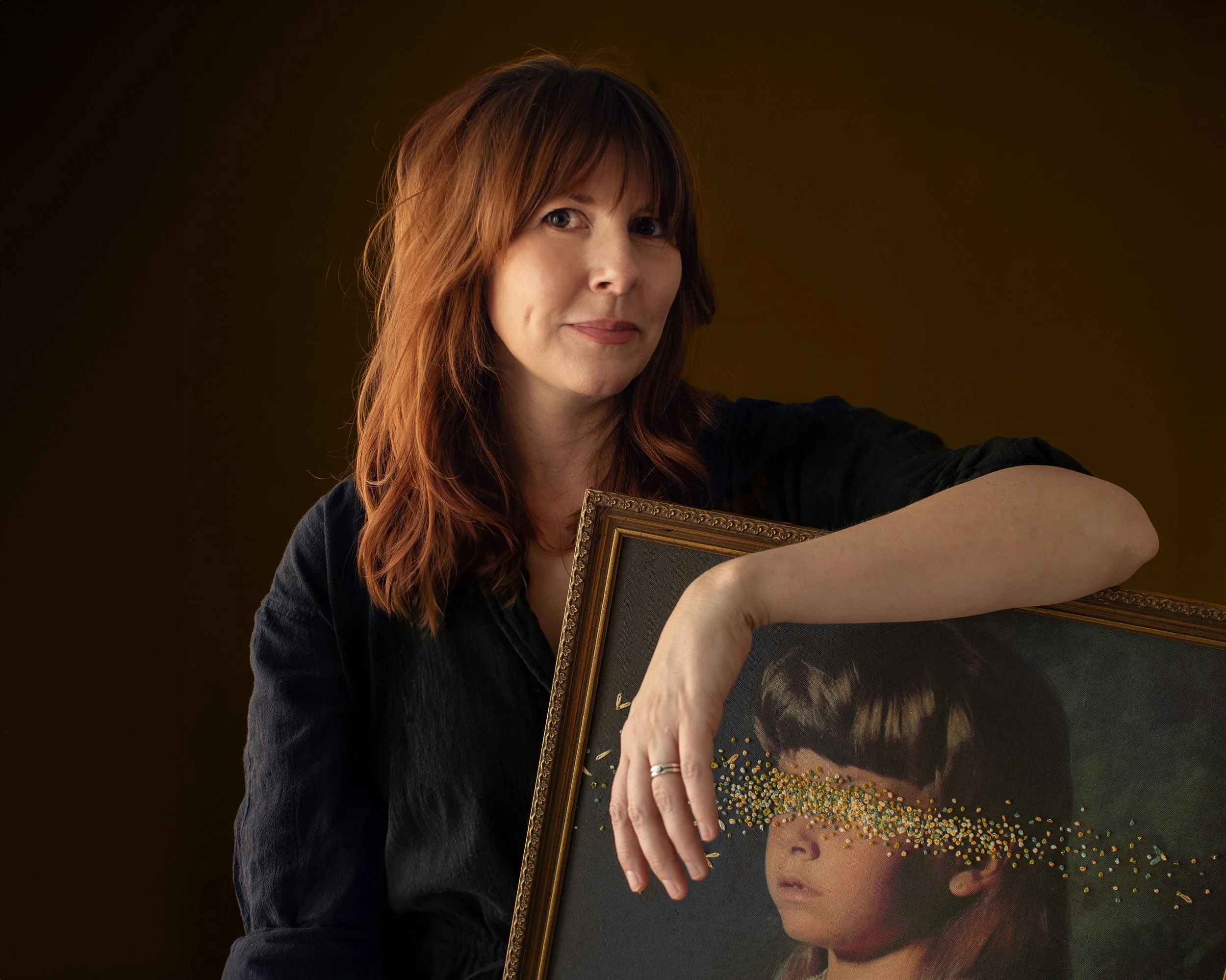
HEATHER EVANS SMITH is a North Carolina–based photo-artist whose work is rooted in her Southern heritage and shaped by the long hall of memory, family, and inner life. Born in Kinston, NC, she now lives and works in Chapel Hill.
Her path to art was not linear. She holds a BA in Visual Communications, and for fourteen years worked in graphic design; a route she followed out of necessity but that never nourished her creative soul. Over time, she returned to photography: drawn by its capacity to embody soul, memory, and emotion. She began with “lunchtime self-portraits” while working in design, small, spontaneous experiments at a window’s edge, and gradually shifted toward staged, conceptually dense photographic narratives.
Her art draws heavily on memory, family, and the experience of womanhood: motherhood, childhood as an only child in a rural town, longing, loss, and the ghosts of what once was.
Over the years she has developed multiple series, each with its own emotional and aesthetic logic:
· Seen Not Heard, a meditation on mother-daughter relationships, childhood memory, and the silent histories that persist.
· Alterations, rooted in memory of her grandmother’s sewing and childhood recollections of buttons, dresses, textures; a nostalgic yet uncanny reconstruction of the domestic archive.
· Blue, a deeply personal series exploring mid-life melancholy and depression, particularly as experienced by women balancing aging parents, children, shifting bodies, time, and loss. For Heather, “Blue” became the color of silence, grief, and the slow accumulation of unspoken sorrow.
· Once Removed, The Heart and the Heavy, Skipping Sundays (her current work), further explorations into memory, identity, faith, absence, and belonging.
Her work is theatrical yet intimate; she builds small sets in domestic spaces, sources vintage props and fabrics, stitches palms with thread, arranges tableaux that bear the weight of memory and longing. She approaches the photographic act as a kind of ritual, a reconstruction of the psychic: lighting, palette, composition, props all painstakingly chosen to evoke past lives and inner landscapes.
Smith’s efforts and talent have been recognized widely. She is a multiple-time Critical Mass “Top 50” recipient (2014, 2018, 2021, and recently 2024); she was named to the Silver Eye Center for Photography 2022 “Silver List”; and she was awarded the CENTER Me&Eve Grant (2022) for her Blue series. In 2023 she also received the Evolution Grant from Art‑Fluent.
Her images have traveled: she’s shown in solo and group exhibitions at venues including the Fox Talbot Museum (Lacock, England), the Nasher Museum of Art at Duke University (NC), and Leica Galerie Milano (Milan, Italy), among others.
Her work is now also part of several permanent collections, such as the Colorado Photographic Arts Center (Denver), Cassilhaus (Chapel Hill), Tatter Textile Library (Brooklyn), and the Nasher Museum of Art at Duke University.
She describes her photographs as “stories”, cinematic stills lifted from the swirl of memory and emotion. Her work moves between the tenderness of memory and the jaggedness of memory’s ghosts.
More of her work may be appreciated on her website and Instagram Account.
Editor’s Note
Skipping Sundays, by Heather Evans Smith
There are artists who photograph the visible world, and there are artists who photograph the tremor beneath it. Heather Evans Smith belongs to the second group. Her images rise from the quiet wound of doubt and the stubborn desire to believe. They explore the distance between the self we are told we should be and the self that refuses to disappear. This distance becomes a landscape; it becomes the field where the self meets the other and tries to recognize what in that other has been shaping it since childhood.
Skipping Sundays is a record of that search. These images carry the weight of a faith inherited but never fully owned. They speak in the language of ritual. Prayer hands. Icons. Needles and thread. A body folded at the edge of a bed. Crosses imprinted on skin like fading instructions. The work circles the same questions that lingered in the artist’s youth. What makes belief possible. What makes it impossible. Why some enter faith as if walking into a house already theirs, while others remain at the threshold, uncertain of the key.
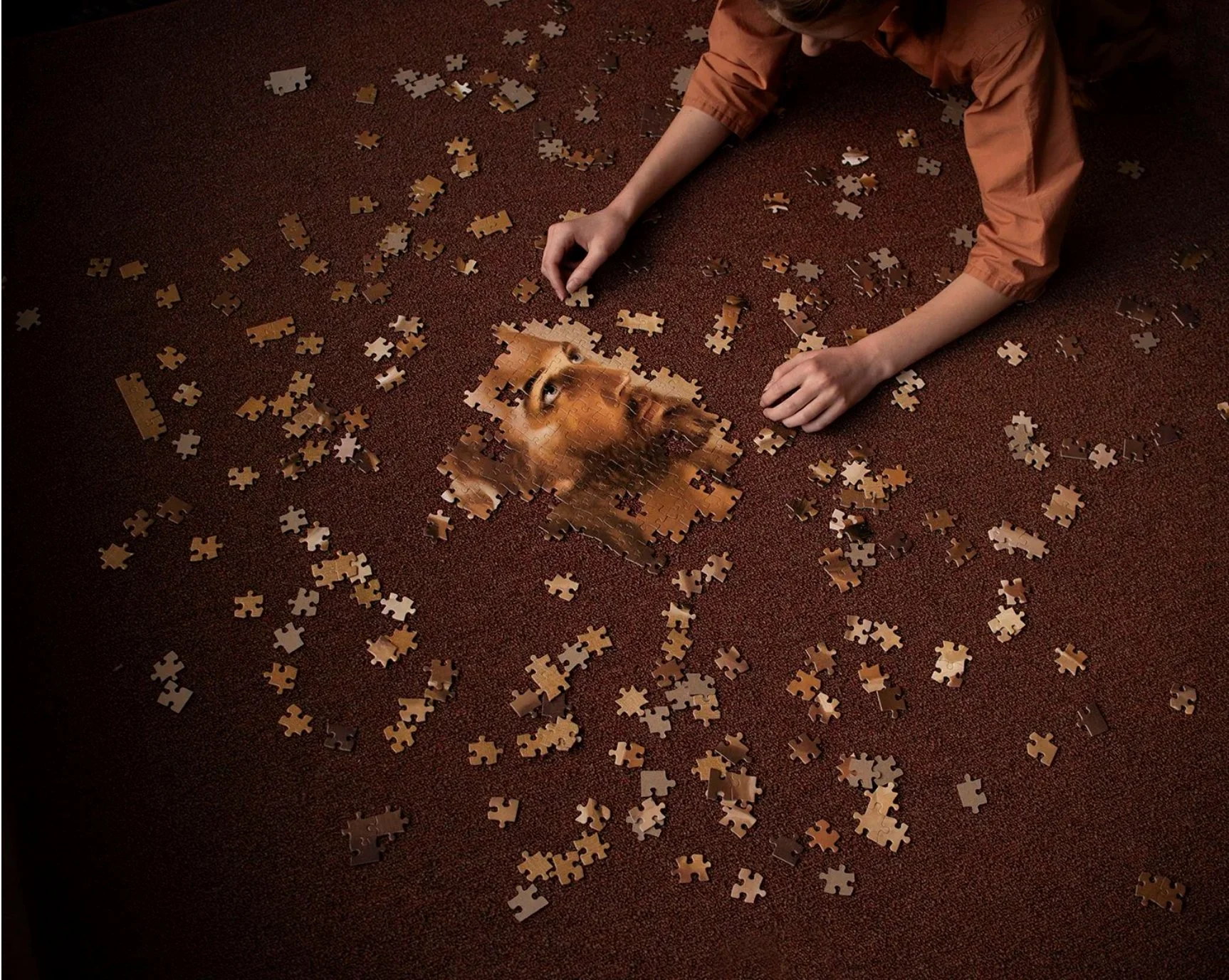
Smith stages this uncertainty with a rare intimacy. The puzzle that reconstructs a face. The gloved hand with the word Sunday stitched into its wrist. The fish sutured with red thread. The young woman crowned by a halo of light that feels as fragile as it is unwavering. These images don’t resolve their symbols. They refuse the ease of answers. Instead, they allow the familiar objects of devotion to reveal their cracks. They show faith as something handmade, stitched together, taken apart, tested again. They show doubt as a form of attention, as a way of lingering with what hurts and still calls.
The series moves through memory, but it doesn’t remain in the past; it reaches toward the present and asks what part of the child still kneels inside the adult. It asks whether the stories we were given as children can survive the body’s later knowledge of loss. The images open these questions without trying to settle them. This is their power. They honor the mind that seeks, the heart that waits, and the person who keeps returning to the same threshold even when nothing seems to answer.
In the context of Self and the Other, Smith’s work becomes a meditation on identity shaped by forces both intimate and ancestral. The self she photographs is never alone. It is always shadowed by the others who formed it. Parents. Preachers. Friends whose faith appeared effortless. The community that welcomed her and the community she felt outside of. Her photographs hold these presences with respect. They acknowledge the tenderness and the ache of belonging to a world that doesn’t always make room for questions.
What emerges is not a rejection of faith. It is neither rebellion nor confession. It is something more delicate and more human. A portrait of a person trying to understand what belief asks of a life and what remains when belief doesn’t arrive. A portrait of the ongoing attempt to shape meaning out of inherited rituals and private doubt.
In Skipping Sundays, Heather Evans Smith gives us an art of stillness and scrutiny. She places doubt at the center of the frame and lets it breathe. In doing so, she reminds us that the search for the sacred is not a failure. It is one way of honoring the mystery of being alive.
Jorge R. G. Sagastume