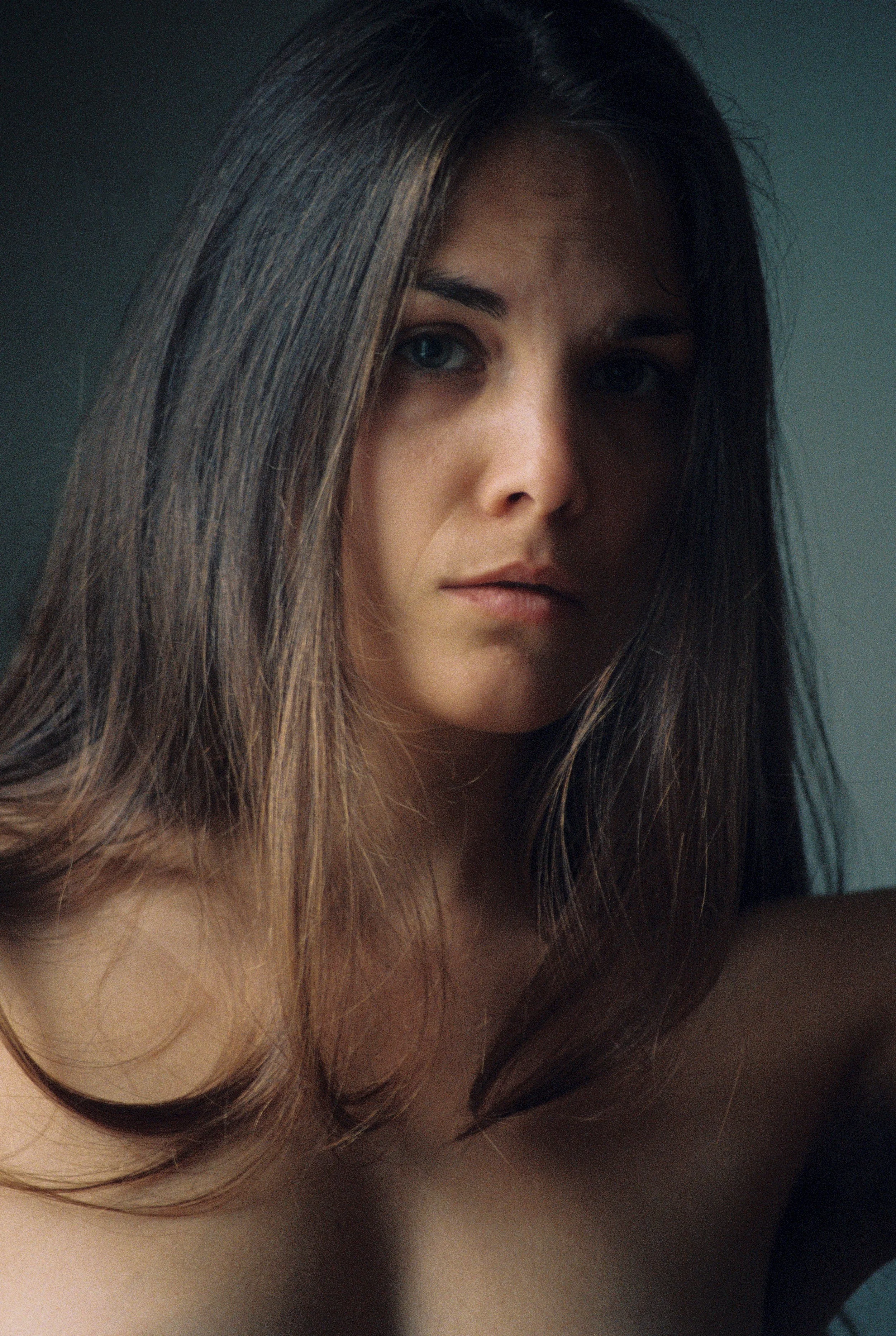
CHANTAL CONVERTINI (b. 1992, Schaffhausen, Switzerland) is a photographer and artist based in Basel. She began with painting and drawing, received her first camera at fifteen, and studied art education at the Hochschule für Gestaltung und Kunst Basel, completing her master's degree in 2018. A difficult period brought her to self-portraiture eight years ago, and she has worked with analog film ever since.
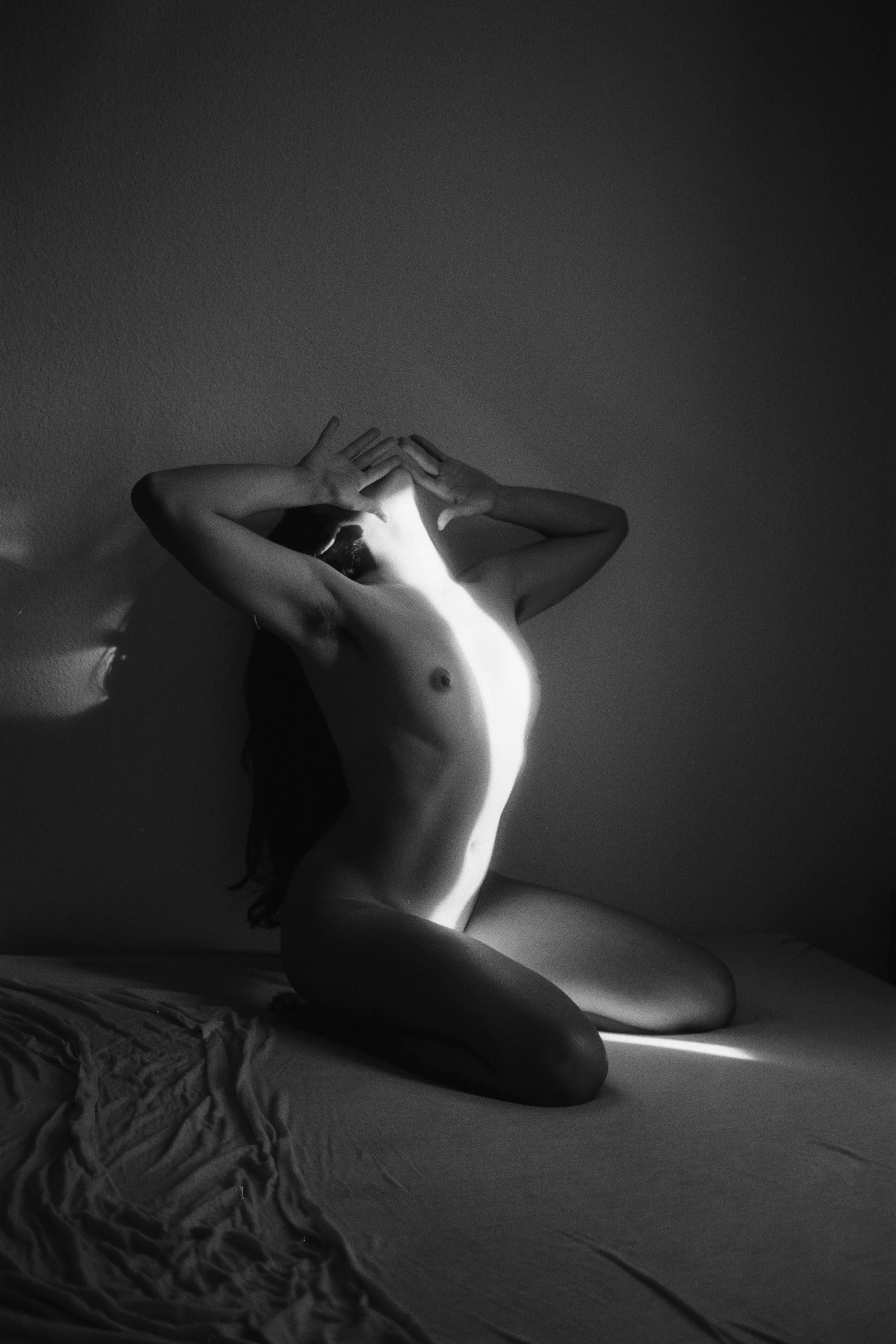
Her practice begins with light. Natural light entering a room through shutters and blinds, falling across skin, warming the image before the shutter opens. She treats ambient light not as a condition to manage but as a collaborator, letting it shape mood and meaning. Analog film introduces delay: the waiting, the uncertainty, the small gift of images returning weeks later, sometimes surprising, sometimes exactly what she intended. The process slows her down. It keeps her honest.
Convertini often photographs herself in front of mirrors, alone or with her partner, staging intimate scenes that refuse the polish of commercial imagery. She has called self-portraiture a form of self-acceptance, a way of seeing emotions she couldn't put into words. The camera becomes a vein through which feeling passes into visible form.
Her work has been exhibited in Basel, Zurich, Paris, Milan, and New York. She published her first photography book, Permeable Membrane, in 2020. She has collaborated with Polaroid, and her commercial clients include Gucci, Omega, Bulgari, and others. She teaches workshops on analog self-portraiture alongside Laura Zalenga. She lives and works in Basel.
More of her work may be appreciated on her website.
In Conversation
In a self-portrait, the body becomes both instrument and score. Chantal Convertini knows this. Her photographs render what words cannot hold: the weight of a feeling before it finds its name. Light enters her frames the way memory enters the mind, at an angle, altering what it touches. A mirror doubles the figure not to multiply but to witness. The camera, set on its tripod, waits. And in that waiting, something happens that Convertini calls alchemy.
Based in Switzerland, Convertini works almost exclusively in film. She courts the accident, the grain, the soft rebellion of analog process against the tyranny of control. Her images feel intimate without being confessional, resolute without being closed. They don’t explain themselves. They ask to be looked at slowly, the way one returns to a familiar room and notices, for the first time, how the afternoon light falls across the floor.
This conversation began with a simple question: where does an image start? Her answer moves through feeling, through vision, through the body in motion, and arrives somewhere else entirely. What follows is a meditation on solitude, vulnerability, and the quiet strength of making oneself visible.
Q&A
Many of your self-portraits feel like emotional weather. When you begin an image, do you start from a visual impulse, a feeling, or from the need to understand something within yourself?
I’d say all three are true. In different variations or levels of importance, yes, but all of the above help me start a photographic process. At the very beginning it was strongly about understanding and processing my feelings. Now I also use writing to do that, so photography has become more motivated by visual impulse. But the beautiful thing is that even if it starts with the eyes, it can end up touching the heart, even if that wasn’t the intention.
Our issue frames self-portraiture as inquiry rather than exposure. How do you keep the work open as a question, even when the subject is your own body?
Maybe by not thinking in words. The one huge thing I love about self-portraits is that you don’t need words. You don’t have to articulate an idea or a feeling or anything at all. You don’t need directions or second guessing. It’s pure doing. And by that, I think the work remains open and remains a search, rather than something analyzed or predetermined.
You once said that self-portraits are a vein to pour out emotions. Has that vein changed over time?
Yes and no.
Yes, in the sense that life got better and with it the level of desperation got lower, which means that vein is no longer only processing bad or difficult things. I also portray good feelings now. I’m happier, more grounded, more self-confident, and I feel mostly at ease in my friendships and relationship. And that comes through too.
But also no, because I still use it in the same way, even though the feelings are different now.
Light in your work seems alive. It touches the body like a thought returning. What does light mean to you as both material and mood?
It’s true. The light for me is almost as, or sometimes even more important than the subject portrayed. It becomes the subject itself.
I don’t know since when, and I don’t know how it started, but somehow light has become my favorite requisite. I see it everywhere. In the beginning I would set up my camera and tripod for any little patch of light and see what I could create with it. Over time the need to chase every ray of sun lessened, but it’s still a strong source of inspiration.
Light brings dynamic, contrast, and depth into an image. These are all things I love in a photograph. And as someone living in a place where it’s cold for six months, sitting in sunlight is something I connect with warmth that is more than physical.
Film introduces a tension between intention and chance. How does waiting for the result shape your relationship to control, surprise, and trust?
Yes, definitely. With its inherent nature of coincidence and imperfection, film can act as your muse. I love that.
And the waiting is a big part of the process. It’s one of many things I appreciate about the analog world. I also know it makes my work better.
Sometimes not having one hundred percent control over the outcome makes me try something new or experiment more, and sometimes it makes me a million times more intentional with what I shoot.
I also usually like my work more when I get it back from the lab at a moment when I’ve forgotten what I shot. Like that I can see the image almost with neutral eyes, and see it more for what it is rather than what I expected it to be.
Mirrors recur in your images. They turn one body into many. What draws you to mirrors, and what do they let you ask that a single viewpoint cannot?
They absolutely do.
I think I introduced mirrors because I needed to see what I was doing when I shot self-portraits. And I think they stayed because, like light, they bring depth into a photograph. A frame within the frame. Sometimes I also find it very empowering and a strong statement when the viewer can see that I am indeed my own muse.
And last but not least, mirrors are beautiful objects and let you play, which is the core of what I do in my self-portraits.
John Dewey writes that the self is in continuous formation. Does this idea resonate with your practice? Do you think of identity as a verb rather than a noun?
I haven’t thought much about it, to be honest, but the first thing that comes to mind is that the self might have two layers. One is the core-self, the one that might be called your truest inner being, a soul maybe, and that part stays the same. It’s you in your purest essence.
The second layer is the one that experiences things and is shaped by them. Always learning, shifting, and growing. And maybe the more that outer self becomes aligned with the core-self, the more at ease you are.
Paul Valéry writes that to see is to forget the name of the thing one sees. Do you ever try to forget the name you have for yourself in order to see differently?
I don’t actively try to un-name what I see or work with, but in self-portraits I rarely use words to create. The only time words are involved is when I’m photographing another person and need to direct them. Other than that, words don’t exist, and like that, names don’t exist either.
Your photographs hold both tenderness and resolve. Do you think of vulnerability as a kind of strength? What does strength look like in an image that is quiet?
Absolutely. Showing vulnerability is an act of strength.
Strength is letting yourself be seen. Strength is showing a nude body that has nothing to hide behind anymore. Strength is giving something of yourself to something that isn’t efficient or profitable, but purely expressive.
Which writers or poets feel close to your work, not as influences to imitate, but as companions in thought?
I adore Rupi Kaur’s poems, literally all of them. milk and honey went straight to my broken heart and hugged it, while home body resonated deeply with how I feel in this world today.
I loved Caroline Emcke’s writing in How We Desire. It helped me appreciate my native language (German and Swiss German).
I was deeply touched by Young Pueblo’s Inward. In that moment of my life his words were an anchor.
Elizabeth Gilbert’s Eat, Pray, Love is a masterpiece. It is rightfully famous. I’ve read it at least five times and it still makes me laugh and cry.
I don’t know if these writers feel particularly close to my photographic work, but they are close to me, and my photographic work is a huge part of me, so I think one can assume they are.
You have described self-portraiture as healing. What kind of healing does the practice give you? Can this act of looking help others name emotions they cannot yet speak?
Yes, it is immensely healing.
Even after the very first afternoon I ventured out with my camera and tripod to take my first ever self-portraits (autumn 2015 in Italy), I felt such relief. Back then I had no words for it, but I kept doing it because it was the only thing that let me escape a heavy heart for a while.
Self-portraits bring a kind of healing that is difficult to describe. It’s a kind of alchemy. It’s as if whatever you feel changes solely through moving your body and being allowed to express it. And the fact that the camera captures it makes it an act of truth. And then, as a last step, seeing reflected back what you felt becomes a moment of understanding and forgiveness toward yourself. That is immensely healing.
Next to that, spending time alone with yourself, accepting yourself and your body more, and the fact that creating, making art, and play make us happier beings. I think that is universally true.
What ideas are calling to you now? They can be small or unfinished. What are you curious about that might lead to the next image?
I never work with specific ideas, but I do have a general sense of direction. It’s never far from what my life is. The topics of growing out of youth, womanhood, my relationship, and family are on the horizon or already woven into my work.
Convertini's practice reminds us that self-portraiture is not vanity but vigilance. It is the discipline of paying attention to oneself without flinching. In her hands, the camera becomes a collaborator, the light a companion, the mirror a door. She speaks of play, of healing, of a vein that once carried only sorrow and now runs with something closer to ease. The photographs bear this out. They don’t perform happiness. They hold it, lightly, the way one holds a cup of something warm on a cold morning.
What stays with me is her insistence on wordlessness. Self-portraits, she says, don’t require articulation. They exist before language, in the space where feeling has shape but not yet syntax. This is the gift she offers: an image that doesn’t translate experience but embodies it. To look at her work is to be reminded that seeing, truly seeing, is its own form of speech. And sometimes the truest things we say are the ones we never put into words.
Jorge R. G. Sagastume
To view the artist’s work, please click below on The Light & the I
Artists & Writers in This Issue
In alphabetical order by the first name
