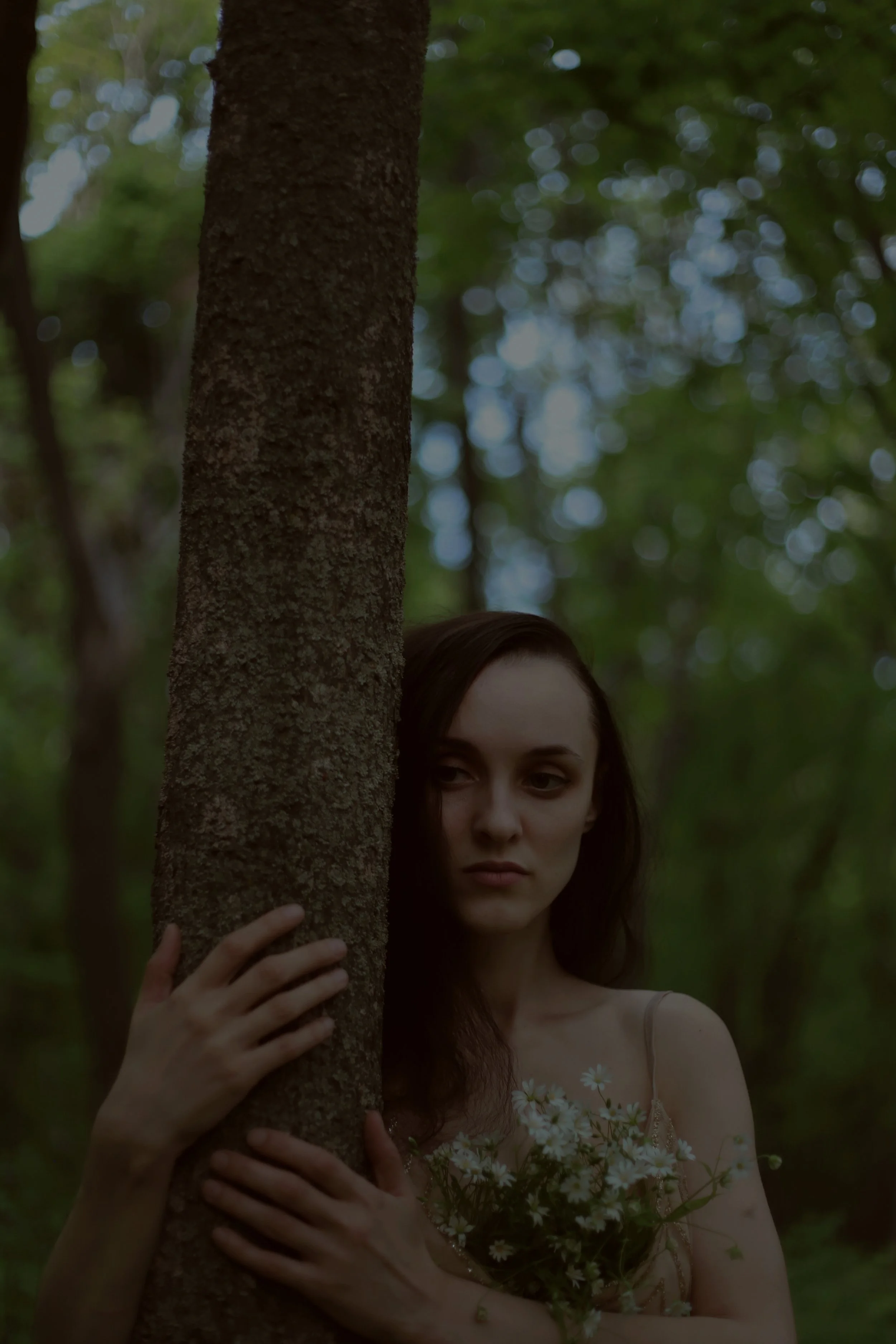
MELA KALF (pseudonym) is a self-taught photographer whose work unfolds at the intersection of visual art, psychology, and lived bodily experience. She considers the forests of Karelia her true home, both geographically and existentially. Her photographic practice emerged alongside a period of severe illness, during which pain, physical fragility, and altered states of consciousness reshaped her relationship to her body and to the world.
Kalf’s self-portraits are not conceived as performances or constructed images. They arise from lived states and function as a form of healing, a way of giving visual form to what she describes as an inner scream and a “hunger for eternity”. Working primarily in forests and often in darkness, she treats nature not as a backdrop but as a collaborator and philosophical ground. The forest becomes a space where identity loosens, boundaries blur, and the self enters a dialogue with elemental forces.
Her images inhabit a liminal zone between presence and disappearance, vulnerability and instinct, stability and transformation. Light and shadow are not merely formal elements but modes of perception, with darkness offering a heightened sensitivity that resists clarity and control. Kalf’s work draws aesthetic inspiration from cinema, particularly surrealist and dreamlike traditions, and literary influence from Lautréamont, while her deepest philosophical orientation remains rooted in nature itself.
For Kalf, photography is an intuitive, non-linear process guided by states rather than scripts. Each image is a fragment, a trace left behind by an encounter, rather than a complete narrative. Across her practice, she returns persistently to a single question: where does the self end, and where does the forest begin?
In Conversation
Mela Kalf doesn’t perform for the camera. She uses it to witness a transformation already underway. Her self-portraits emerge from a practice rooted in physical suffering, prolonged contact with the forest, and what she calls "a hunger for eternity", a longing that resists satisfaction and pushes toward dissolution.
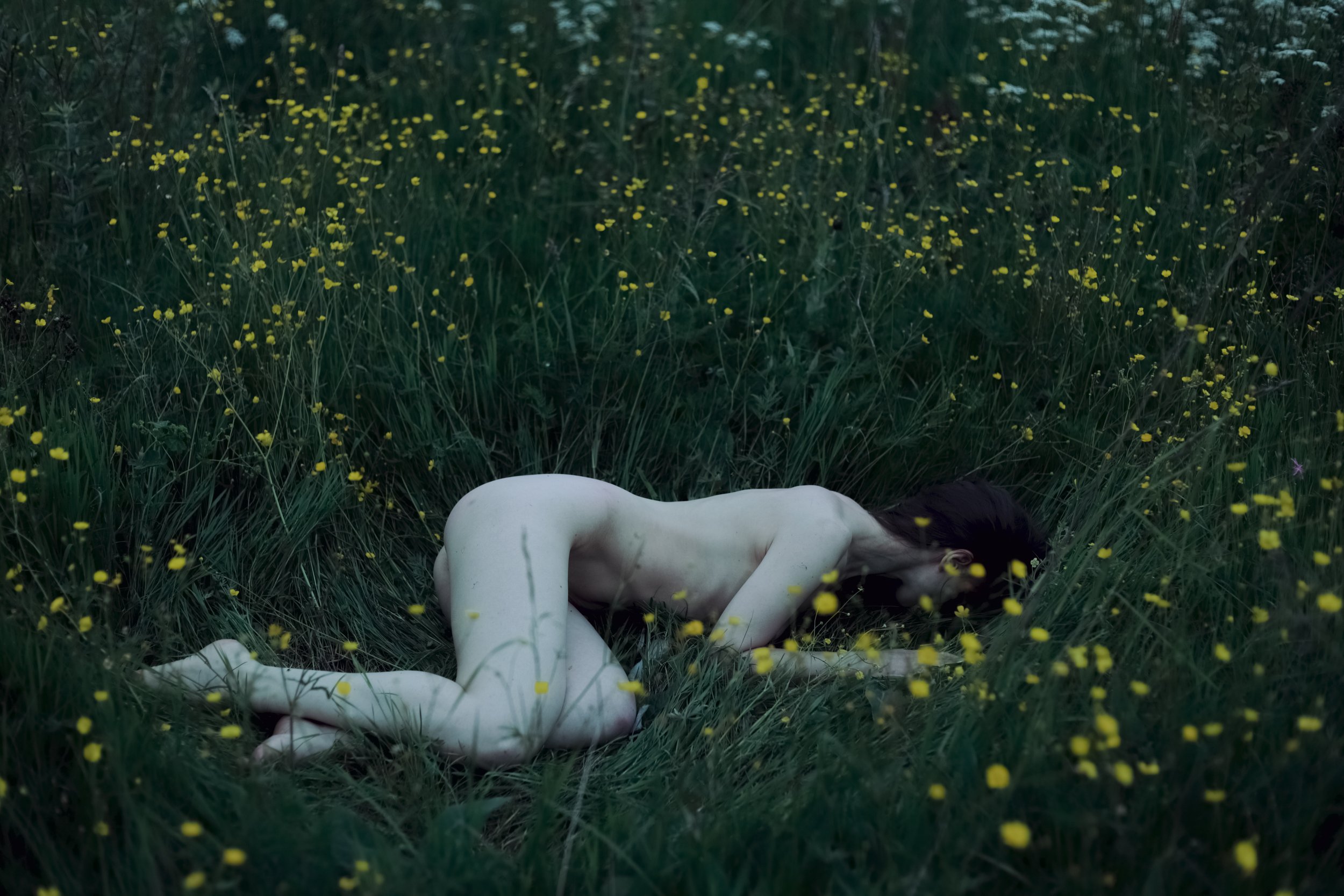
The body in these images is never decorative. It appears vulnerable, cold-toned, pressed against earth or held by trees. The forest is not backdrop but collaborator, a space where Kalf suspends the boundary between human consciousness and elemental force. She photographs at night, moves without sight, lets the timer run while she lives through states she cannot script in advance. The result is work that refuses theatricality even as it carries high emotional charge.
Kalf's illness brought her to this practice. What began as remedy became method. The photographs function as fragments, each one a trace of an encounter that can’t be fully captured or resolved. In the conversation that follows, she speaks plainly about healing, darkness, and the question she returns to: where does the self end and the forest begin?
Q&A
1. Your self-portraits feel more like encounters than images. What draws you to using your own body and face as the primary space of exploration?
Healing. At the beginning of this path, which can now be identified as creativity, though for me it is simply an organic part of my world, there was a severe physical and psychological condition. Everything happened accidentally. I would set up the camera and photograph myself. My goal was not art. I did not invent images. Everything came from within. I lived through these states. The process itself was a remedy, although at first I did not yet understand it as such. I simply followed an inner voice.
To ease the pain, even slightly, I spent all my time in the forest. Only there can I be truly myself. I feel the forest as my home. I went there more and more often, unwilling to return to what I think of as human essence, constantly embracing trees, dissolving into the magnitude of the elements. My illness progressed during this time, which is why many of the works directly reflect that difficult period.
For me, this work is first and foremost healing, overcoming, and the possibility of living the life of a parallel world. And only in the forest can I live this honestly. Later, I began to think of my illness as a song: melancholic, at times anxious or even dark, but with an underlying sense of overcoming woven into its motifs. I relate to self-portraiture and to my creative practice as an elixir against this pain.
2. In many of your works, there is a quiet tension between presence and disappearance, between openness and concealment. Do you see the self as something stable or as something constantly changing?
I see it as two parts of a single whole: stability and impermanence. However contradictory they may seem, they coexist in a harmonious unity. There are two parts of me, and they differ from one another. One part, visible in the finished photographs, appears as a huntress, a forest dryad, a lost soul within dense woodland. This part inevitably touches another: more sensitive, vulnerable, gentle, and fragile, searching for peace.
They are united by one vulnerable body, which serves as a vessel for both. It is precisely at this point, where fragility meets elemental force, that the quiet tension is born. It is a dialogue that the camera records.
3. Light and shadow play a key role in your images. What does darkness allow you to express that light alone cannot?
I often go into the forest late at night. There, I move not through sight, but through inner touch. It is a state beyond fear, somewhere between intuition and vibration. I trust my movement in complete darkness, making my way through dense growth and fallen trees, learning to turn off human sensations: fear, doubt. The forest does not forgive them.
For me, darkness is a natural environment, a kind of vision through which I see. Light, by contrast, feels like resistance. Light blinds, dulls heightened sensitivity, suppresses the instincts that awaken in me at an animal level. My essence resists moving toward it, because everything connected to light feels deceptive, like a trap, like something artificial.
4. Your images often exist in a liminal space, not quite real and not quite imagined. How important is this in-between zone to your creative process?
This zone is essential. I would compare it to false awakening. Sometimes, in a dream, you wake up and begin your familiar morning routine. At first, everything seems normal. Then a strange feeling arises: something is wrong. You try to understand the source of this anxiety. Suddenly, you notice that there is no reflection in the mirror. Everything inside contracts.
You realize that images and sensations from the dream have seeped into reality. They begin to fill the space, to settle into this world, absorbing everything around them, including you. And in that moment, you wake up, truly wake up. Or perhaps it only seems that way.
I bring my dreams and my waking life into the fragments of states I photograph. And when I return from nature to everyday reality, I carry the forest within me.
5. Do you experience your self-portraits as a narrative, or rather as fragments, moments, emotional states that resist linear storytelling?
Each photograph is like a shard of a shattered vase, only a small fragment of what was once whole. I would compare it to cinema, which I love deeply. It is like a frame torn from a long film reel. The character struggles, suffers, resists, searches for hope, all of this unfolding in the forest or in the darkness of night, in complete solitude.
The difference from cinema is that there is no script. It is like an animal accidentally captured at night by a camera trap. The camera simply happened to be there.
6. Are there writers, poets, or philosophers who have influenced your understanding of identity, the body, or the inner world?
Lautréamont, The Songs of Maldoror. I have reread it hundreds of times. I passed the prose through myself like a sweet poison, intoxicated by the aesthetic force of every line. It deeply shaped the way I express my thoughts.
Aesthetically, cinema has influenced me even more. I watch a great deal of old film, often surrealist works, complex films that resemble dreams.
As for philosophy, the greatest and truest philosopher for me remains the element itself: nature.
7. Your work carries high emotional intensity without ever feeling excessive or theatrical. How do you find this balance between depth and restraint?
The answer lies in a single encounter. Once, a street photographer stopped me and asked if I would pose for him for a few minutes. I agreed. But during the shoot, he suddenly lowered his camera and said, "I have the feeling that while you pose, you are addressing the sky, searching for hope there."
He had expected routine images, light coquetry, but instead encountered something else. I call it my inner dialogue.
That moment made me realize that I simply do not know how to create an artificial image, because I have never needed to. That is why there is no performance in my photographs. There is only a state and the act of living through it.
8. In an era when self-portraiture is often associated with display and self-presentation, your work moves in another direction. What does it mean for you today to turn the camera toward yourself?
At first, my inner voice demanded healing, and photography became that. It remains a remedy even now, but my perception of the process has deepened. Today, it is a separate facet of my life, just as unconditionally real as touch itself: subtle, attentive, sensing the forest and its world in the smallest details.
9. How would you describe your creative process: intuitive, deliberate, or somewhere in between? What comes first: an image, a feeling, or a question?
It is always movement in blindness. A state always comes first. I never see the final image and never know what the frame will be, so I plan nothing. Everything begins with contact. I seek support from the trees, and when the forest accepts me, I set up the camera.
I start the timer and allow what is inside me to break free and take form. I do not know what my scream will be about, or what kind of song it will become: frighteningly dark or gently melancholic. I press the button and fully surrender to the lived experience. I do not know which moment the camera will capture, because I exist continuously within this flow.
The final image is only a trace left along the path of living through that state.
10 If the self-portrait were not an image but a question, what question do you return to again and again?
Where do I end, and where does the forest begin?
This is a question of boundaries. In moments when I dissolve into the element, it feels as though my body no longer belongs to me. It becomes a continuation of the trees, of bark, moss, fallen leaves, everything that constitutes the forest. And I ask myself whether there remains a human part to which I must return, or whether I have fully become a forest creature in human skin.
Kalf's work asks what the self-portrait can hold when it is not addressed to an audience but to the elements themselves. Her images refuse the logic of display. They don’t explain or confess. They record the residue of states lived through in solitude, in darkness, in sustained physical contact with a forest that functions as collaborator, witness, and home.
The photographs carry the weight of illness and the release that comes from dissolving into something larger. Kalf doesn’t resolve the tension between human consciousness and elemental force. She sustains it, returning again and again to the same question: where does she end and the forest begin? The answer, if there is one, lies not in language but in the act of returning, camera in hand, to the cold ground and the trees that hold her.
Jorge R. G. Sagastume
To access the artist’s work, please click below on Entering Mela Kalf’s Home
Artists & Writers in This Issue
In alphabetical order by the first name
