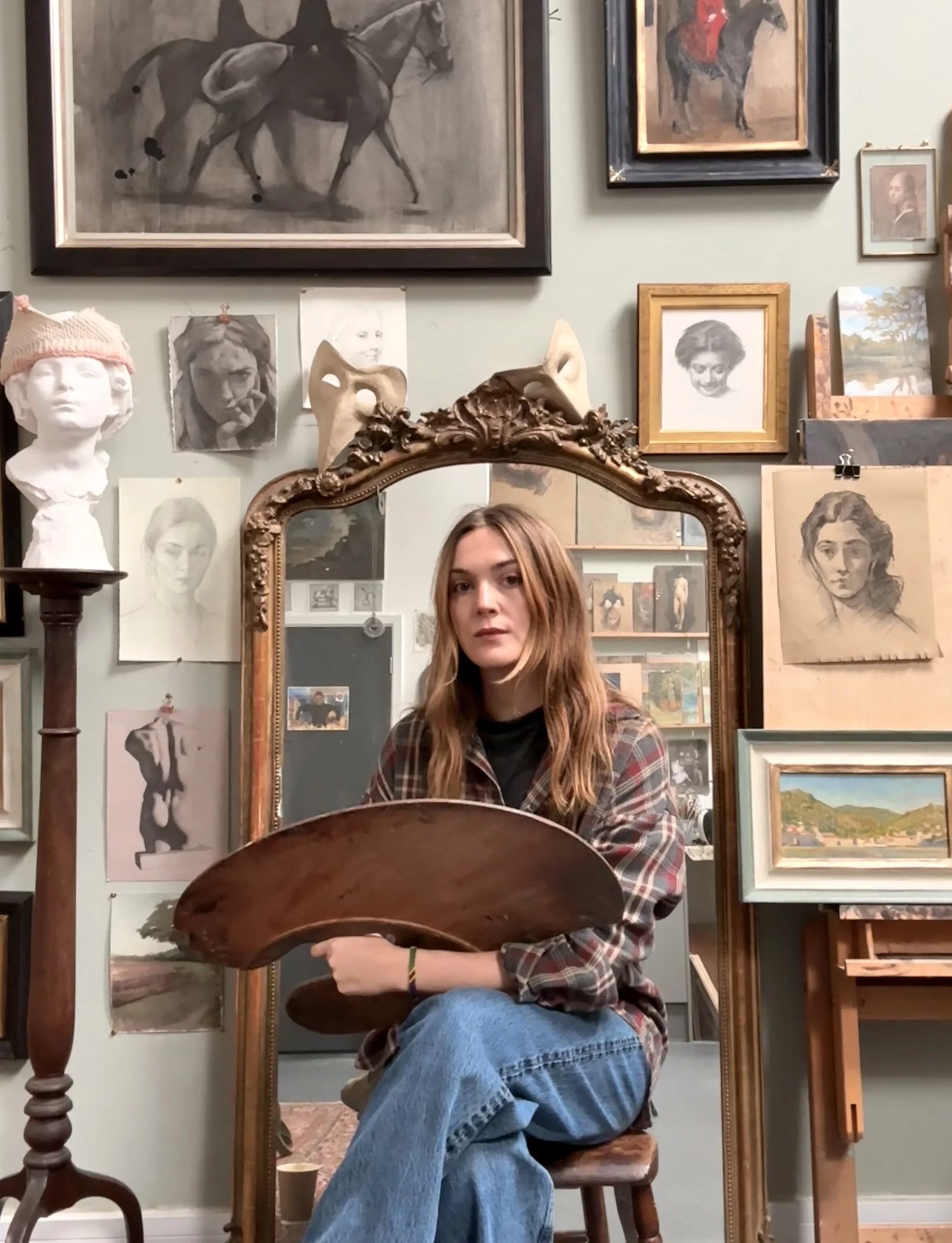
CLEMENTINE HANBURY is a London-based painter whose realism listens before it speaks. Her work attends to the slow arrival of things: a face in half shadow, the weight of a shoulder, the brief warmth of late afternoon across a table. In her hands, looking becomes a form of hospitality. Objects and bodies are not displayed, they are received.
Hanbury trained at the City and Guilds of London Art School from 2015 to 2017 and at the Florence Academy of Art from 2017 to 2020, where she graduated with distinction. The discipline of the atelier gave her precision, yet her paintings carry something more supple than skill. They move between intimacy and restraint, between the private world of observation and the public world of exhibition, without ever feeling staged.
Her practice includes portraiture, figurative scenes, still life, and landscape, often painted from life and almost always in natural light. This choice matters. In natural light, forms reveal themselves slowly, and the act of painting becomes a negotiation with time rather than a reproduction of appearances. The result is realism not as imitation, but as attention.
Hanbury’s work has appeared in exhibitions with the Royal Society of Portrait Painters, the New English Art Club, the Hampstead Art Society, and Arcadia Contemporary in New York. In 2022 she exhibited in Paris alongside Pablo Picasso, Andy Warhol, and Jean Cocteau as the only contemporary painter present. In 2022 she was highly commended for the De Laszlo Foundation Award, and in 2025 she received the award.
Her paintings are held in private collections across Europe, the United States, and Asia. She works from her studio in Battersea, London, where the act of looking has not yet been exhausted, and the quiet of the studio remains a kind of refuge.
In Conversation
There are artists who use the mirror to confirm what they already know. Clementine Hanbury uses it to discover what she doesn’t yet understand. Her self-portraits don’t assert. They wait. They hold the face in suspension until something surfaces that couldn’t have been summoned any other way.
Hanbury trained in the classical ateliers of Florence and London. The discipline shows. Light and shadow move across her drawings with a precision that belongs to centuries of careful looking. But technique here serves inquiry. The hand follows the eye, and the eye follows something deeper. She calls this overhearing herself. The phrase is exact. These portraits catch the self at the edge of articulation, in the moment before thought becomes speech.
Charcoal is her primary material. It is ancient, fragile, and unforgiving. It doesn’t allow revision in the way paint does. Each mark commits. Each erasure leaves a trace. The medium mirrors the subject. The self, too, is something that forms and fades, that holds for a moment and then shifts.
In this conversation Hanbury speaks of self-portraiture as a metaphysical act. She means that the search for likeness becomes, at a certain point, a search for something else. The face in the mirror gives way to the face that only the drawing can reveal. Representation blooms into encounter. And the encounter, held long enough, becomes its own form of knowledge.
Q&A
1. The title of the February issue asks, “Who is that”. When you look at one of your self-portraits, what is your first, honest answer to that question. Who do you feel you are painting - a person you know, a role you inhabit, or someone you meet only in the work.
What strikes me first is that I’m painting a version of myself that I only meet in the act of making the work. It’s familiar and it’s me, but it is also someone I can’t fully access outside the studio. Self-portraiture creates a liminal version of the self, one that surfaces only when I suspend social identity, abandon performance, and observe with sustained concentration. It is a person I only ever half-know, who emerges solely through the work itself on that specific day.
2. You describe self-portraiture as a metaphysical act. Can you talk about what happens for you between the mirror, or the photograph, and the paper. At what point does likeness turn into inquiry.
There is a moment in the process where the looking turns inward. At first, the act is purely empirical: observing shapes, angles, the passage of light and the design of the shadow. In this way, drawing itself is an inquiry from the very beginning - a slow assembling of abstract marks that, like pieces of a puzzle, gradually cohere to a likeness. Somewhere in that shift from parts to whole, the gaze folds inward. As the drawing begins to resemble me, it also begins to ask something of me. The search for likeness becomes an inquiry the moment I grow less concerned with the mechanics of depicting a face and more attuned to what the face is disclosing.
I think the metaphysical interval occurs precisely there - when representation blooms into self-encounter.
3. Many self-portraits throughout history assert presence. Yours often feel quieter, almost like a question held in the face. When you work, are you trying to reveal something you already sense, or to discover something you don’t yet understand.
Both, but discovery probably leads. I rarely know what I’m circling until I’ve circled it. Sometimes I sense what I’m revealing, but often the drawing shows me something before I’ve consciously named it. It’s a way of overhearing myself.
I feel sometimes feel that maybe my portraits read as pensive simply because that’s the face I make when I’m concentrating. What people may perceive as “quietness” is often just a result of the stillness required to do it. On the other hand, sometimes that stillness allows something inside the self to move - an uncertainty or unresolvedness. The work often reveals to me what I didn’t initially understand. In that sense, the portraits function as a method of self-inquiry: they externalise states of mind I had not fully reasoned through. The making of the portrait allows me to meet myself at the edge of understanding.
4. The issue treats the self as a process rather than a fixed identity. Has working with your own image over time changed who you feel you are outside the studio. Do you notice that the act of looking at yourself has slowly rewritten you.
Yes, I think it has. My early attempts at self-portraiture felt overwhelming and acutely self-conscious. The idea that others might interpret not only the image, but my own self-perception, was deeply unsettling. I was afraid of being misunderstood or judged - not for how I looked, but for how I saw myself.
Over time, the practice has become a kind of balm. The more I look at myself without flattery or defence, the more at ease I feel with who I am beyond the studio. I’ve come to understand these portraits less as descriptions of a fixed identity and more a way of charting psychological weather.
The self now feels fluid - a shifting cluster of moods, questions, and seasons. In that sense, the act of looking has slowly rewritten me, helping me become more accepting of myself and less preoccupied with how I may be perceived by others.
5. Your drawings suggest a strong psychological and emotional depth, yet they rarely feel theatrical. How do you navigate the line between honest intensity and mere performance in your self-portraits.
By not attempting to manufacture an emotion or adopt a persona.
With commissioned work, there is inevitably an external gaze to respond and adhere to. For me, self portraiture eliminates that pressure and the weight of expectation. If the image is unflattering or strange or emotionally raw, it is allowed to be. There is no need to perform because no one necessarily has to see the work.
If I try to orchestrate a character or heighten a mood too much, the image resists. The work tends to collapse unless I stay close to what is actually true on that day. The psychological state I’m in is what determines the expression and general atmosphere. The line between honesty and performance is maintained simply by staying faithful to actuality.
6. Charcoal has been part of your life since childhood. It is raw, fragile, and unforgiving. What does this particular medium allow you to say about the self that paint or photography cannot say in the same way.
Charcoal is elemental - a simple, versatile material made of little more than carbon, dust and residue. It is one of the earliest tools used to mark human presence, and I feel that history carries a weight. It’s diverse nature allows me to achieve both delicate, linear, precision, all the way to rich, painterly renderingsIt’s flexible, fragile, and raw nature mirrors the internal terrain I’m exploring. It’s monochromatic, material, and historical qualities encourage both nostalgia and directness.
7. You trained within a tradition of realism in Florence and London. How do those classical methods sit beside your inward, contemporary questions about identity, doubt, and consciousness. Do you ever feel tension between the two.
My traditional training gave me the discipline, structure, and craft I rely on every day. Those technical foundations form the skeleton of my work - the language that allows me to build anything at all.
When I first began working independently, there was perhaps some tension. I struggled to branch out creatively while remaining preoccupied with accuracy and technique. Over time and accumulative experience, however, the two began to support one another. Technique provides the confidence and freedom to roam, while inquiry gives the technique its purpose.
8. Are there writers, philosophers, or filmmakers who accompany you in the studio. If so, how do their ideas or voices shape the way you understand self-portraiture as more than depiction.
They accompany me more in spirit than through direct reference. I’m drawn to thinkers who treat the self as porous and fluid - writers such as Virginia Woolf and Rainer Maria Rilke. I’m particularly influenced by Rilke’s emphasis on the necessity of a “great inner solitude,” and the idea that truly inhabiting oneself is something that must happen in private.
I also take significant inspiration from artists such as Käthe Kollwitz and Helene Schjerfbeck. In Schjerfbeck’s work especially, self-portraiture functions as a record of internal dialogue, aging, and stylistic evolution - incidentally making her a compelling figure when thinking about the tension between academic training and self-expression that we spoke of earlier.
Together, these voices offer a sense of permission. They remind me that self-portraiture is not simply about depicting a face, but about examining the experience of being a person at all, and that the act of looking inwards is part of a much longer and ongoing conversation.
9. Viewers often feel that they have walked into a private moment when they encounter your work. What kind of moment are you most interested in catching. The instant before an emotion appears, the height of it, or the quiet after it has passed.
I’m most interested in transitional moments - the delicate edge where something is forming or fading. The dramatic peak would feel perhaps theatrical or performative. What draws me is the ambiguity surrounding the feeling.
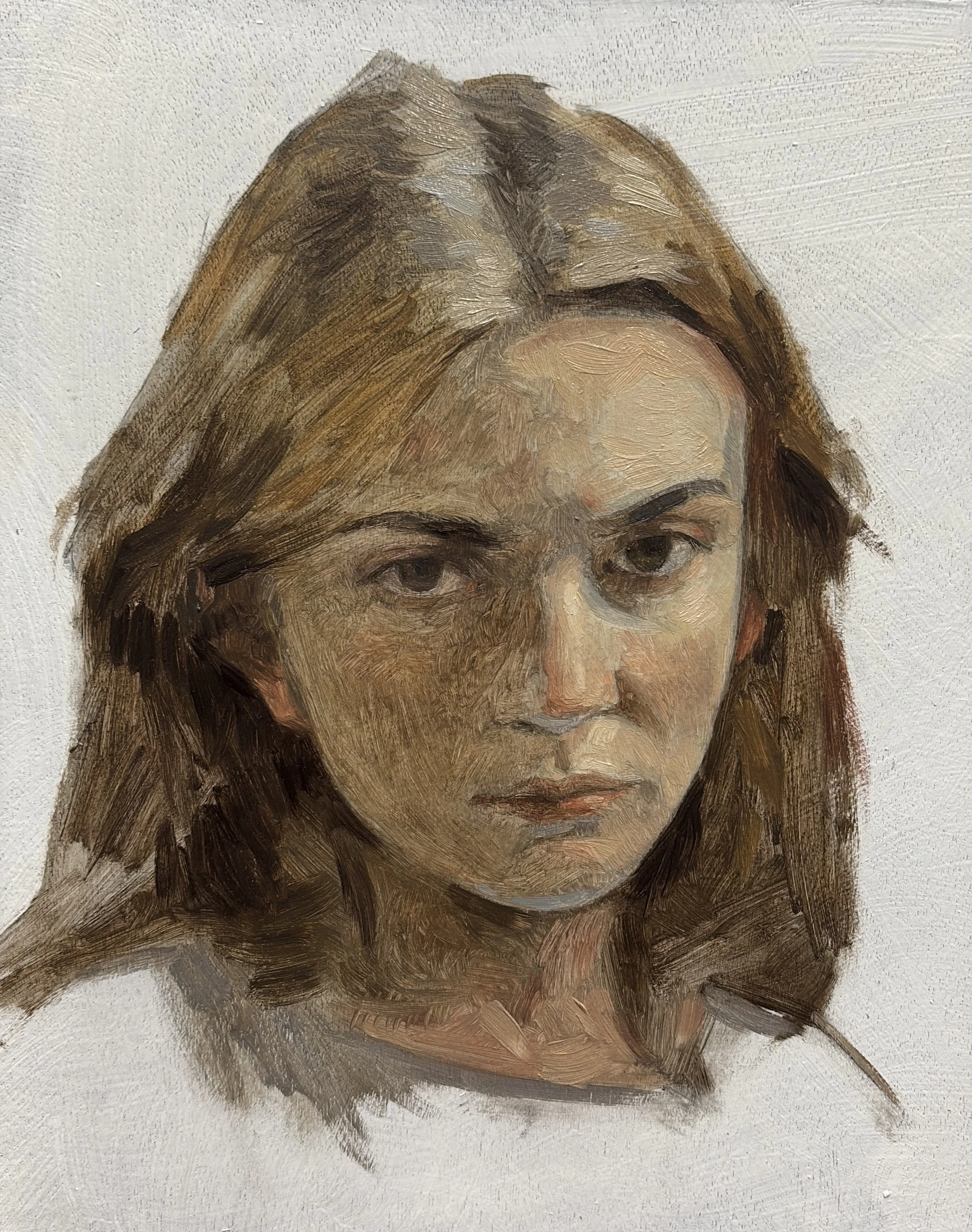
I made a self portrait right as I was unknowingly ill with pneumonia (‘The distance between us’), the moment was simply one of stripped-down presence. I was physically fragile, and I think that fragility shaped the gaze. That’s the intimate moment I hope to describe - unguarded, suspended and transitional.
10. Finally, if you think of your self-portraits not as images but as questions, what question do you feel you are asking again and again. Has that question changed as you move through different seasons of your life.
The enduring question is: What constitutes true likeness - visually, emotionally, existentially - and is it something one can ever fully perceive from within?
This question shifts as I do, but at its core, always orbits the same thing: the gap between self-perception and the perception of others, the distance between who I feel myself to be and who emerges in the work.
Each portrait becomes a provisional answer, a diary of states rather than certainties. Over time, the recurring question has become less about defining the self and more about witnessing its evolution.
Hanbury returns to one question. What constitutes true likeness, and can we ever perceive it from within? She doesn’t answer it. She keeps asking. Each portrait becomes a provisional response, a record of a state rather than a definition of a self.
What matters in her work is the refusal of drama. These are not faces caught at the height of emotion. They live in transitional moments, the edge where something is forming or fading. The expression doesn’t perform. It simply appears, the way weather appears, without announcement.
Rilke wrote of the necessity of a great inner solitude. Hanbury takes that solitude seriously. Her practice requires stillness, patience, and the willingness to look without defense. Over time, she says, the looking has rewritten her. She has become more at ease with who she is beyond the studio. The portraits have not fixed her identity. They have taught her that identity doesn’t need to be fixed.
This is the quiet radicalism of her work. It insists that the self is not a problem to be solved. It is a process to be witnessed. The drawing doesn’t capture. It accompanies. And what it accompanies is not a person but a passage.
In Clementine Hanbury's hands charcoal becomes a way of paying attention. The face emerges stroke by stroke, and with it something the artist could not have known before she began. That is the gift of her practice. It doesn’t show us who she is. It shows us what it means to ask.
Jorge R. G. Sagastume
To access the artist’s work, please click below on Transitional Moments
Artists & Writers in This Issue
In alphabetical order by the first name
