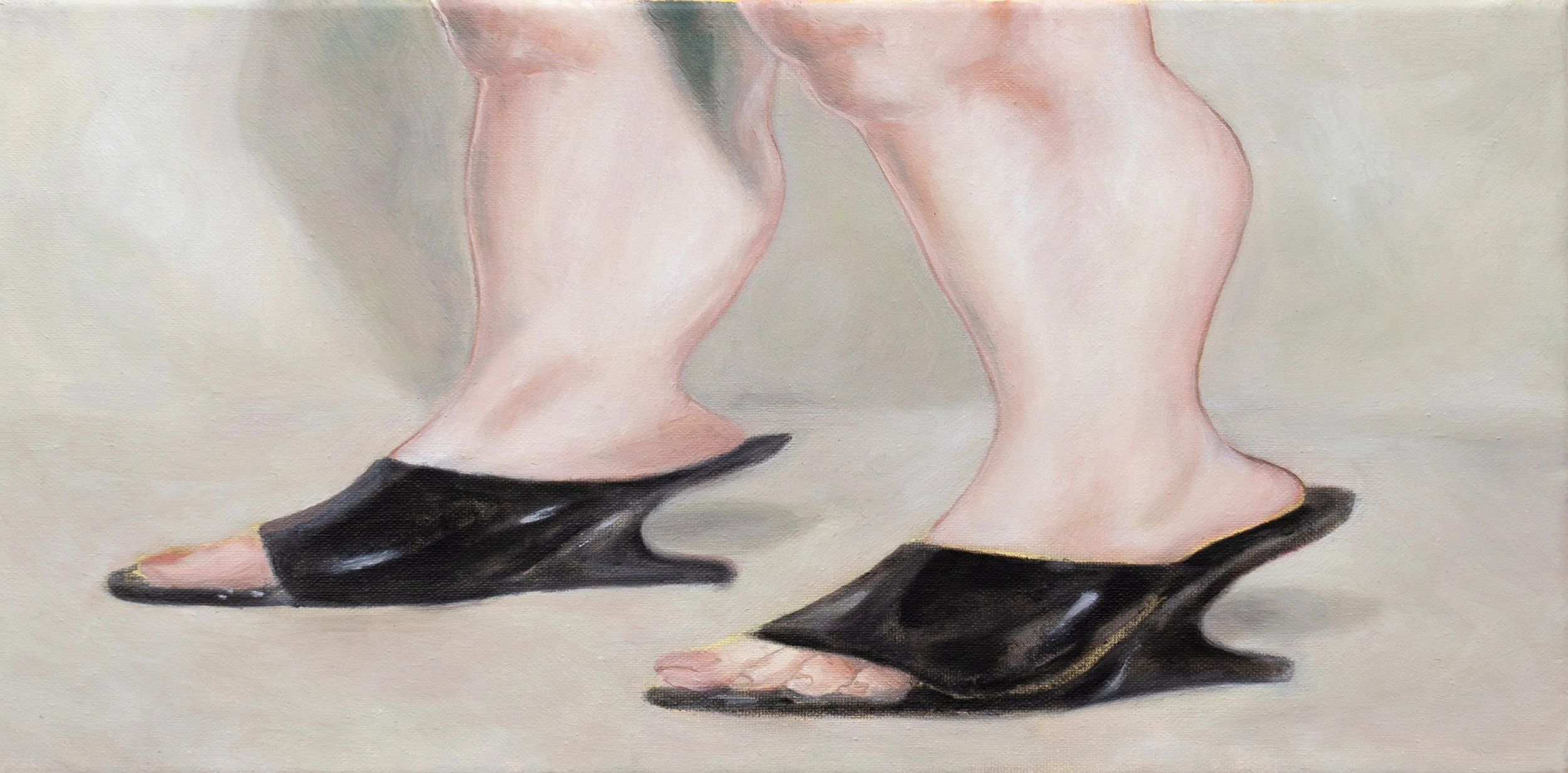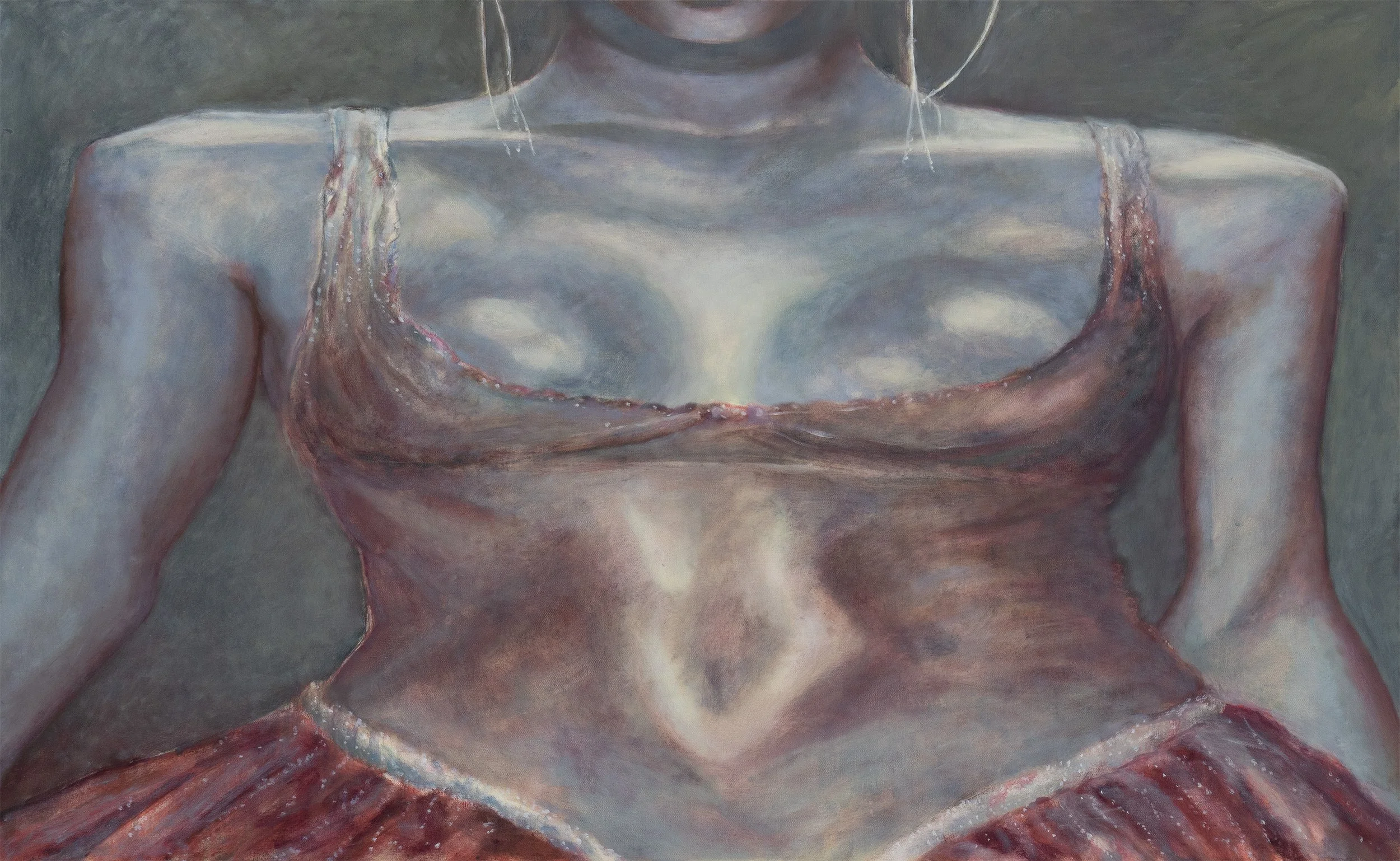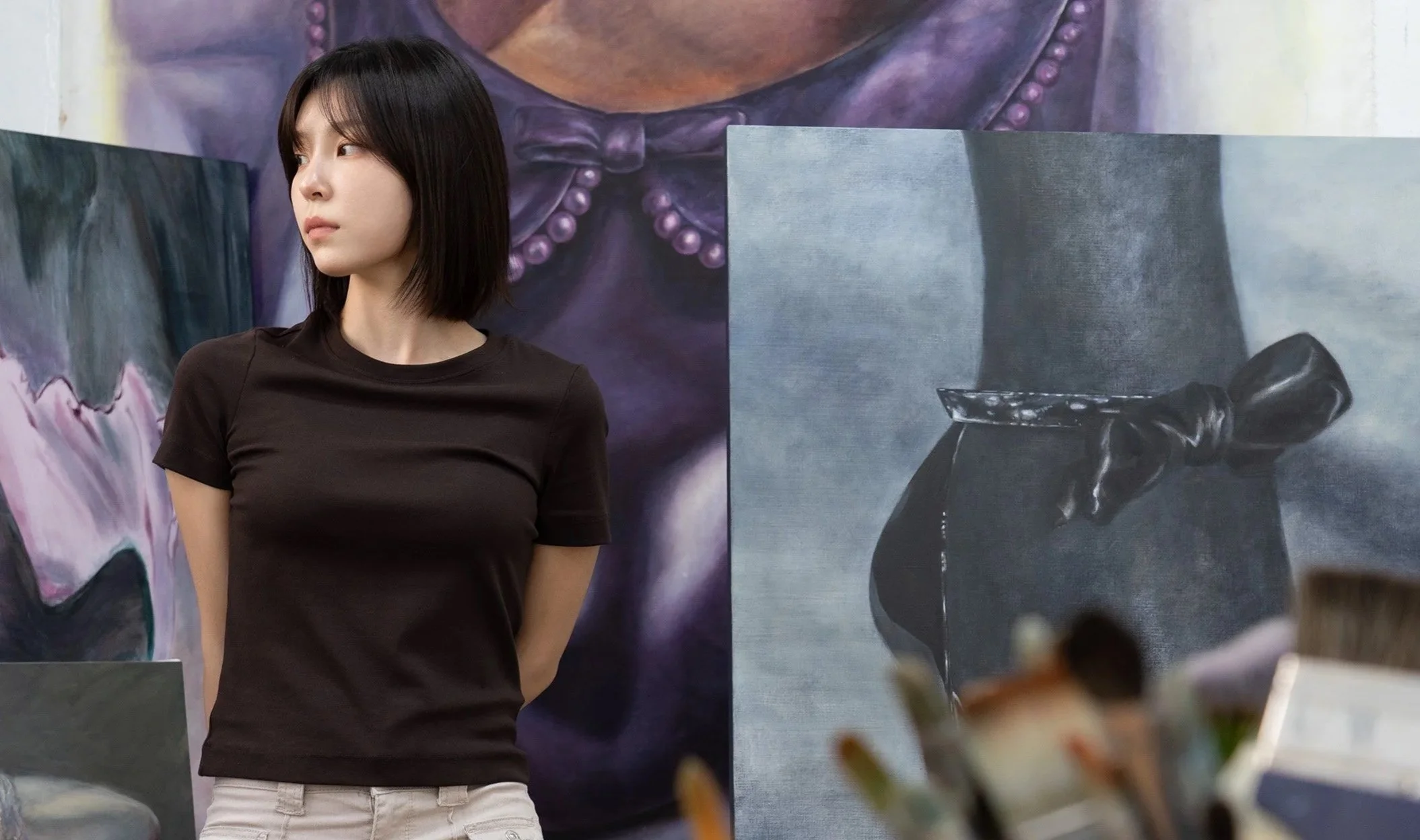
JUEON IM 임주언 (b. 1997) is a painter based in Seoul. She received her MFA from Hongik University in 2024. Her work moves through a series of sustained bodies of painting, Overlapping (2023), Puzzling (2024), Skin, Fabric and Folds(2025), Fragments of Boundary (2025), and The Way of Seeing (2026), each returning to questions of sensation, memory, and the fold as a figure that resists fixed boundaries. Her paintings often withhold the face or the complete body, allowing garments, gestures, and surfaces to carry what a figure cannot fully say. Her series The Way of Seeing was recently included in Soft Boundaries, a three-person exhibition at Gallery Crane, Seoul (August–September 2026). This is her first appearance in The Pasticheur.
In Conversation
with artist Jueon Im - 임주언
The following exchange grew out of a longer correspondence between the editor and the painter Im Jueon, conducted over several months and two languages. What follows keeps to six questions, chosen because each pulled a genuinely new answer from her, about force and sensation, the discipline of an unfinished surface, the panorama a body of work only recognizes in hindsight, and the quiet argument between thought and the eye that a painter settles fresh every day. Nothing here was rehearsed. Some of it, by Jueon's own account, she hadn't put into words before being asked.
Jorge R. G. Sagastume: You write that the applied force vanishes the moment it is felt, that what reaches the skin is already the force departing, so that painting tracks an afterimage rather than the thing itself. I want to understand where this conviction comes from in you, before it became a sentence in an artist note. Was there a particular moment, an image, a physical sensation, when you first understood that what we feel is the leaving rather than the arrival?
Jueon Im: The sentence "the force vanishes the very moment it is sensed, and what reaches the skin is not the force itself but the trace of its leaving" began from an image. I conceive most of my thoughts as images. And by image I don't mean something clearly visual, but rather a kind of tingling, prickling sensation that is hard to put into words. I think this is something that can be conveyed gradually, through conversation.
What I always hold as important in painting is to paint what cannot be put into words. Because language always slips. Just as an apple, no matter how many long sentences you use to describe it, can never become the whole apple itself, I pay attention to that slipping part and try to express it through painting. So I'm drawn less to the object itself than to the invisible forces surrounding it, to what is wrapped in a translucent veil, to the traces left after writing and erasing.
That said, rather than "the fact that what we feel is the leaving and not the arrival," I think I'm more interested in how an applied force vanishes in that instant, becomes an entirely new sensation, and then comes to exert some effect. I mean how a surging, swirling sensation acts within my body.
You say the overly clear image must sometimes be erased so that sensation can enter. For a painter this is a strange and demanding discipline: to refuse the very clarity your hand is trained to produce. How do you know, in the act of painting, when an image has become too clear? What does that recognition feel like, and what do you do in the moment right after it?
Yes, that's right. In Korea especially, to get into art college you take exams in still-life drawing and plaster-cast drawing, and for that you train for a fairly long time to render the object as closely as possible. But I think this kind of training is absolutely necessary in art. Drawing blurrily because you can't draw, and drawing less when you know how to draw, plainly give different impressions. Just as Picasso mastered the techniques of painting early and in the end returned to drawing like a child, I too think that process matters.
A perfectly smooth painting feels to me as if it has no gaps, and I tend to feel stifled by it. When there's no breathing hole between one brushstroke and the next, when the surface is painted with uniform evenness, when no unplanned, accidental effect or force can be felt, when everything is tidied up cleanly with no rough surface, I feel "the image is too clear, and stifling." I also want the very first brushstroke on the canvas to remain visible in the finished painting, and when it gets too covered over, I feel stifled.
To continue with Picasso: the reason a child's drawing is charming is its uncalculatedness, its unplannedness, its not being thickly painted, and the unity felt within all that. That's why I think Picasso too tried to draw like a child. So when an image becomes too stifling, I tear the canvas cloth off the frame and start again from the beginning.
The long panorama, from which the individual works are cut, is the idea I find deepest in your writing, and I read it next to certain Argentine writers who imagined a single book, or a single endless instant, behind all the separate things we are shown. When you picture that panorama, does it already exist, so that you cut from it, or does it come into being only through the cutting? Put another way: does the whole precede the fragment, or do the fragments dream the whole?
The first thing that came to mind when I saw this question was the phrase "the part is the whole, and the whole is the part." I think it's something I read somewhere.
If I explain the panorama and the individual works within it through an image, it's similar to pulling out one book at a time from a very long, very wide bookshelf. This bookshelf is connected as one. Like the four-dimensional space behind the bookshelf shown in the film Interstellar.
Individual works sometimes appear to be on completely different themes. But I believe they share something unified, like books pulled one by one from the bookshelf of my thoughts. That something would, in the end, be a single theme toward which all my future work and all my past work converge, though it seems I haven't yet put it into clear words.
To answer the question of whether the whole comes first or the fragment, right now it is of course the fragment, the individual work, that exists first. I don't paint while thinking of the whole, the panorama. But once a work is finished, when I connect the works to one another, I come to realize that they emerged, after all, from a single panorama. So rather than the works being laid out in chronological order, what comes to mind is a panorama with empty places, loosely filled parts, and densely filled parts. I feel that someday this panorama will be connected into something long. It seems to be the lifelong task of a person who paints.
You describe oil painting as closer to drawing, where a broken line can't be undone, than to slow accumulation. You paint thin and fast, you let the first stroke and the bare cloth stay visible. This is a wager against revision. What does irreversibility give you that correction would take away? And is there a relation, for you, between that refusal to revise and the way memory itself refuses to be corrected?
A painting made through correction feels more like a "manufactured painting" than a "drawn painting." If revision piles on revision and elaborate description continues, it becomes a stifling painting. Because you have to take in even what cannot be undone, and it has to be something you are able to take in, it requires a great deal of practice.
But whether minimizing revision is connected to the way memory works was a point I hadn't considered. I tend to think that memory can be revised even after it has once been formed. Because memory feels to me extremely subjective and at times emotional, I think it can deepen, or fade, or sometimes change into something entirely different.
You've said that painting without philosophy can't fully function as painting, and also that no amount of conceptual strength makes a painting good if it can't be felt through the eye. I believe both, and I'd like to hear how they actually live together in a single working day. When the two pull in different directions, when the thinking wants one thing and the eye wants another, which one do you follow, and how do you know?
I clearly know the direction I want my painting to aim toward. But making it fully reside within the painting seems to be a difficult thing. I always wish for philosophy and painting to go together, and I want philosophy not to be used as an accessory to painting but to form a parallel line alongside it. For that, the painting must exist without anything superfluous. So I try to keep my head always thinking and my hand always moving. If I sink into thought and my hand stops, the painting goes backward.
Between thought and the eye, I tend to follow the direction the eye wants. Within the direction the eye wants, I think deeply about why I want this, and in that process, when thinking alone becomes difficult, I borrow the words of philosophers. I think I paint by way of seeking justification for what the eye wants. Judging a painting is truly difficult, but I try to trust my own judgment. The time spent preparing before painting is far longer than the time spent painting, and the moment of painting surges and passes in a single instant. That's why I try to take responsibility for my thoughts and to accept them, whether they turn out to be a good direction or not.
Away from your own work entirely: what have you been reading, looking at, or listening to lately that has nothing obvious to do with painting, but that you keep returning to? I often learn more about how an artist thinks from these than from anything they say about their own work.
Recently I enjoyed the Netflix series The End of the F***ing World. After his father's death, the protagonist James carries around a ceramic jar holding the ashes, so as to send his father off in the best possible place. But in the final episode, when he opens the lid to scatter the ashes, they have already turned to mud, and he has no choice but to turn the jar over and pour it out like dumping dregs. The scene that shows how the thing he had firmly held onto, believing it to be his father's ashes, had changed, without his knowing when or where or how, into a heap of mud, was both absurd and quite a shock. It isn't a part that takes up a large portion of the drama's narrative, but I felt this scene implied everything about the drama. I usually like looking for hidden devices within films. The small, not-very-important objects that build a character, or things like props in the background.
Reading these six answers together, what remains with me isn't any single claim but the pattern beneath them: an artist who trusts the hand before the sentence, and who has learned, slowly and without shortcuts, to let that trust hold even when it can't yet explain itself. Jueon Im paints first and understands afterward, and somewhere in that gap, between the stroke and the thinking that follows it, is the whole of what this interview and the two pages below have been trying to describe and show.
I remain grateful to the artist for the time she’s invested throughout these past months in helping me understand her philosophical framing and the process of her work.
Jorge R. G. Sagastume
Editor-in-Chief