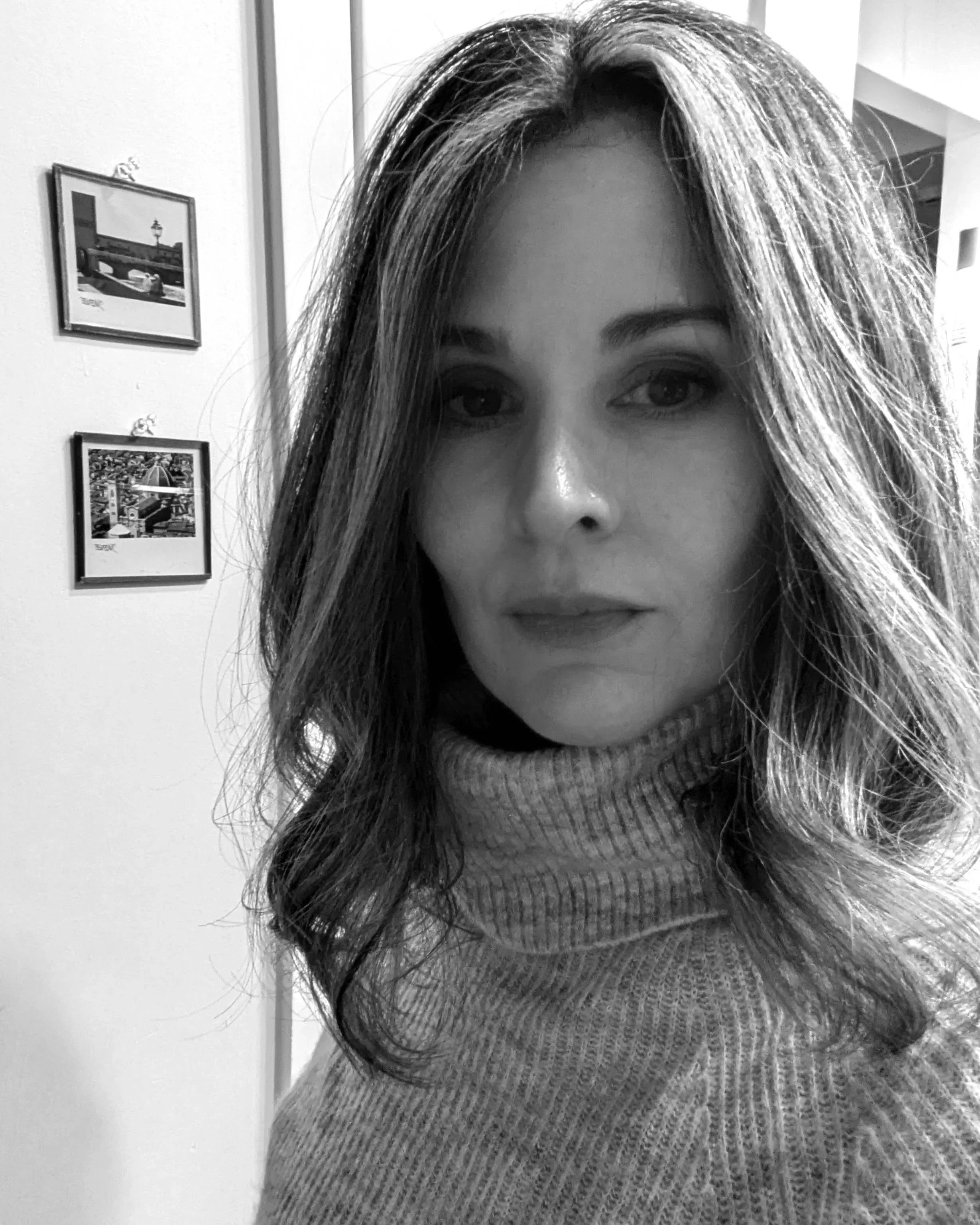
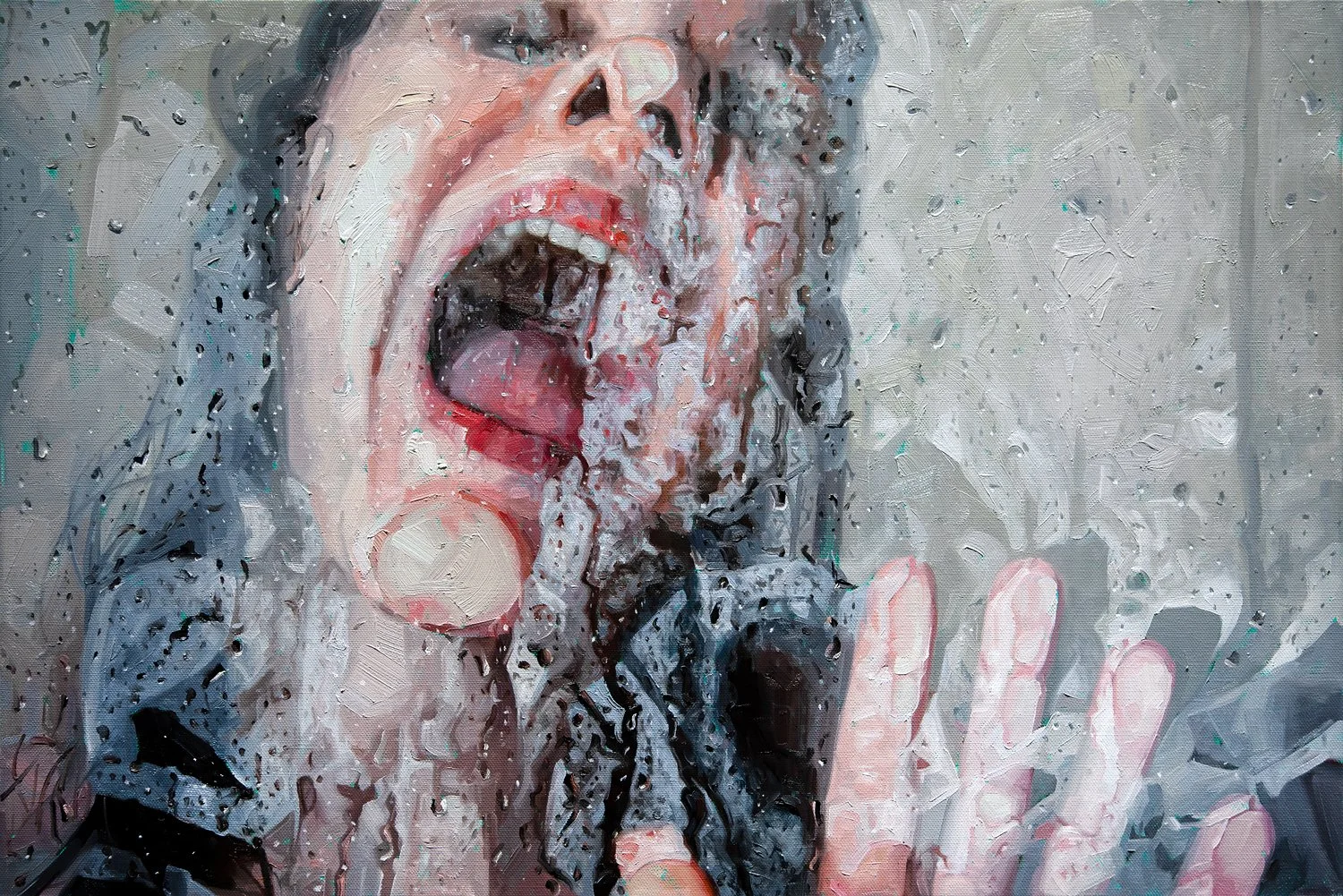
ALYSSA MONKS is a contemporary American painter whose work unsettles the boundary between realism and abstraction, surface and depth. Her paintings often unfold through veils of glass, water, steam, vinyl, or foliage, where foreground and background trade places and the act of seeing becomes provisional. These translucent filters don’t obscure the figure so much as test it, asking how intimacy survives mediation, and how presence emerges through distance.
Central to Monks’s practice is the material insistence of paint itself. Thick, deliberate brushstrokes accumulate like sediment, recording decisions, hesitations, and revisions. The surface becomes a kind of archive, tactile and unstable, where the human hand resists illusion even as the image flirts with it. This tension between control and vulnerability, precision and empathy, animates her figures and lends them their quiet psychological charge.
Monks’s work has been widely exhibited in the United States and internationally, including solo and group exhibitions at the National Academy Museum of Fine Arts in New York and the Kunst Museum in Ahlen, Germany. Her most recent solo exhibition, Where Longing Meets Limits, was presented at MM Fine Art Gallery in 2023. Her paintings are held in numerous public and private collections, and her work has appeared across disciplines, from museum exhibitions and academic publications to film and television. In 2015, she delivered a TED talk at Indiana University reflecting on perception, process, and vulnerability in painting.
Born in New Jersey in 1977, Monks began painting in oils as a child. She earned her BA from Boston College, studied in Florence at Lorenzo de’ Medici, and completed her MFA at the New York Academy of Art. Alongside her studio practice, she has lectured and taught extensively at universities and institutions worldwide, and continues to offer workshops and mentorships that foreground both technical rigor and emotional intelligence.
More of her work may be appreciated on her website.
In Conversation
Alyssa Monks talks about painting the way some people talk about weather. Not as decoration or depiction, but as a living system of pressures, energies, and small conditions that change everything. Pigment, medium, surface, light, climate, even the state of the painter's body. Nothing is stable, which is exactly why the work can become real.
Across these answers, her focus keeps returning to one hard-earned question: how does a painting stop being a made thing and start feeling like it exists on its own. She describes that shift as a change in agency. First the mind assembles and decides. Then, if she can reach the right kind of openness, the painting begins to lead. Not magically, not passively. It is a disciplined flow state where intention is still present, but not rigid. The result is a realism that isn't about detail for its own sake. It is about touch, surface, and the exactness of color. It is also about leaving the meaning unresolved enough that the viewer has to stay.
This is why the self-portraits here don't read as performance. She uses herself because she's available and unguarded, because she can begin now. The subject is not the biographical Alyssa Monks. It's a more general human register, where grief can remake perception, memory can be held at a distance, and the body can communicate without speaking. What follows is a conversation about how paintings think, how they look back, and what it costs to chase pleasure without letting it become a trap.
Q&A
1. Your paintings often hover between surface and depth, between the tactile and the translucent. How do you know when a figure has crossed that invisible line from representation into presence?
Thank you for appreciating that level of nuance, it is the very thing that excites me about making paintings. That moment when something ceases to be a representation of something and somehow seems to become the thing itself. The quotations marks are removed, and the painting almost breathes. I don't think every painting I've made has reached that point, but a few really have for me. It starts to happen when I go from feeling like I am trying to piece together the painting and making conscious decisions about what to do next, to feeling like the painting is pulling me through something, easily nudging me toward a next move that feels more like I'm watching it happen than doing it myself. I spend a lot of psychic energy trying to figure out how to get myself there faster for longer, and to take others with me who want to try it to. It comes down to really seeing something into being, focusing in a certain kind of open way that you can see both possibility and a clear path toward it. I think it's a blend of imagination and hope in a way, then add to it experience and knowledge of one's materials, and of course a lightness of expectation. Hope and expectation are not the same thing. If one needs it too much, the focus is narrow and not useful. But if there is a kind of optimism that this thing could breathe on its own one day, we just have to nudge it along – it can work.
2. In your process, where does accident end and intention begin? Do you ever feel that the paint itself "decides" something before you do?
I think paint has a kind of mind of its own and it's tendencies are too varied and vast and unpredictable with all the different variables of mediums, pigments, brands of paint even, brushes, knives, grounds, surfaces, lighting, climate, even the energy in your own body and hand – we can't really predict perfectly what it might do every time. But we can be curious and allow it and appreciate it and work with it instead of against it. I start with a certain clear intention, and as I go, I let the paint lead me more and more. As I said earlier, it's the ideal flow state when I'm at that point where it doesn't feel like I'm making the choices anymore, but that the painting is pulling me through.
3. Many of your self-portraits seem to register emotion at a distance, as if feeling and observation could happen at once. What role does memory play in the physical act of painting?
I don't physically paint while I'm in the apex of the emotion. I think it's too much limbic brain and I need to be more in my pre-frontal cortex to paint. I find it useful to address my emotional state prior to painting and process any feelings first. I don't do my best painting when I'm in a highly emotional state. I'm in a trance like state. I think what's fascinating about accessing this state is that you have full access to the memories of emotional moments and experiences, but you can see them objectively, from a distance, as though watching a film without connecting to them emotionally. I think that has been a profoundly helpful thing in my life.
4. You have spoken about painting as a way of confronting loss. Do you think grief has its own visual logic, a way of shaping composition, color, and form that differs from joy or serenity?
I think grieving colors everything when it is very deep. It steals one's very identity and often their point of view. For someone in deep grief, there is a sense of losing big parts of yourself that leave you somewhat disconnected from the reality everyone seems to be in. You may recreate a similar identity and a similar point of view – but often, and for me, it's been a very different one. So, it just makes sense that this new perspective would be identify with its own color, texture, composition, or light quality. I'm not sure it's as simple as grief is one look and joy is another look. I think it's the whole point of view which is complex and inclusive of all emotions and psychological states, and as we travel through our experiences, we see and arrange all these states in different ways. One thing I know about grief is that it is different every day and does what it needs to do until it's done with you.
5. If the body in your paintings could speak, what language would it use: silence, gesture, breath, or something else entirely?
You know that feeling you get when you know someone is looking at you? I think that's the language it uses. I'm not sure that's a language, but it's a way of communicating – a kind of presence that wants you to connect to it but only on its terms.
6. Contemporary self-portraiture often flirts with performance and identity politics. Yours seems more concerned with permeability and dissolution. Do you think of the self as something to reveal, or something to lose?
I think that in revealing the most vulnerable self we learn there is no self at all because we are all feeling the same thing down at the core, so both, I guess? I'm not really turned on by identity politics and get claustrophobic with seeing things in very didactic or binary ways. The more I learn the more questions I have and realize how little I understand. I tend to want to always be gathering information and never feel quite satisfied or content if I pick a side completely without questioning it. I am often suspicious of black and white thinking. As for my paintings and self-portraiture, I use myself because I am there and I am ready and I want to make something now and I know how to do it and don't care how I look. I love to work with others I am deeply connected to as well, but that's a different way of working and we're talking about the self-portraits. I don't think of myself so much as the subject but more as the vessel to put the subject in, I guess. And even then, I am doing it very intuitively rather than forcing it. I like to discover it as I go. I don't think of the same me that I see in a photograph or who has a family and friends or who lives in NY. It's just a me that is all of us that I am deeply connected to. The idea of self has been debated forever, and I love the idea of the dissolution of the self or ego to more deeply connect to our lives and each other. I also love the idea of employing the ego to make art and other things in the world but ignoring its need for ownership of it all.
7. Your work has been described as hyperrealist, yet the realism feels almost metaphysical. The closer we get, the less certain things become. How do you reconcile precision with ambiguity?
I don't love the term hyperrealist for my work. What I think it means is like a photorealism but even sharper and with more detail. Every pore, hair follicle, and cuticle are addressed and the paint is denied and smoothed out - the kind of work made using triple zero brushes and magnifying glasses. My work isn't that. Perhaps when viewed on a phone and the image of the work is compressed to a fraction of its size it may appear to have a great amount of detail, but if you zoom in or see the painting in real space, it's all brush stroke and surface. I love paint, not detail. I love how paint can ride that moment when it is just becoming something else. I love how it records the human touch like a fossil, remembering the humanness of the hand that made it forever. I don't think about precision when it comes to the detail. I think about it when it comes to color, however. I think, when I am working, there is only one specific hue and value and color that is right for this particular moment in the painting. And I have to hunt for it. But the expression, the intention, the identity, the meaning, the destination are all ambiguous. I have used filters to obfuscate my subjects with the intention of making them harder to reconcile, to nail down. I want to draw you in and make you stay until you find what is there. That time it takes to do that is attention, and attention is a form of investment. When it's all not laid out on the surface, there is a reason to look more deeply. This has also given me a language in painting as it is a way of seeing. I like that it comes in and out of clarity. I think that's how most things are. Life is not a series of easy to understand, totally clear, unambiguous experiences. Things are just varying degrees of clarity and uncertainty. If we think we really see or understand something or someone completely, we are very wrong. There's always more to discover.
8. When viewers project their own stories onto your painted faces, do you see that as distortion or collaboration?
I see that as art. It is what is supposed to happen. Art, music, film, poetry, all of it – is something we get to connect to with our own minds and histories without the burden of the artist's history and experiences – if we want to. We all have songs that just know us, are about a certain moment or person for us, and have nothing to do with who made them. This is what is fascinating about art. It's a perfect container of connection without the burden of responsibility to the one who made it. Project away. I wouldn't call it collaboration or distortion. I just call it art doing what it can do.
9. Painters once worked within the long shadow of mirrors. Now we live under the blue light of screens. Has digital image culture altered your sense of what a self-portrait can be?
I think more than just the nature of digital photography vs working from life or mirror is the digital photo's pervasiveness and how unremarkable it has become. Working from photography can be a great help in painting, if one isn't placing too much trust in it and has ample experience with working from life and imagination to know how to avoid the pitfalls of working from photographs. But I remember how a photograph used to be special in its own right. I remember developing film in a darkroom and exposing my own photos for hours to get it just how I want it. I remember when digital photography was new and the resolution was so poor it was almost useless, and still difficult to manipulate, store and afford. And now it is just so never ending and limitless, disposable, un-special. I still take my time making my photos just the way I want them, though, and it takes a long time. Ultimately though I think the better the tools, the more options you have as an artist and that is good. It matters what you do with the tools. I do not believe in any purity or virtue of not working from photography. It can all be interesting if done well and uniquely.
10. If painting is a conversation between the seen and the felt, what remains unsaid in your most recent works?
I may be still too close to this work to answer this yet, but I will try. Just leave lots of room for in 5 years when I can actually see it with some objectivity. I know it has a lot to do with pleasure and indulgence and the precarious relationships we can have with pleasure. For me there was never pleasure without some heavy cost. It was built in. And lately I have been coming to understand the way dopamine works in our brains to motivate us towards more of the thing that gave us the pleasure. And how we drop to a lower level than when we started after we get a dopamine hit, and this is addiction. Pleasure is a slippery slope. I suppose what remains unsaid is the cost of the pleasure.
By the end of this exchange, Monks has quietly moved the discussion away from categories and toward conditions. Not "what is the self-portrait now", but what has to be true in the studio for something honest to happen. A certain kind of attention. A lightness of expectation. A willingness to let paint behave like paint. A refusal of tidy, didactic certainty.
Her realism is not the realism of counting pores. It is the realism of presence, built from brushstroke and surface, from color hunted until it is right, from ambiguity protected on purpose. She wants the image to come in and out of clarity because that is how living works. We never fully understand a person, not even ourselves. Assuming we do is the real distortion.
Two claims sharpen the frame. First, projection is not a problem to correct. It is the point. The viewer's story is not an intrusion but the mechanism of connection. Second, what she is circling in the newest work is not simply pleasure, but the shadow pleasure throws. The brain's hunger for more, the drop after the hit, the price built into the sweetness. She can't name all of it yet, and she's honest about that.
That honesty matters. It tells us what kind of artist this is. Not one who arrives and declares. One who stays in the work long enough for it to begin moving on its own. Then she follows, alert, skeptical of easy answers, and stubbornly devoted to the strange fact that paint can hold a human touch like a fossil and still feel alive.
Editor
Please click on the link below to access the work of the artist and the introduction
Artists & Writers in This Issue
In alphabetical order by the first name
