What the Image Keeps
On the paintings of Jueon Im
Jorge R. G. Sagastume, Editor
During several months and until recently, Jueon Im and I have maintained a steady exchange of weekly correspondence. We began discussing her paintings, then moved into questions about sensation, memory, language, philosophy, and the strange order by which an artist comes to understand what one’s own work has been doing. Our writing crossed two languages and a considerable distance. Some thoughts arrived through machine translation; others as images that resist translation altogether. Jueon once described the beginning of a thought as a tingling or prickling sensation, something felt before it becomes clearly visual and long before it can be put into words. I've learned to read her paintings from that point of departure: the image begins before its meaning is settled.
This essay grows from those letters, though it can't claim to explain the person who wrote them. What the exchange has given me is a more exact way of looking. Jueon's paintings attend to what remains after contact: the pressure a body leaves in a garment, the sheen of light after it crosses leather, the first brushstroke still breathing beneath the finished surface. Her images often withhold a face or a complete figure. In its place, a glove, a jacket, a shoe, or a fold carries the weight of the body that touched it. The object remembers through its shape.
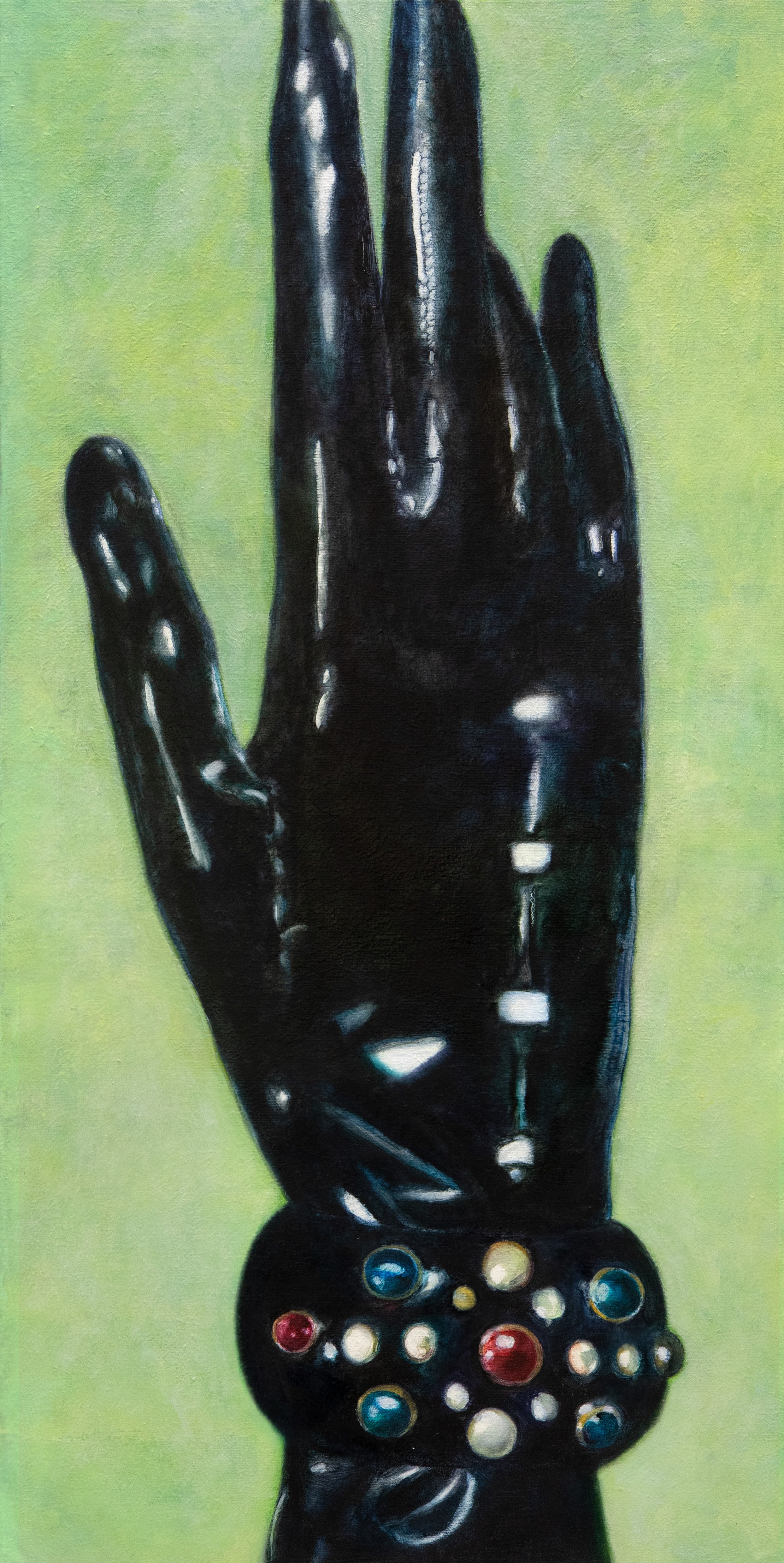
In A Glove, a black hand rises vertically against a pale green field. Its fingers extend beyond the upper edge, which makes the gesture feel larger than the canvas can contain. The glove is glossy and severe. White reflections travel along its surface, while colored stones gather around the wrist like a small constellation. No arm or face tells us who wears it. The hand has been separated from ordinary action and given the stillness of an emblem. Yet it remains physical. The dark material creases at the palm, catches light along the knuckles, and tightens where the wrist bends. The absent hand is present as pressure inside the glove.
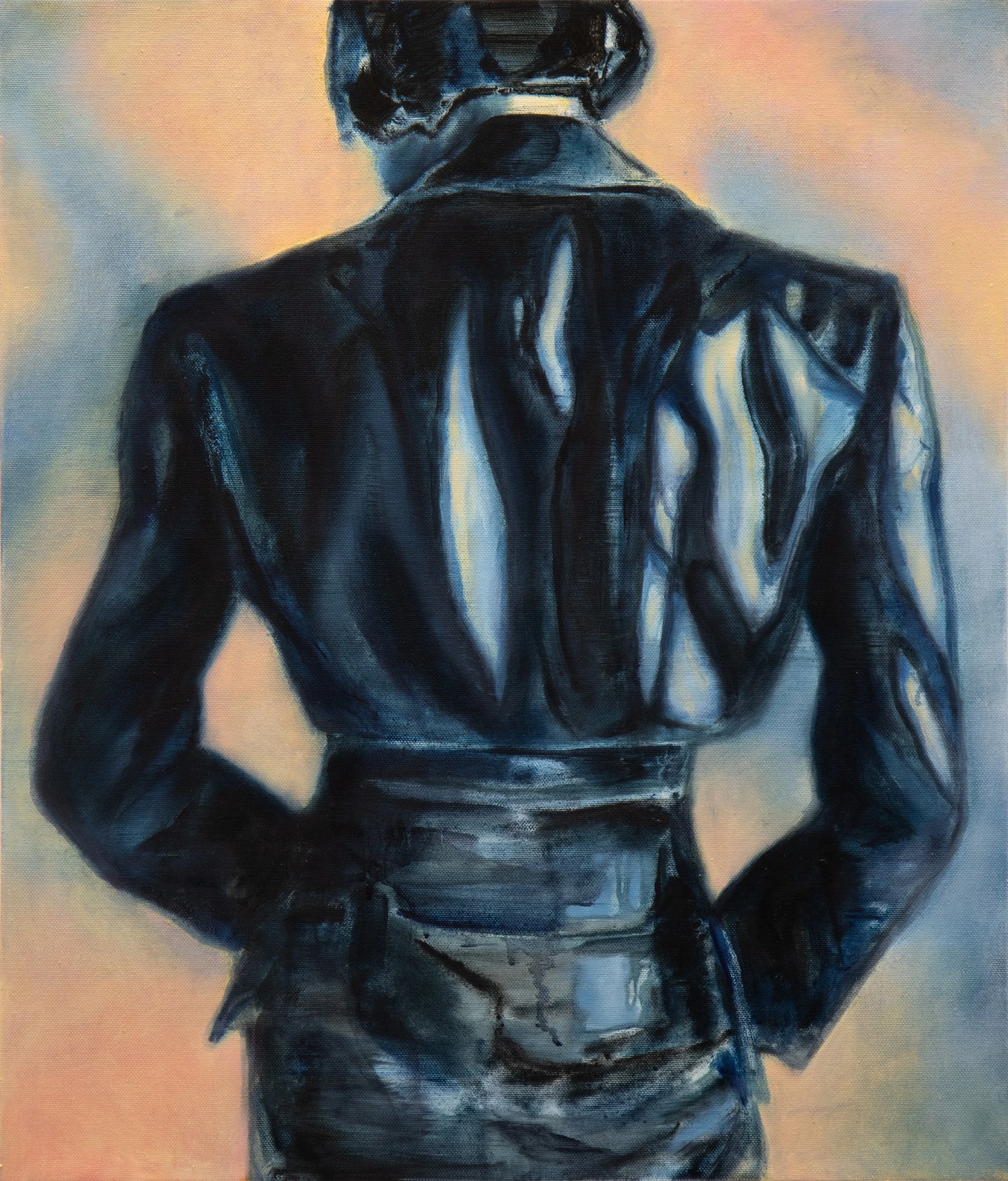
That distinction is important throughout this group of paintings. Jueon doesn't treat clothing as decoration added to a finished body. Cloth and leather are the places where a body becomes legible. They record how it stands, turns, submits to a seam, or pushes against a fitted form. In Back, a figure faces away from us. The black jacket reflects streaks of blue and white, and those reflections break its surface into shifting planes. We can't see the wearer's expression, yet the squared shoulders, bent elbows, and hands placed at the waist establish a character. Identity has migrated from the face into posture.
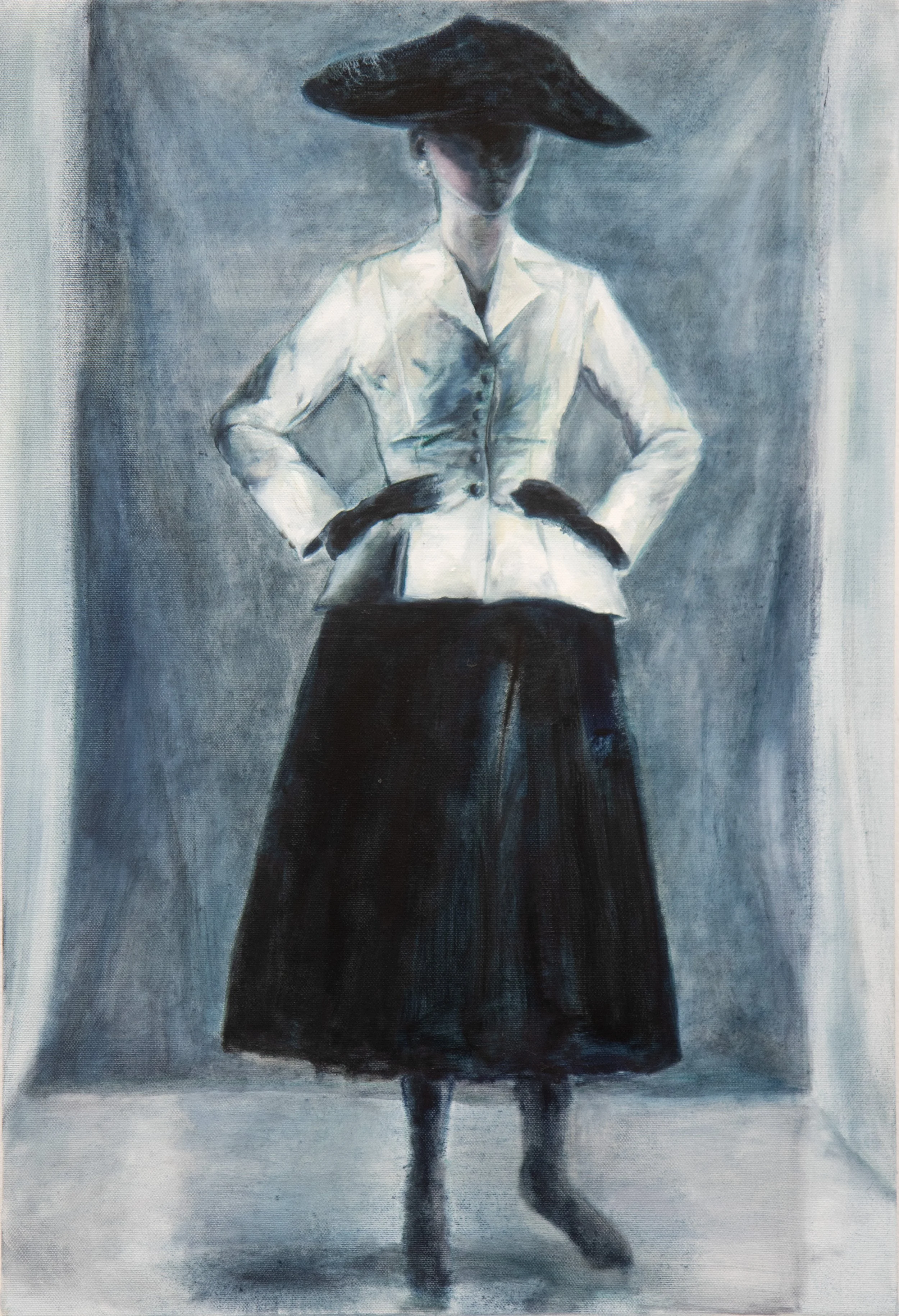
Bar Suit 1947 offers another full figure and another withheld face, its title borrowed from Dior's own. A wide black hat casts the head into near darkness. Beneath it, the fitted white jacket narrows at the waist before opening over a long black skirt. The pose is formal, almost confrontational, but one foot turns inward and unsettles the symmetry. That small deviation is enough. Jueon has written of the “single hair’s breadth of disarray” found inside a tidy order. Here the disturbance appears at the bottom of a carefully composed silhouette. The figure holds the pose while the foot quietly refuses it.
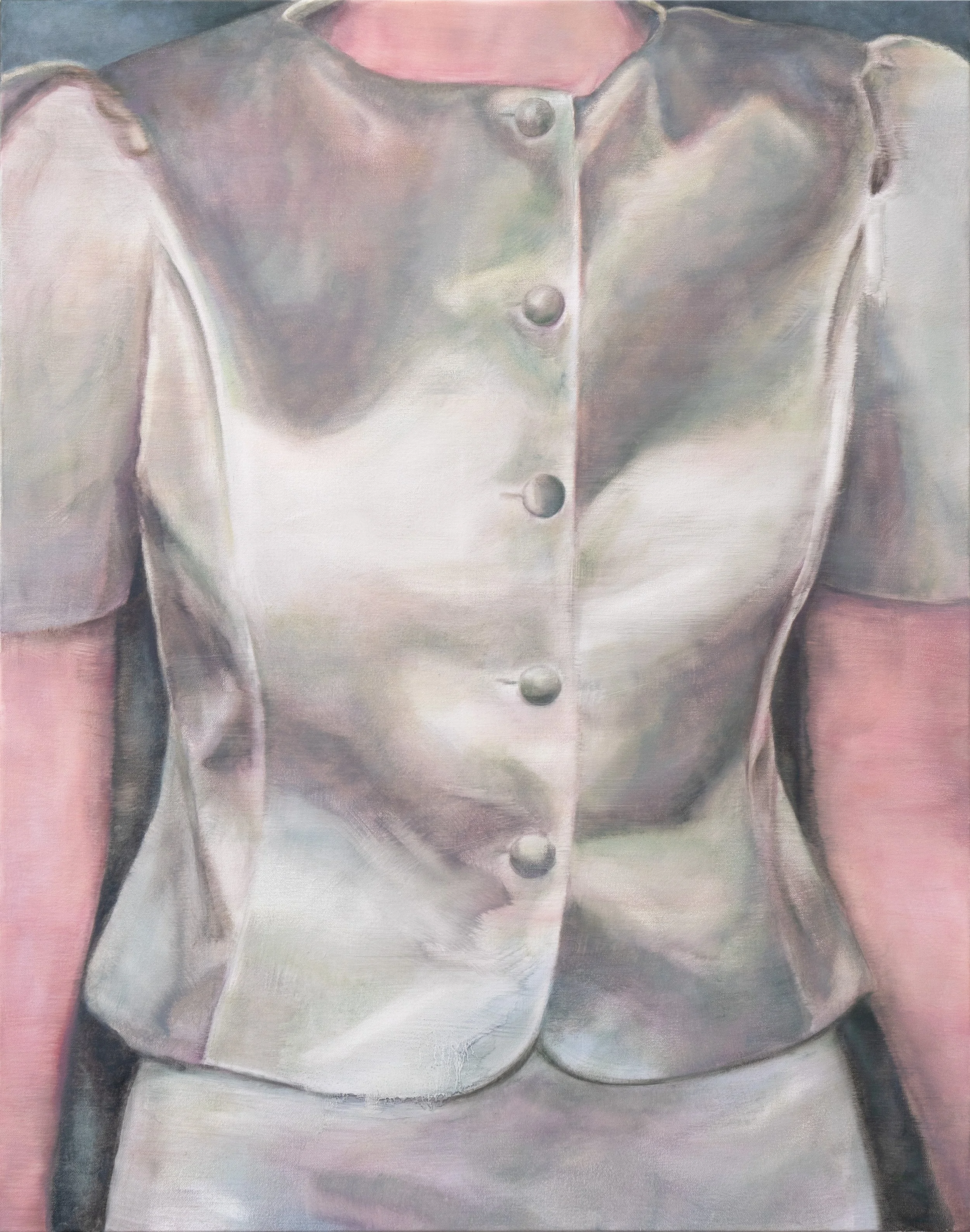
The same pressure runs through Uniform Suit. The painting cuts the figure at the neck and thighs, concentrating attention on the pale jacket, its rounded buttons, and the areas where fabric stretches or sinks. The exposed arms are an improbable pink. They flank a torso whose colors move through gray, green, violet, and cream. Skin appears flatter than cloth in places, while the garment seems to swell with bodily life. Jueon keeps exchanging the properties of one surface for those of another. Paint becomes fabric; fabric becomes flesh; flesh is held at the edge of becoming paint again.
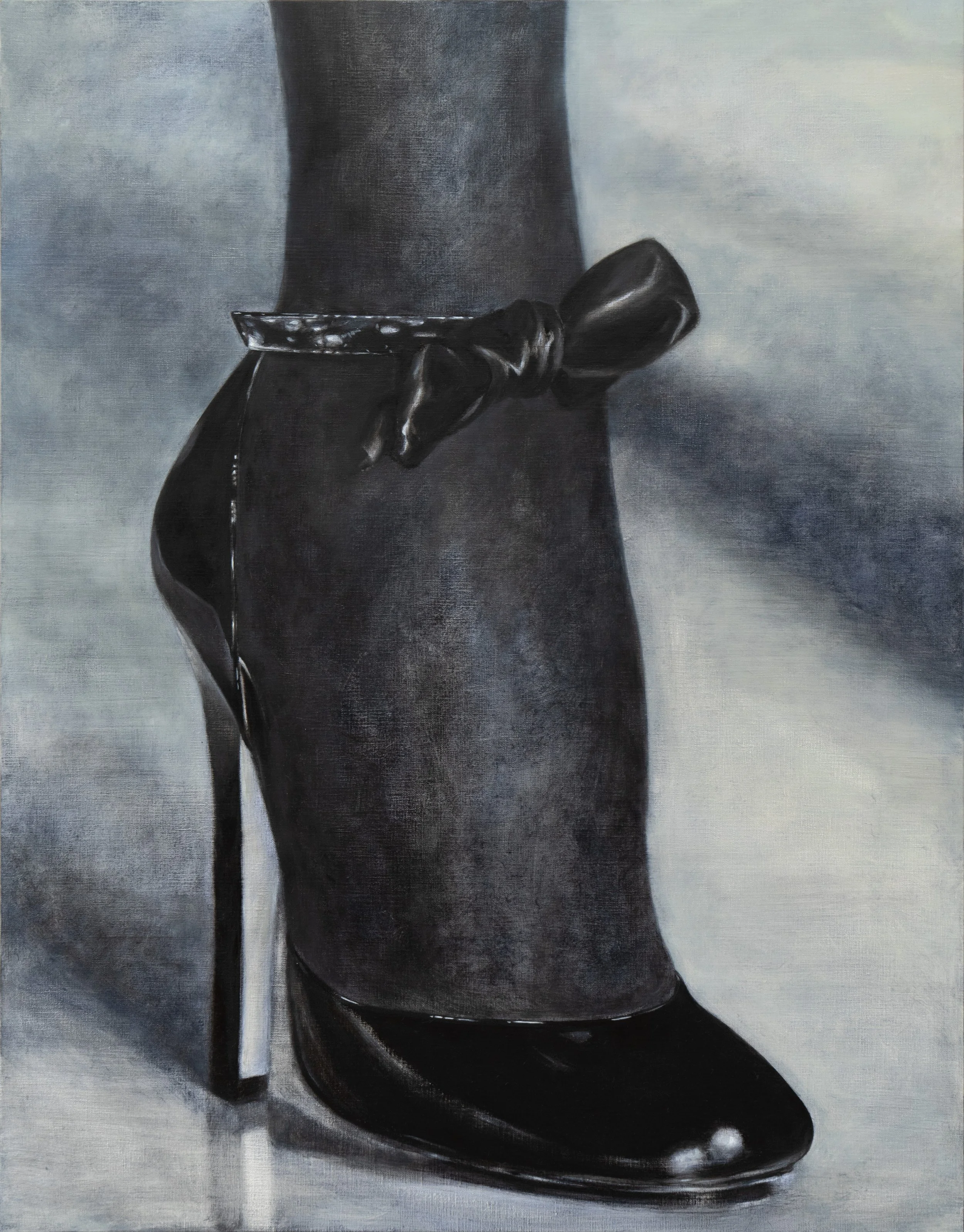
Jueon’s portrayal of shoes intensify this exchange because footwear contains the body while directing its movement. Black Ribbon Heel is presented at a scale that exceeds use. The stiletto rises like a narrow support beneath a dark column of stocking. A bow sits at the ankle, polished enough to share the shoe’s hard gleam. Enlarged and isolated, the heel becomes architectural, but the foot within it remains vulnerable. The elegance of the object depends on constraint: the body enters, bends, balances, and accepts the shape prepared for it.
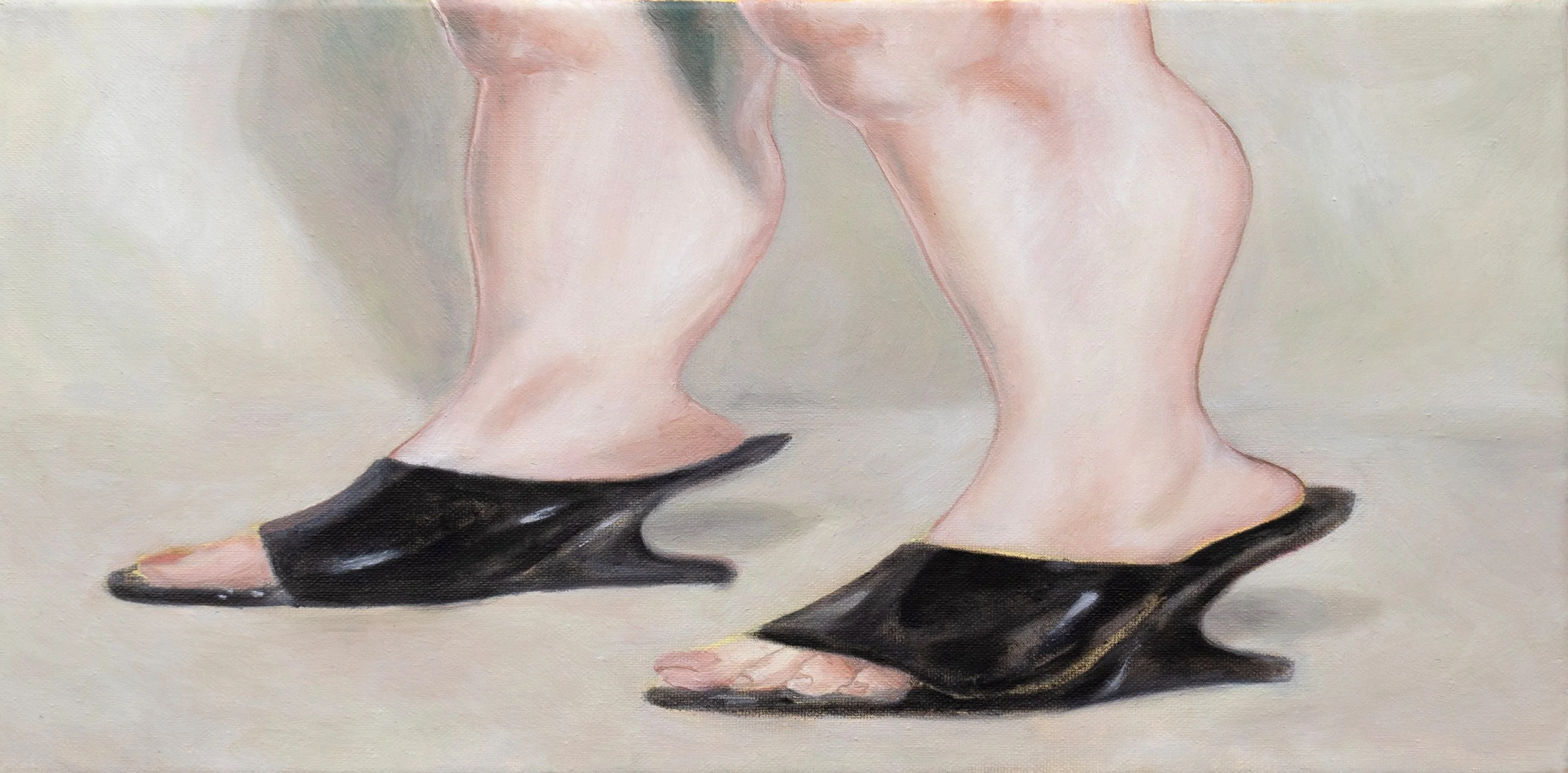
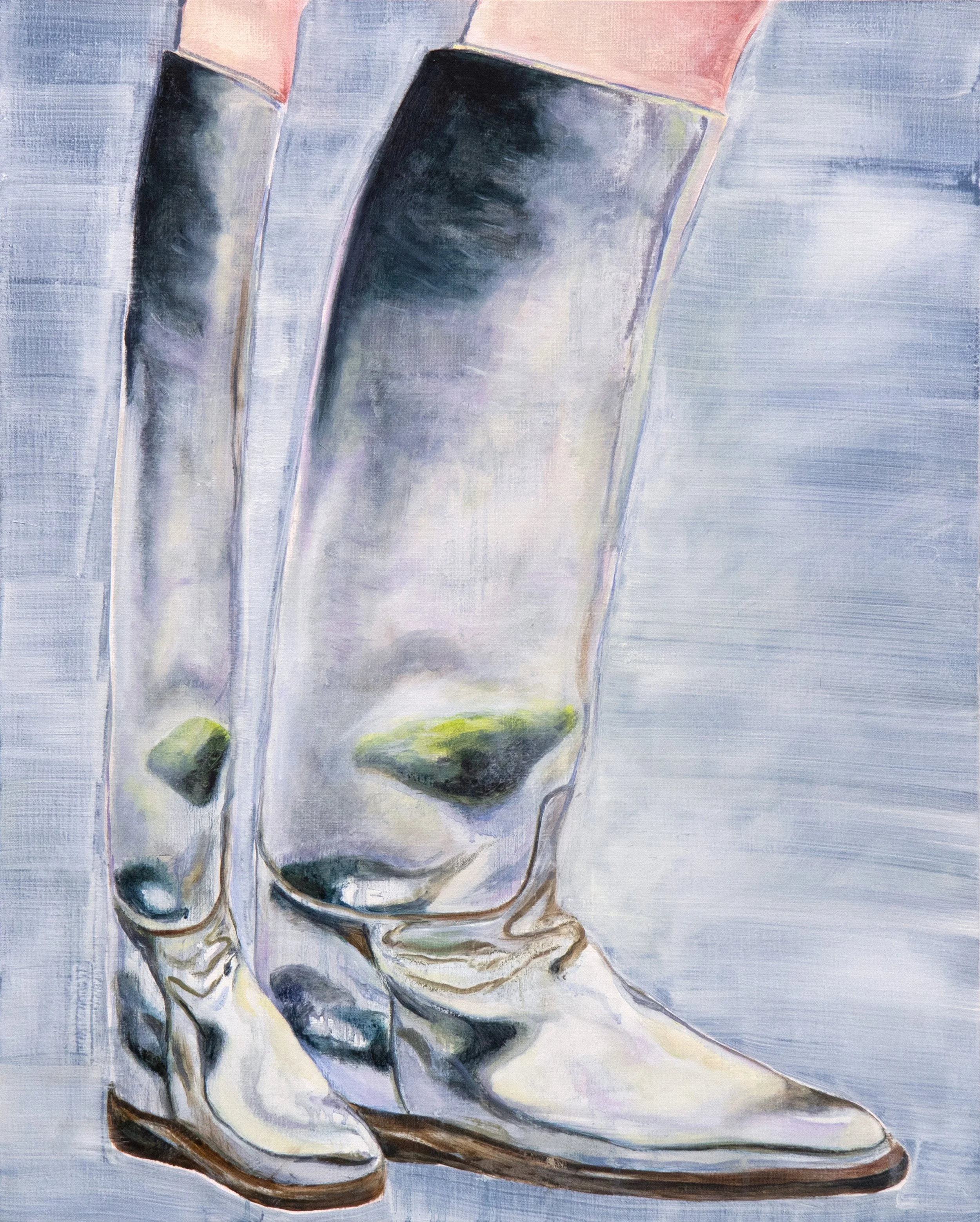
In Legs, two black open-backed shoes appear in profile against a pale ground, but the feet have already begun to leave them. Both heels’ backs are exposed, and the body moves forward while each shoe seems to lag behind. One foot advances, the other pauses, and the cropped legs preserve a moment when contact is being broken without showing where the person is going. Silver Boots gives a different sensation. Two tall and almost translucent boots stand close together, their whitened shafts marked by cloudy shadows and touches of acid green. The boots seem to retain pale impressions of legs even as the bodies dissolve into their surfaces. What should protect or conceal has become porous.
Jueon’s images depend on this threshold. She was trained, as many Korean art students are, through sustained exercises in still-life and plaster-cast drawing. She insists that the training was necessary. Drawing without that skill, she told me, and drawing loosely once the skill is there, “plainly give different impressions.” Her blur is a decision made from knowledge. She renders enough to establish the authority of the object, then loosens that authority before description closes around it.
The word she uses for an image that has become too complete is “stifling.” A uniformly smooth surface leaves no breathing hole between brushstrokes. It suppresses accident, roughness, and the force of the first mark. When a painting reaches that condition, Jueon may remove the canvas from its frame and begin again. She distinguishes a “drawn painting” from one manufactured through repeated correction. The distinction names a discipline. Her oils are often thin and quickly placed, closer in her mind to drawing than to slow accumulation. The finished painting must retain the risk of its beginning.
This helps explain why the surfaces feel suspended between resolution and erasure. Jueon doesn’t blur an image until it disappears. She leaves enough information for the source to persist as a problem. The folds of the jacket in Back can be read as material, reflection, or muscular structure. The white passages in Silver Boots describe volume, though they also bleach the object into its ground. The paint in Uniform Suit gathers the body and garment into the same unstable weather. Each work brings recognition near, then lets it loosen.
Her account of sensation gives this method a sharper purpose. She writes that force vanishes at the moment it’s felt. What reaches the skin is already something new, a sensation produced as the initiating force recedes. A needle passing through paper, clay, or water creates three distinct experiences, even when the action can be named by the same verb. Painting can’t retrieve the force in its original state. It gives form to what the body receives after the event has changed.
Read through that idea, the garments and shoes become more than subjects. They’re contact surfaces. Each has been shaped by forces that can no longer be seen directly: weight, tension, friction, gravity, the discipline of a pose. Jueon paints the result while keeping the cause slightly out of reach. The body is often cropped or turned away because a complete body might explain too much. Its absence lets pressure become visible.
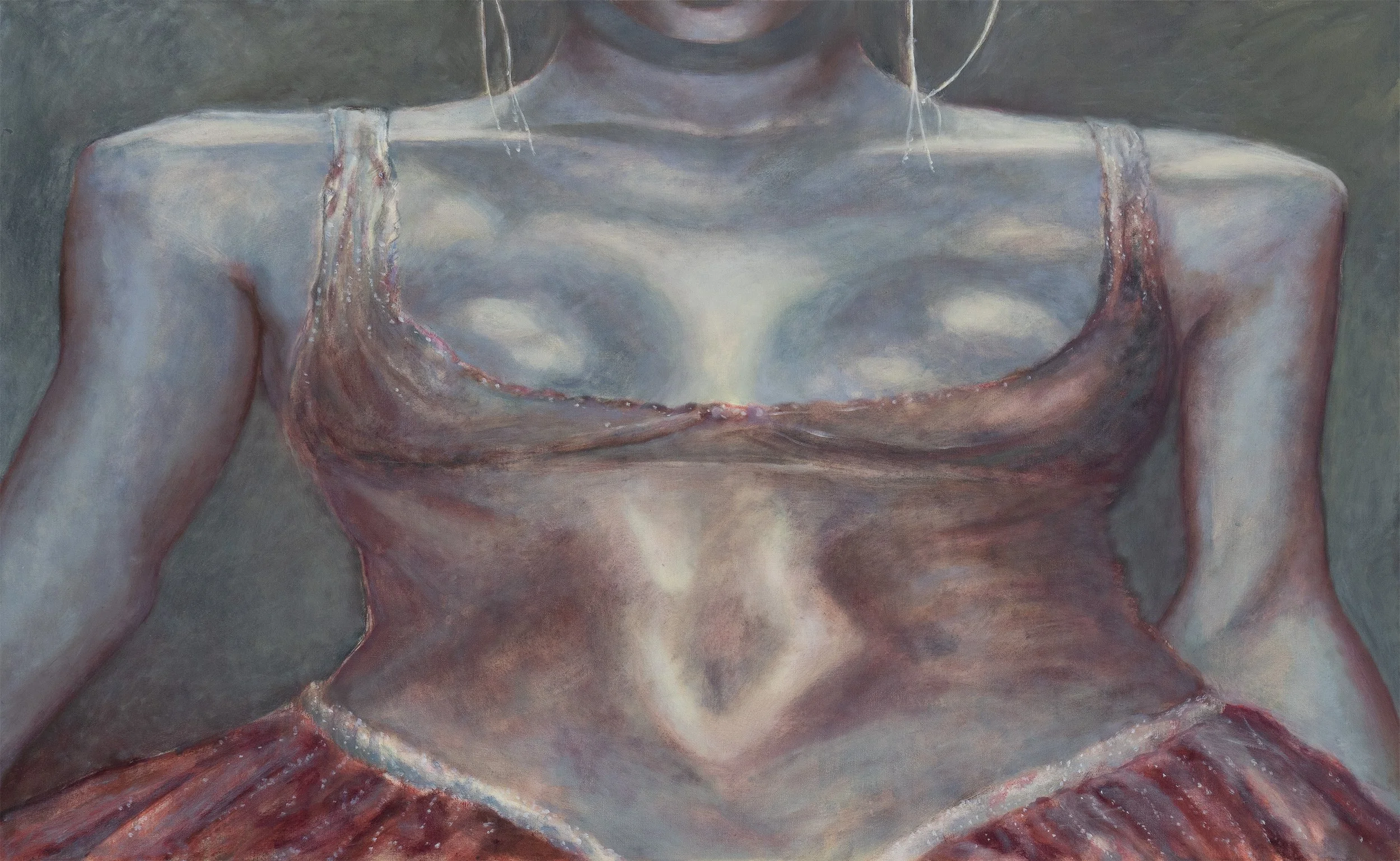
Highlights makes this visible with unusual intimacy. The canvas presents the upper torso of a woman in a reddish dress. Her head is mostly removed, and her arms continue beyond the lower frame. Pale light lies across the clavicles and chest. The dress presses upward; the body presses back. Along the straps and neckline, small points of paint resemble beads, reflected light, or droplets. The division between skin and cloth remains clear enough to orient us, yet color passes across it. Violet enters the flesh. Red enters the shadow. A pale central glow joins the body to the garment without erasing the seam between them.
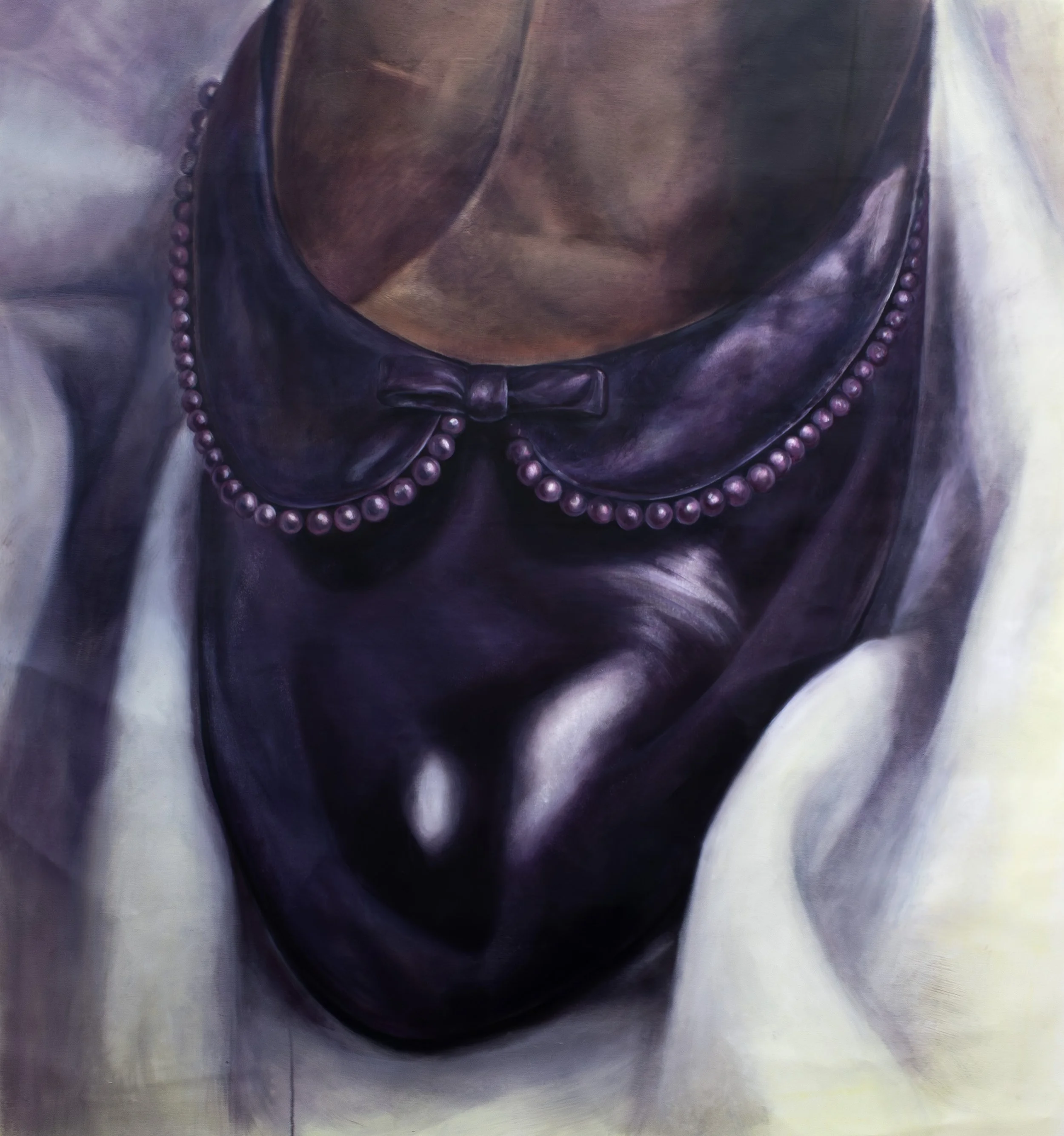
Purple Toe makes naming itself hesitate. At first glance, the image can be read as a dark bodice or blouse, with a bow and pearl trim following the curve of a collar. The title presses another reading upon it: a purple shoe seen at such close range that its opening, ornament, and surrounding fabric lose their familiar proportions. The brown form above may be a foot entering the shoe, yet it can also register as exposed skin at a neckline. Bow and pearls belong easily to either object. Jueon leaves both readings active, and the eye moves between them without settling. What appears clear changes as soon as it’s named.
The fold is the material form of that relation. For Jueon, a fold never settles on one side of a boundary; it holds both at once, always mid-motion between them. Deleuze gave this same figure a name: the fold as the operation that lets inside and outside pass into one another without a stable line drawn between them, an idea he developed from his own reading of the Leibniz already at work in Jueon’s panorama. The paintings give the thought its necessary resistance. A painted fold has a specific weight, color, speed, and direction. It belongs to a sleeve, a skirt, the palm of a glove, or the shadow under a shoe. Theory clarifies the operation for a moment, then the object takes over again.
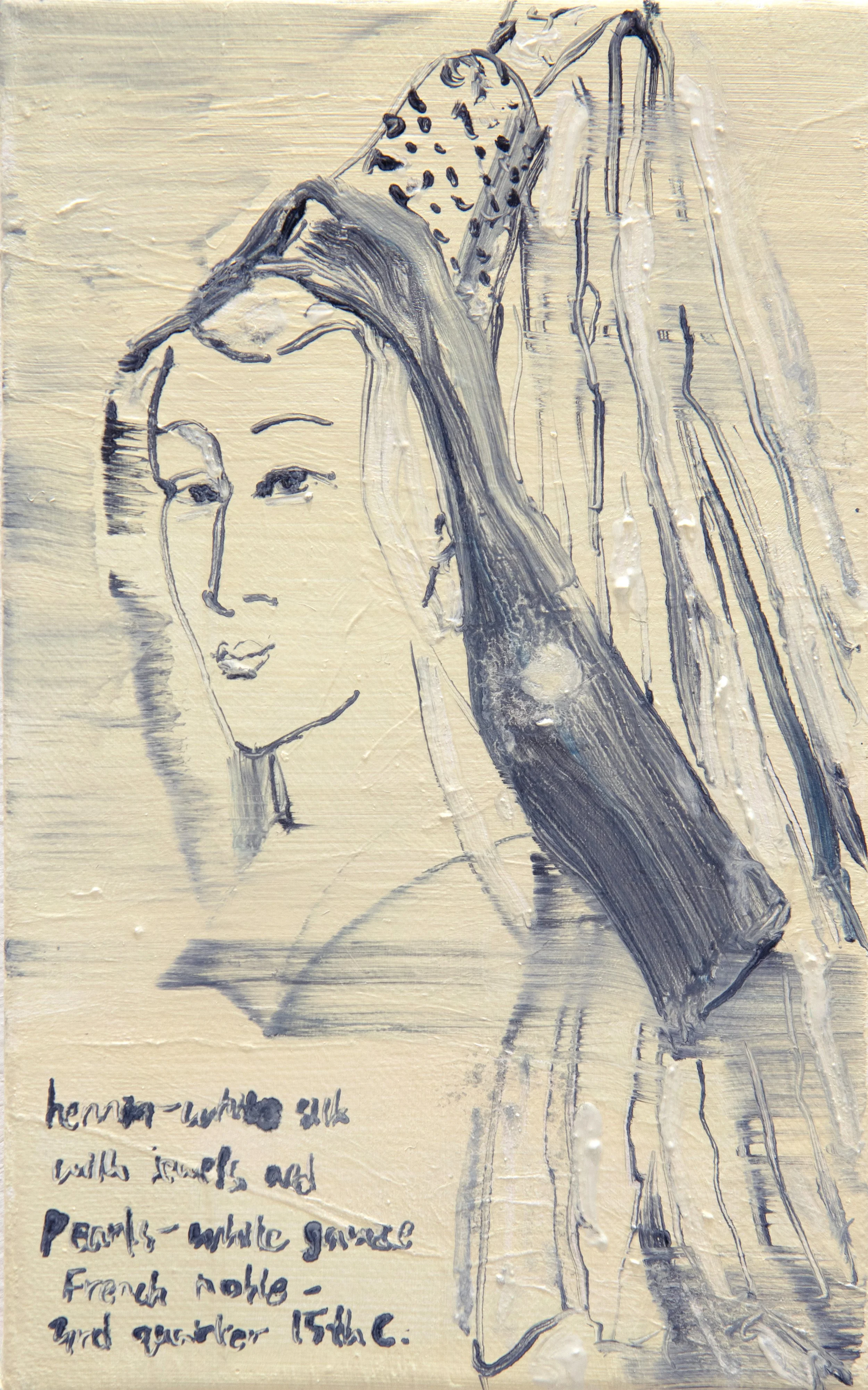
That return to the object is essential in Hennin. The work resembles a study page: a woman’s face, a long veil, the pointed headdress, handwritten notes, and areas where the pale ground remains active. The image carries its historical source openly. The marks at the bottom identify the hennin, pearls, and fifteenth-century French nobility, though the writing remains partly difficult to read. Unlike the monumental glove or enlarged shoe, this painting preserves the provisional condition of research. It shows an image in the process of being found, named, copied, and altered by the hand.
Critique enters these paintings through attention. By critique I don’t mean denunciation, but the act of making the familiar strange enough to be seen. A glove, a uniform, a Dior silhouette, a hennin, a pair of heels: each belongs to a history of forms that has taught bodies how to appear. Clothing presents itself as surface, yet it also organizes posture, gender, class, labor, ceremony, and desire. Jueon isolates these forms from the stories that made them seem natural. Enlarged, cropped, blurred, or emptied of a face, they begin to disclose the quiet authority they exercise over the body.
Jueon Im’s paintings ask who we are before they offer an answer. The absent figure survives as pressure, stance, compliance, and resistance within the thing worn. We recognize a person through a sleeve, the set of shoulders, or a foot withdrawing from a shoe. This recognition unsettles the comforting idea that identity begins in a private interior and later chooses its outward signs. Jueon shows a self formed in contact with images and objects that precede it. We enter the wardrobe of history and discover that its garments have already imagined us.
Her use of images gathered from digital environments brings that critique into the present. Their origins may be uncertain even when their contents feel familiar. The algorithm does more than deliver fashion, cinema, historical costume, and anonymous fragments of bodies in a continuous stream; it arranges habits of looking before we know we have them. Jueon has called this stream a long panorama. Painting interrupts its speed. A screenshot that could have vanished in the next movement of a thumb becomes slow, material, and available to repeated attention.
The source image is still a kind of MacGuffin, to use her own term. It draws the eye and starts the work, while the deeper event occurs in the handling of paint. The object drifts from whatever story once contained it. We may recognize a historical headdress or a formal suit, but the painting doesn’t return the image to a secure origin. It gives the image another duration. In that duration, a prop may disclose a character more fully than a face does. Jueon’s response to a television series is telling: the scene she remembered was a small one in which a son opens the container holding his father’s ashes and discovers that water has turned them into mud. She’s attentive to objects whose physical alteration quietly contains the larger story.
The eleven works gathered in this feature of The Pasticheur behave in this way. Each looks complete enough to stand alone, though recurring forms begin to connect them: covered hands, cropped torsos, formal clothing, black shoes, reflective surfaces, bows, veils, and closed containers. The painter doesn’t plan the panorama in advance. She paints the fragment first. Only later, looking across finished works, does she discover that each came from a continuous field of thought. She compares the process to removing one book at a time from an immense bookshelf, connected behind itself like the four-dimensional library in Interstellar.
Borges gives us a related figure in the Aleph, the point that contains all other points. Leibniz’s monad offers another, a singular perspective that expresses the universe from its own position. Jueon Im’s panorama makes a quieter claim. Its whole remains unfinished. Every new painting changes what the previous paintings appear to have belonged to. The fragment precedes the panorama in time, then discovers the panorama backward. The field grows because each completed image leaves an empty place beside it.
This is also why I’ve come to understand her relation to philosophy differently over the course of our exchange. At first she told me that painting without philosophy couldn’t fully function as painting. Later she described philosophy and painting as parallel lines, with the eye leading and thought seeking the reason for what the eye desired. More recently she allowed that a painting may reveal a philosophy unlike anything a philosopher has defined, one that rises from the long panorama of a life and may never become fully speakable. I don’t hear three incompatible positions. I hear one conviction becoming more exact.
Wittgenstein entered our correspondence because Jueon thinks through images before words. His distinction between what can be said and what shows itself offers a useful approach, provided it doesn’t turn the paintings into examples of a doctrine. Jueon’s own formulation is better: “Rather than naming something, I think my work is to give it another form”. Naming fixes a relation long enough for language to use it. Her painting lets the relation move instead: what starts as sensation settles as color, and what starts as pressure settles as contour.
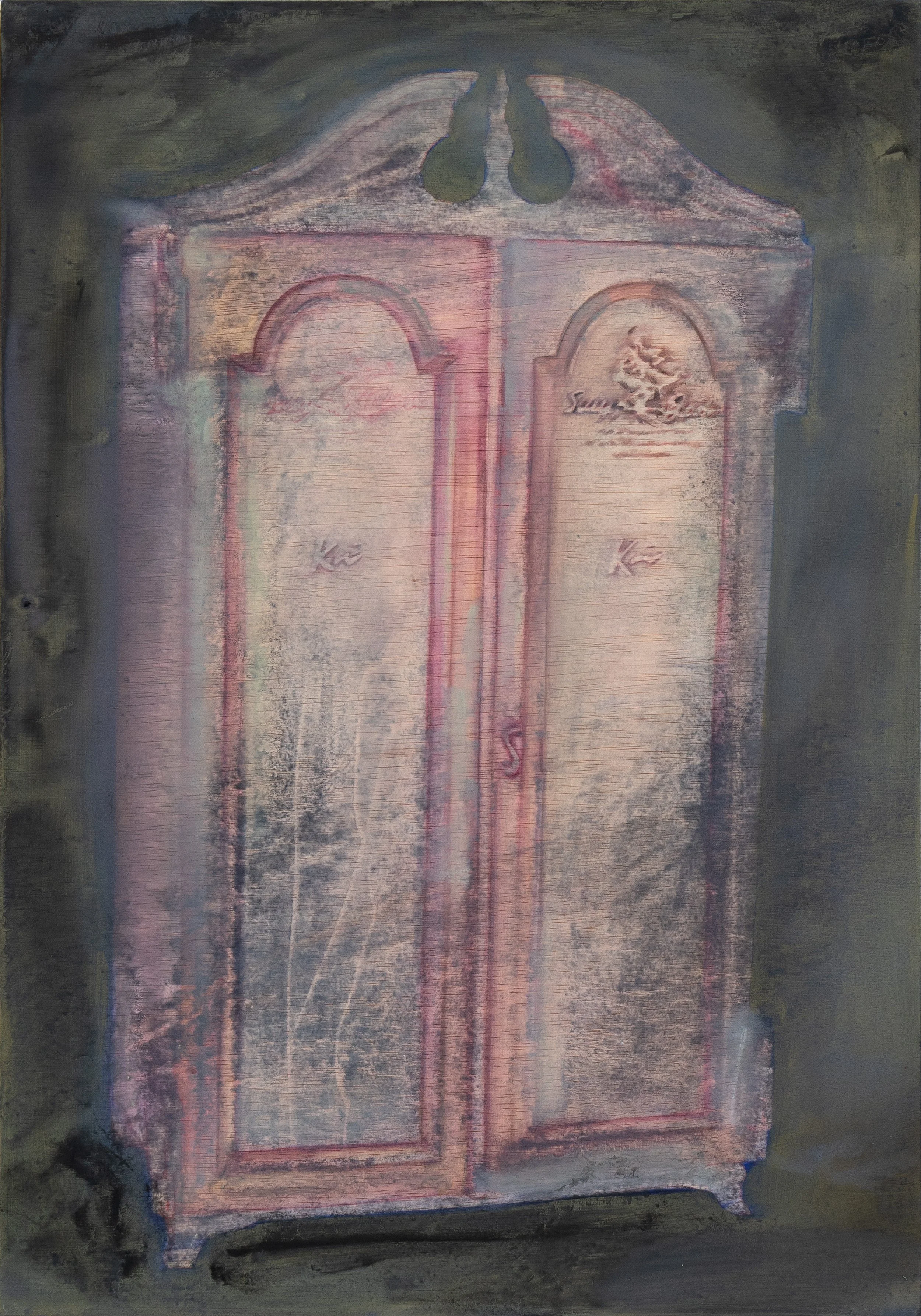
The final painting in this constellation, 사자와 마녀와 옷장 (The Lion, the Witch and the Wardrobe), presents a wardrobe frontally against a dark ground. Its two doors are closed. Pink, gray, and green drift across the cabinet’s surface, wearing down the solidity of the wood. Faint lettering and ornament remain visible, as though they’d been recalled rather than copied. After so many garments shaped by unseen bodies, we arrive at the place where garments themselves would be kept, and it refuses to open. The title names the door children once found at the back of a wardrobe, the one that led somewhere else entirely; here the door stays shut, and the somewhere else stays only a possibility.
The closed doors don’t conceal a solution. They establish a limit that the painting can hold without forcing. Behind them may be another world, or only darkness. The surface gives us enough: the worn symmetry, the central seam, the suggestion of handles, the slow color moving across the panels. Jueon has said that she’s almost always living inside questions. Her paintings preserve that condition with unusual confidence. They let the eye enter through a recognizable thing, then leave it before a field that continues beyond what can be seen.
© 2026, Text by Jorge R. G. Sagastume
© 2026, Paintings by Jueon Im
