A Body in Relation
On the Paintings of Hayeon U
Jorge R. G. Sagastume, Editor
I look at these paintings as a reader; I’ve spent much of my life reading literature, and I approach painting with a similar attention to the relationships among its elements. I begin with what I see, consider how the parts of an image affect one another, and occasionally turn to philosophy when a concept helps me understand what the text or painting is doing. My correspondence with Hayeon for the past several months has become part of this process as well. Through our exchanges, I have reconsidered some of my assumptions about painting and, unexpectedly, about my own work as a poet, fiction writer, and literary critic. Reading another person’s work closely can change the reader, especially when the exchange continues long enough for each question to produce another.
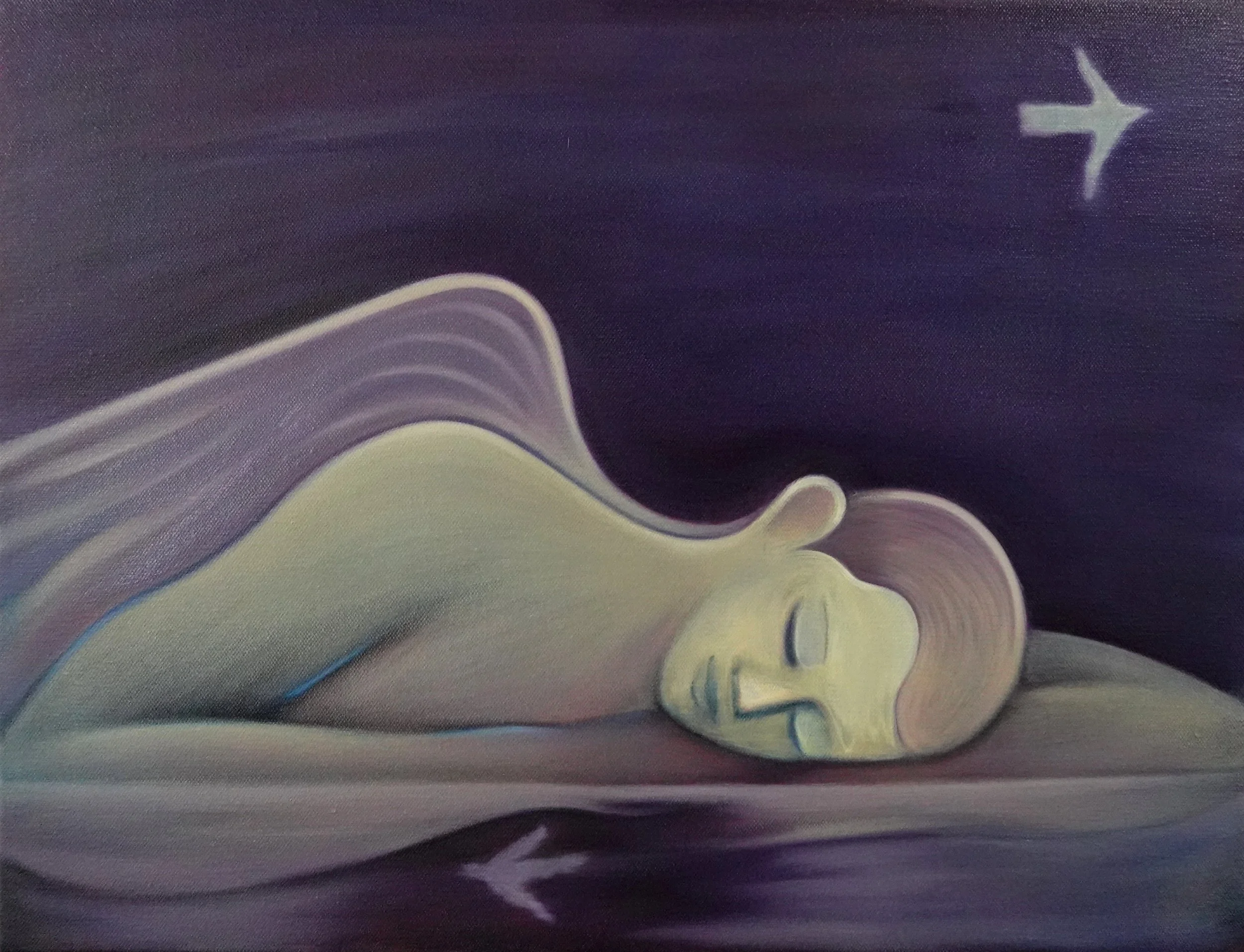
Hayeon U’s paintings maintain connection without erasing distance. What I mean is, her figures share colors and contours with their surroundings, sometimes to the point where we can no longer determine precisely where a body ends. Yet we are able to recognize a person, a posture, or a gesture. This tension is important because the paintings make connection visible through the distinctions they preserve. In Hayeon's work, the recognizability of the body allows us to perceive its relation to what lies beyond it.
However, the recognition of a body depends on expectations that painting can make uncertain. We understand a reclining posture through our own bodily experience. We know how weight settles against a supporting surface, how the position of the head affects the neck, and how the arrangement of the limbs allows the body to rest. Maurice Merleau-Ponty describes the body in Phenomenology of Perception as “our general medium for having a world” (161). Our knowledge of space begins with our experience of occupying it, and we recognize another body through that knowledge as well, even when its physical circumstances remain unclear.
In Time Seeping In, a reclining figure occupies a composition organized by broad green hills. A small gray-blue face appears near the upper left, surrounded by a thin line that rises above the head and continues into the pink sky. The body extends diagonally toward the lower right, its dark teal coloring close to that of the forms beneath it. Some contours belong unmistakably to the figure, and others seem to continue through the landscape.
The green hills meet the pink sky along a clear horizon line, establishing a recognizable division between land and sky. Yet that same division makes the figure’s position difficult to understand, as the body appears to recline among the hills, while its contours approach those of the landscape. But we can identify the horizon without determining how the figure rests in relation to it. A line that seems to describe an arm may continue into the surrounding green, and the landscape offers recognizable spatial information, but that information doesn't settle the position of the body.
The title, Time Seeping In, introduces another dimension: the figure appears motionless, although our attention moves repeatedly among its forms. We easily identify the face, follow the diagonal body, and return to the green curves, where an earlier distinction may no longer hold. The painting, thus, seem to ask us to reconsider something we ordinarily recognize without difficulty: the position of a resting body.
A gesture can establish a direction without revealing what lies at its destination. In Following the Light, a reddish face turns toward the right, with yellow concentrated around the eye and along the nose. Blue-green and turquoise occupy much of the surrounding field, and a thin horizon line passes behind the head, and broad curves in the lower portion approach the face closely enough to make their relationship to the figure uncertain.
We follow the direction of the face, searching for whatever might have attracted its attention. The title suggests light as its destination, although the most noticeable illumination falls across the face itself. Consequently, the painting gives us the act of turning toward something while leaving its circumstances unknown. The yellow around the eye may suggest an encounter already taking place, and beyond the face, the blue-green field continues without offering an identifiable object.
Hayeon’s description of her practice helps clarify why the surrounding forms matter. In our Q&A, she speaks of space as an extension of inner consciousness and describes the tensions that arise around the figure, including those associated with stability and uncertainty (U, “Q&A”, answer 3). Elsewhere, she tells me, “I don’t really think of the figure and the space as separate things” (U, “Q&A”, answer 8), and she explains that the lines and shapes of a figure create additional spaces within the composition.
The boundary of a figure, then, can establish the conditions for its connection with another form. And what I’m proposing here is particularly evident in Becoming One Another: a left-facing profile occupies the central portion of the painting, dark hair and a few facial marks establish the figure, while a pale blue contour describes the head and upper body. Behind it, a dark curve rises through the blue-green field, and near the lower portion, the outline becomes warmer and extends into thin pink lines. Above the head, another pale contour rises in a broad arc before descending toward the sides of the canvas, and two birds appear in the upper region.
The larger contour resembles an extension of the figure, but it contains no second face or recognizable anatomy. Its shape allows us to imagine another body, an enclosure, or a form that has grown from the smaller figure. But the painting gives no reason to settle on one interpretation. The smaller profile remains identifiable through its dark hair, the direction of the nose, and the pale line separating the face from the surrounding blue.
The title, Becoming One Another, invites us to consider a relationship between persons, and yet only one human face is clearly represented. The larger outline occupies much of the surrounding field, and its proximity to the smaller figure encourages us to associate the two forms. Their contours remain distinguishable, even where the lines approach one another.
In conversation with Hayeon, she has described a development in her work from an earlier concern with boundaries toward an interest in connection (U, “Q&A”, answer 6). In Becoming One Another, the smaller figure's recognizable outline allows us to perceive its relationship to the larger form. Without that outline, the larger form would lose much of its significance; we perceive their possible relationship because the painting allows us to distinguish them.
The relationship between figures can continue across separate canvases, although the viewer must establish that continuity through attention. Hayeon conceived Time Seeping In, The Sky We Once Shared, and Becoming One Another as paintings that could connect when displayed side by side. Each measure 72.7 by 90.9 centimeters (U, “List of Works” 1). Their common dimensions establish a physical correspondence, while the figures and surrounding forms introduce relationships that become apparent as our attention moves among the three works.
In The Sky We Once Shared, an elongated greenish figure with orange in its upper part stands near the right side of the canvas, partly overlapping a paler form. Tall violet divisions organize the composition around a broad blue region, and an orange band crosses the middle of that blue, with a dark curve below it. A large bird enters from the upper left, partly concealed by the edge of the canvas, while a much smaller bird appears farther away. Near the bottom, a foot touches the dark ground.
The standing figure differs from the reclining body in Time Seeping In: its vertical position gives it an apparent stability, reinforced by the contact of the foot with the ground. Higher in the painting, the overlapping forms make the body more difficult to follow. The violet divisions interrupt our view of the blue region, while the orange band introduces a horizontal movement across it.
The title suggests a shared experience belonging to the past. We might look for the other person implied by we, perhaps in the paler form overlapping the bicolor figure. Yet the painting doesn't establish whether these shapes represent two people, successive positions of one person, or another kind of relationship. Hayeon identifies The Sky We Once Shared as a work in progress (U, “List of Works” 3), and I personally and secretly wish it stays this way.
When the three paintings are considered together, their differences become more noticeable. Time Seeping In is organized around the reclining figure and the green hills that seem to accommodate it; The Sky We Once Shared introduces vertical divisions and a standing body, and in Becoming One Another, the left-facing profile appears beneath an expansive pale contour. Birds in the second and third paintings offer a visual correspondence, although their placement and scale differ considerably.
The direction of the figures also affects how we move among the paintings. The reclining body in Time Seeping Inextends diagonally toward the lower right; the standing figure in The Sky We Once Shared interrupts that movement with its vertical position, while in Becoming One Another, the profile faces left, toward the neighboring canvas.
The intervals separating the paintings prevent the compositions from becoming a continuous landscape. A line ends at the edge of one canvas, and we may discover a related form in the next, separated by an actual stretch of wall. We remember the earlier line as we examine the later one, and sometimes the resemblance seems persuasive; at other moments, the differences become more pronounced. The profile in Becoming One Another continues to face the neighboring painting, regardless of what we imagine it sees there.
The recognition of a body can survive substantial changes in the way its contours are presented. Three smaller paintings offer different tests of what I propose: in Wind, pale yellow, gray-blue, and muted pink brushstrokes move across the composition, while red marks around the nose, mouth, and jaw preserve the recognizable profile of a face; in Two Moons, a woman seen from behind stands between two circular forms, one subdued within a pale gridded rectangle and the other conspicuous against a dark field, and her head turns toward the quieter moon. In Three Shadows, repeated lavender contours surround a yellow figure, making it difficult to identify three distinct shadows despite the title.
The brushwork of Wind threatens to absorb the face into its surroundings, while the spatial divisions of Two Moons direct our attention toward what the figure appears to observe. In Three Shadows, repetition makes the body seem capable of occupying several positions. Thus, the paintings offer different ways of testing how much visual information we need to recognize a person and understand that person's position.
The viewer’s recognition of a figure doesn't require access to the experience from which the painting emerged. Hayeon has spoken about painting as a therapeutic practice and about learning that certain distances needn’t be closed (U, “Q&A”, answer 7). Her account offers insight into the development of her work, and it also raises a question about what happens when a painting leaves the circumstances of its making and enters the experience of another person.
I think here of Hayeon’s recollection of standing by the sea, listening to the waves and feeling the wind against her skin (U, “Q&A”, answer 10). The waves reach her through sound, the wind through contact with her skin, and the horizon remains distant. These sensations belong to the same moment, although each reaches her differently.
Something similar happens when we encounter a painting: we bring our own knowledge of bodies, gestures, and places, and that knowledge allows us to recognize what the artist has made. Yet recognition doesn't guarantee understanding. The direction of a face may be clear while its attention remains unknown, or we can follow a contour without knowing whether it describes a second body. The painting gives us something to examine, and our interpretation develops through the time we spend with it.
I began looking at Hayeon’s paintings with questions about the relationship between the body and its surroundings. I leave them thinking about the limits of my own understanding, and about how much another person’s work can change the way I see.
Works Cited
Merleau-Ponty, Maurice. Phenomenology of Perception. Translated by Colin Smith, Routledge, 2002.
U, Hayeon. “In Comversation”. Interview by Jorge R. G. Sagastume, 2026. The Pasticheur Vol.45, November 2026. .
U, Hayeon. “List of Works” 2026. Unpublished document.
U, Hayeon. “Materials for the Critical Essay”. Message to Jorge R. G. Sagastume, 11 Oct. 2026.
Below we provide the information on the exhibition of the paintings discussed and featured in The Pasticheur:
Artists
Hyeon O
U Hayeon
Exhibition: GAZE
Type: Duo Exhibition
Dates: November 8–29, 2026
Venue: h-u-e (gallery hue)
W Square, 1F, 145 Bunpo-ro, Nam-gu, Busan, South Korea
For inquiries: gallery_hue@naver.com
Instagram: @gallery_h_u_e
