Editorial, July 2025
On Beauty, Burden, and the Unfinished Soul
"Art does not reproduce the visible; rather, it makes visible." — Paul Klee¹
Art is less an answer than a disturbance. It does not clarify so much as complicate, revealing not what is finished but what trembles in becoming. Klee reminds us that art does not mirror what we see; it touches what resists being seen, what flickers at the edge of form, sense, or soul. This issue of The Pasticheur gathers work that stays open to change, that carries the burden of beauty like a wound, and that treats the soul as a question still unfolding rather than a completed whole.
In Lectures on Aesthetics, Hegel proposes that art, philosophy, and religion are three expressions of a people's absolute spirit. Art is not decoration but a kind of truth, the Idea made sensuous. Not all art carries this equally. For Hegel, Greek sculpture marked the height of classical beauty; after it, form grew fractured, ironic, interior. The Idea, by then too vast for simple form, pulled away from appearance, and art turned inward.²
Nietzsche reverses the frame. For him the aesthetic is not a stage of spirit but a response to suffering: faced with chaos, we make form. His Apollonian and Dionysian do not resolve into balance; they honor the dissonance between clarity and collapse. The greatest art preserves that tension.³
So do the contributions gathered here. They resist closure, and they widen the rift between what we feel and what we can explain.
Richard Denner, also known as Jampa Dorje, moves from the cosmic to the domestic, from quantum speculation to filial care. Poised throws language into the void, where Buddhist logic meets vacuum soup. The Caregiver returns to Earth, tracing the slow unraveling of an aging father's mind and body. One work asks what we are made of; the other shows what is left when memory begins to slip away. Together they form a diptych of the infinite and the intimate.
Miles Jordan's 504–907 pairs photographs of New Orleans and Fairbanks. The landscapes differ, but the questions are shared. What holds a place together? What makes memory stick to walls, to streets, to skies? His diptychs are subtle and searching, and they suggest that contrast can be a kind of kinship, that to long for one home is often to carry another inside it.
Pura López-Colomé writes poems that receive more than they describe, letting weather become prophecy and silence become structure. Each line is a pause, a flicker, a residue of time. She writes from the edge of perception, from where memory thins, and what remains is less a message than a mood, luminous and unresolved.
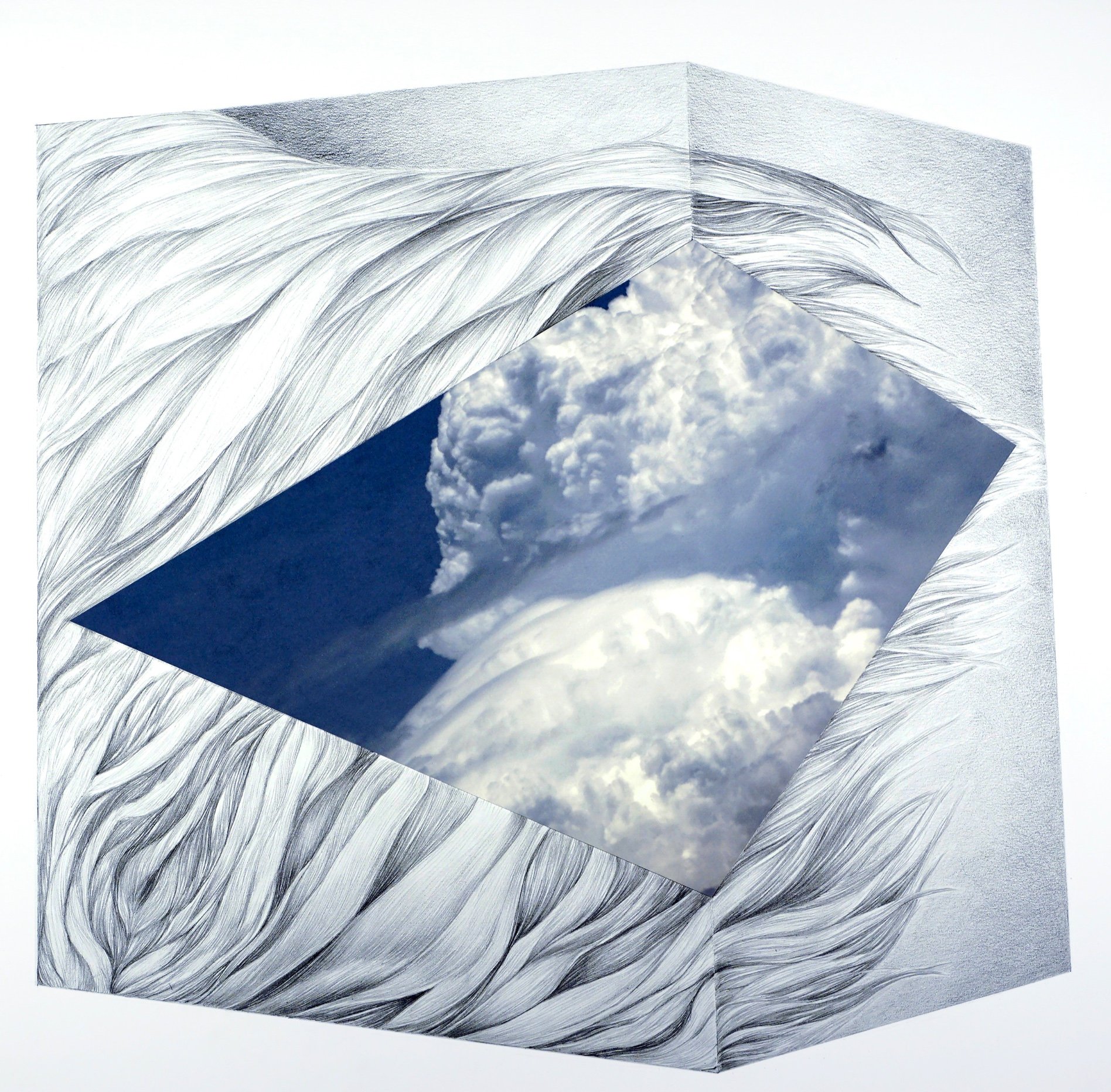
Jennifer Printz works the sky into something you can touch. Using textile and pigment, she gathers breath, light, and atmosphere into tactile form, pleated and stitched and suspended. Her pieces do not impose a shape on the sky; they let its uncertainty settle into the body. The result is meditation made visible, a slow dwelling in what will not resolve.
Jane Sangerman constructs and corrodes. Her surfaces speak with rust, with residue, with the ghost of the urban, layers of netting and fence collapsing into lyrical ruin. They are visual elegies, gridded and grieving, tender with loss and vibrant with decay. The city does not merely inspire them; it seeps into their material, until they read as thresholds rather than walls, portals where entropy and memory meet.
The soul of this issue is incomplete, and should remain so. For Hegel, beauty gave sensuous shape to the Idea; for Nietzsche, it rose out of chaos, pressed just enough into form to help us survive it; and for Oscar Wilde, beauty was its own end, though he knew that pursued without measure it could undo us.⁴ What this issue offers is not resolution but a set of rooms in which the not-yet can breathe. Each contributor leaves the door ajar, welcoming ambiguity, strangeness, and the sacred unfinished.
— Jorge R. G. Sagastume
¹ Paul Klee, Creative Credo, 1920
² G. W. F. Hegel, Lectures on Aesthetics, trans. T. M. Knox (Oxford: Clarendon Press, 1975)
³ Friedrich Nietzsche, The Birth of Tragedy, trans. Douglas Smith (Oxford: Oxford University Press, 2000)
⁴ Oscar Wilde, Preface to The Picture of Dorian Gray, 1891
This Issue’s Contributors (in Alphabetical Order)