Editor's Note
Voices That Vanish: On the Disappeared and the Silenced
Laura Ann Reed enters this issue's question twice, from two sides.
"To Paul Celan" speaks to a silenced voice. Celan wrote in the language of the murderers because it was also his mother's, survived the camps that took his parents, and drowned in the Seine in 1970. Reed addresses him in the second person, through his own "no one's eye", and ends inside the figure that holds the poem: "the stuttering of a stone".
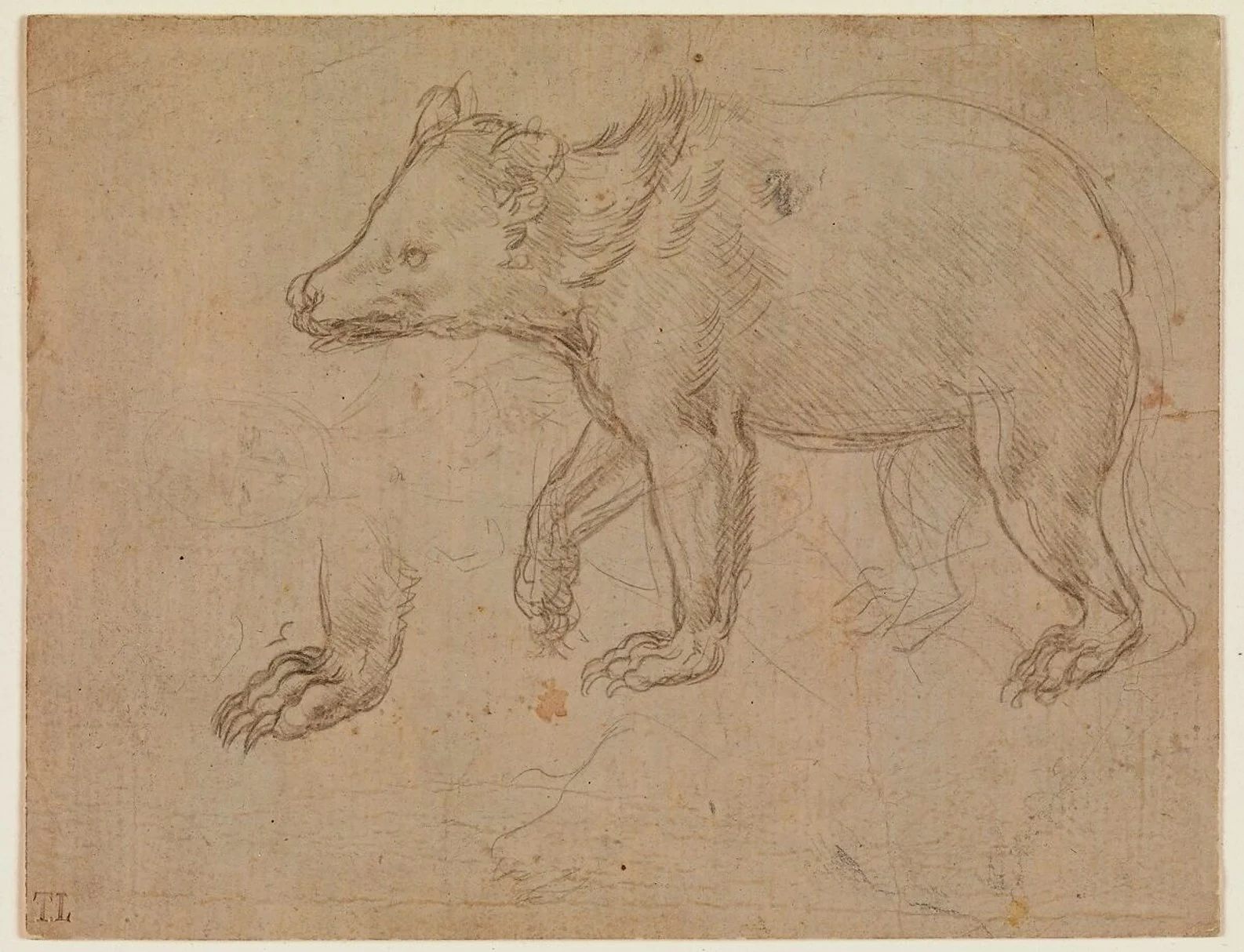
"Shame: An Inquiry" turns from voice to body. Reading Leonardo's "A Bear Walking", Reed notices what the drawing sits on: a reused sheet, a woman's failed portrait painted over to make room for the animal. The erasure is not depicted in the image; it is the image's own support. She lets the harder question stand. Did the artist see the woman he drew over, or not?
One poem listens where a voice was silenced. The other looks at what was drawn over and asks whether anyone looked. Together they hold both halves of what this issue means by testimony: the act of attention, and the cost of its absence.
-Jorge R. G. Sagastume
To Paul Celan
Spit into the face of the God that turned away,
the white ash of the millions
on your tongue. Your negated prayer:
a fist raised against impassive shadow.
Your witnessing no-one’s eye
that saw inside the thousand darknesses
the splintering six-fold star.
The immutable wound at whose altar you knelt:
the muscle that weighed, measured the threads,
disfigured distances.
You, who cursed your persisting
as sign of betrayal, a mark more calcified than Cain’s,
you spoke from the abyss: the stuttering of a stone.
A Bear Walking, Leonardo da Vinci (Italy) ca. 1482–85
Shame: An Inquiry
—after Leonardo da Vinci, A Bear Walking
object of animal’s casual brutality, the dim form of a woman under a bear. any objection she has bearing the weight is silenced by the shame of erasure. the paper the artist used was re-purposed. but there is no proof regarding the artistic objective, whether it included a portrayal of shame or violence. we don’t know if the subject of shame in the history of force was objectified in the artist’s mind when he was seized by the urge to take as subject a bear. on a day when no paper save for the sheet with the failed drawing of a woman was available. still, how could he have failed to note her abject humiliation?
Artists & Writers in This Issue
| Velibor Baćo | Alexis Krasilovsky | Nathaniel Lachenmeyer | Jeff Larason | Lisa Suhair Majaj | Liliana Mercau | Susanna Fiona Murray | Laura Ann Reed | Michael Roberts | John Whalen-Bridge | Hilmi M. Zawati |
