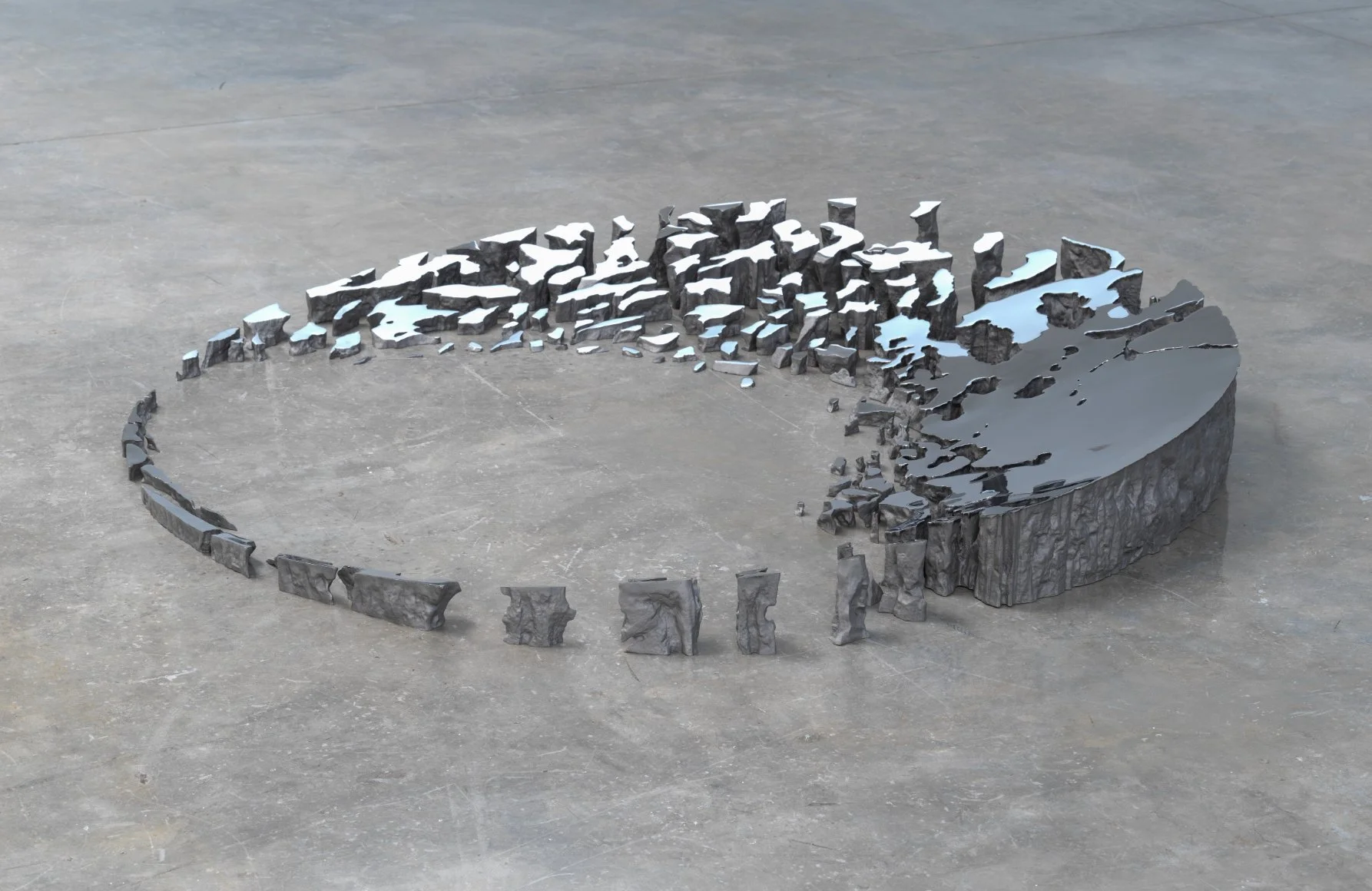
"The splinter in your eye is the best magnifying glass." — Theodor W. Adorno, Minima Moralia "Imperfection is in some sort essential to all that we know of life." — John Ruskin, "The Nature of Gothic"
Editorial, September 2025
Against Smoothness
We live in a culture that insists everything be finished and smooth. We race to produce the most seamless reels, the crispest photographs. We polish until meaning slips off the surface. The spectacle lasts a breath, and then we forget. We do not learn. We do not change.
We inhabit a world that finds friction distasteful, where everything ought to slide. This issue chooses the seam. The splinter is our lens: Adorno warns us with rough mercy, and Ruskin calls imperfection not a failure but a condition of life.
Sarah Sze sets the tone. Her works do not present a finished picture; they expose the scaffolding of seeing. Paper rips. Pigment scatters. Projected light crosses steel. You can trace the join with your eyes, and the splinter stays where you can feel it. Looking stings, then sharpens. Time doesn't move like a smooth river here so much as it eddies, leaps, forgets, returns. The work asks for patience and rewards it. You watch an image learn to become itself, rather than simply consume it. The splice is part of the picture. Keep it in frame.
Tracy Tse ties that stance to the hand. Red string, tough and ordinary, is braided, knotted, crocheted, and sewn until it climbs the wall like a living line. Every loop holds a decision, every knot a memory. The sculptures honor the labor hidden inside the objects we handle every day. We say "machine" and forget "operator". Tse will not let us forget. Her red is ceremony and pulse, and it refuses the fantasy that speed can replace skill. Behind every object is a hand, and the repetition of that hand is what becomes form.
Frank Diamond writes the same ethic in another register. His story holds a son at the threshold of a sentence he wants to mean: I forgive you. He cannot say it clean. He tries. He backs away. He tries again. The attempt is the point. Moral polish prefers quick resolution; this is not that. This is the sound of repair while it is still work.
Why this stance now. Because smoothness is not neutral. It erases history and hides labor, and it sells certainty where attention is needed. These artists and writers choose friction as a method of truth. They keep the seam visible. They let the splinter teach scale.
So we propose a way of looking. Slow down. Let the surface resist you. Ask what has been covered to achieve this shine, and ask who did the covering. Value the visible join, the place where care holds and time gathers and repair begins.
Adorno gives us the courage to keep the mote in sight; Ruskin gives us the dignity to name imperfection as life. Between the two, this issue takes its position. We prefer edges that speak, textures that remember, the unfinished now.
If you feel a tug while you read and look, follow it. That is the seam. That is the splinter doing its work.
– Jorge R. G. Sagastume,
Editor-in-Chief
This Issue’s Contributors, in Alphabetical Order