The Body, After
To look at these images is to feel the body before thought: its weight, its exposure, an arrival already seen before it looks. Daniëlle van Zadelhoff's work isn't about the body. It returns us to it.
It isn't a gentle return.
At first, there is recognition in a familiar form: light enters as it once did; faces emerge from darkness with a discipline we know;
the echo of painting is there, but only as a crossing. What follows doesn't belong to it.
What we look at is what's left of the body once meaning was overthrown.
Clothing remains; gesture remains; the placement of hands, the tilt of a head, the discipline of repose. But something is absent: not belief so much as its assurance. What we look at is the afterimage of a tradition, not its living line.
The body bears that afterimage, silently.
Daniëlle van Zadelhoff gives us over to looking. There is no distance here. We are already inside what we see.
You don't simply look. You are held in place by what looks back, even when the looking is away.
The sequence works by exposure, not visibility; by contact, not revelation.
What follows is instability: a tightening in the chest before you can name it, a hesitation, a resistance without an object.
We don't conclude. We feel first. And in feeling, something in us is rearranged. It inclines, not all at once.
The children stand within structures that precede them, yet don't quite receive them. The priest holds an object whose authority no longer guarantees meaning. The adorned body hesitates between giving and withdrawing. The aged body withdraws further still, into a presence that no longer needs confirming.
Each figure stands within a form that once promised coherence, and each exceeds it. That excess is where the work happens.
Understanding doesn't arrive as method. It arrives as event, taking place between the work and the one who encounters it. You leave changed, more than informed.
The poems begin there.
They don't accompany the images. They don't clarify or stabilize them. They remain within the same space of uncertainty, attending to what resists articulation. Where the images hold the body at the threshold of its appearance, the poems hold language at the threshold of its failure. Together, they refuse resolution; they don't offer the solace of the other.
Uniform, lesson, absolution, adornment, time, corpus: each word names an order that has ordered the body. Yet with each, disintegration begins. Structure remains; authority doesn't. What appears isn't collapse. It's unveiling.
The body after structure, after belief, after meaning stopped guaranteeing itself.
And still, it's present.
Not as symbol, relic, or answer. As presence.
Difficult, irreducible, unresolved.
The Editor
Young Virgins
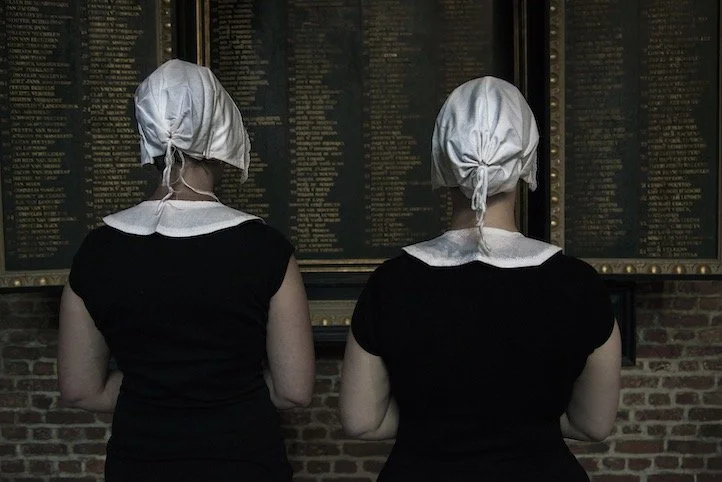
Persistent Structure
They don't look back.
History stands in front of them,
already engraved.
Names fastened to bronze
like futures studied aloud.
Someone dressed them this way.
Black cloth, white collars.
The uniform writes its grammar.
But fabric keeps its own writing.
It curves.
One bonnet is cinched tight.
The other loosens,
a knot forgetting its lesson.
A breath
the structure didn't consent.
We face their backs.
They face the list.
Faces denied.
Identity offered in the plural form.
The uniform says
faith, school, vocation.
Difference survives
like a pulse under linen.
Their names are not on the list.
That may be the only autonomy left to them.
The Lesson
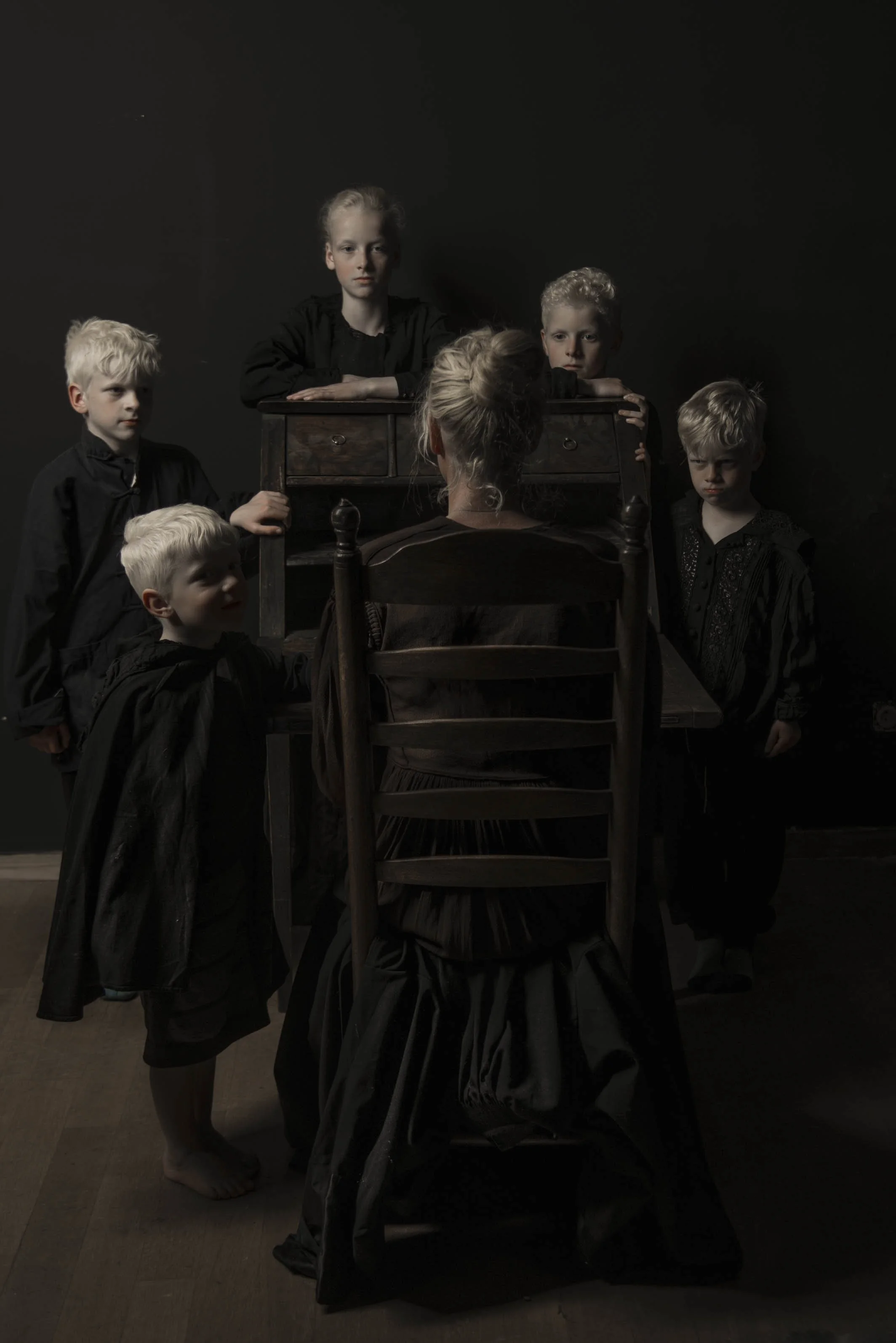
Black Sun
Winter hushes the room.
A black sun holds
in the deep of it,
stable as a held breath.
The boys look towards it
the way boys look at storms,
certain the sky will clear
for them in time.
But the girl encounters the dark
without flinching.
Her gaze does not ask.
It remembers something.
No lesson is taught.
No truth is uttered.
The teacher's back is a wall
the children read by touch.
One child stands barefoot.
The chest of drawers holds
what no one there names.
The night comes closer.
Only she stays still
inside it.
I. Absolution 1
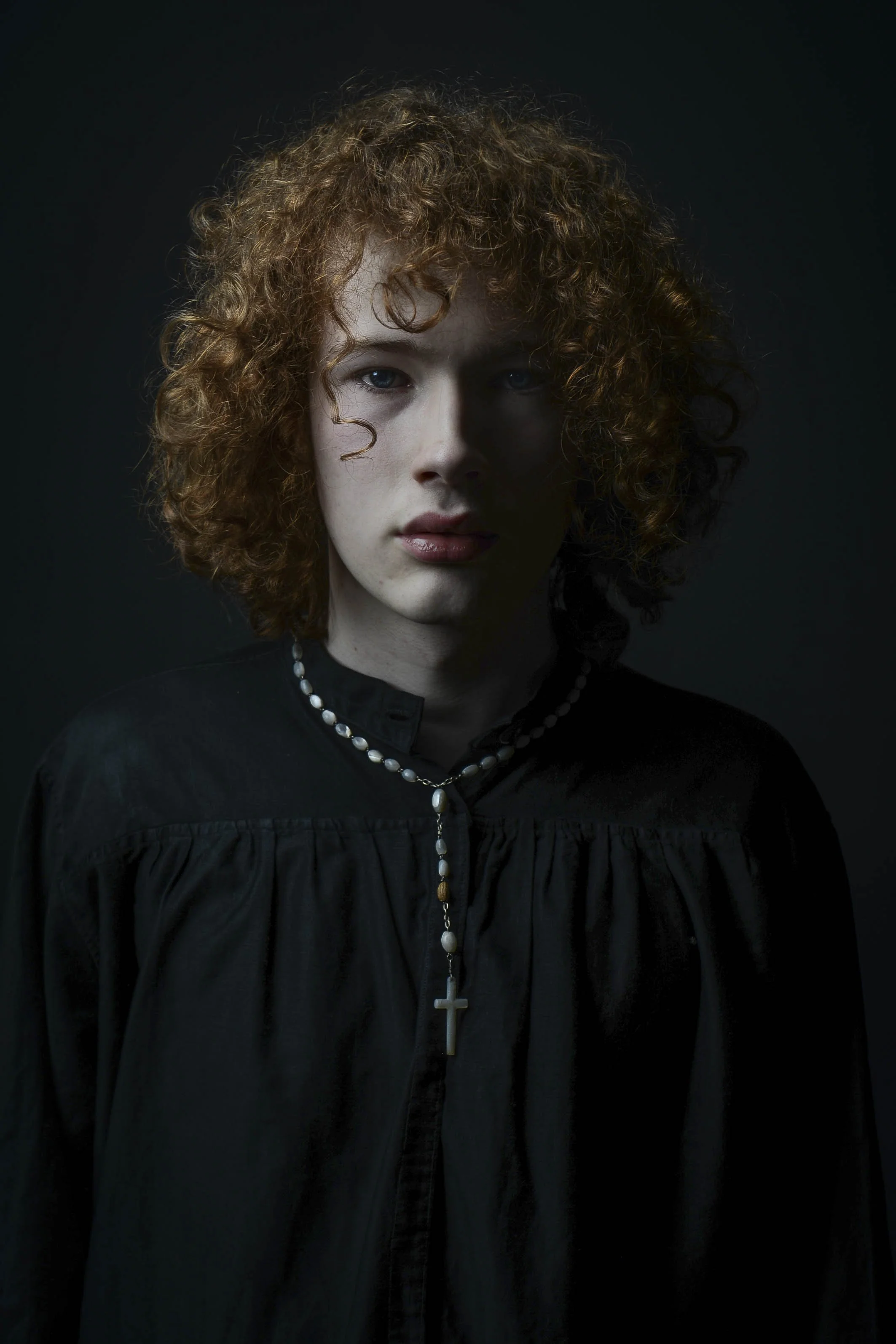
Vestments (Triptych)
I
Not quite a boy yet,
but the hush before a psalm draws breath.
His gaze, neither summon nor deflection,
hangs somewhere in the pause between Latin syllables.
No altar boy, but ember on linen,
waiting for the priest.
Pearls lean like verdicts along his collarbone,
rosary or noose.
Unforgiving light settles like ash.
II. Absolution 2
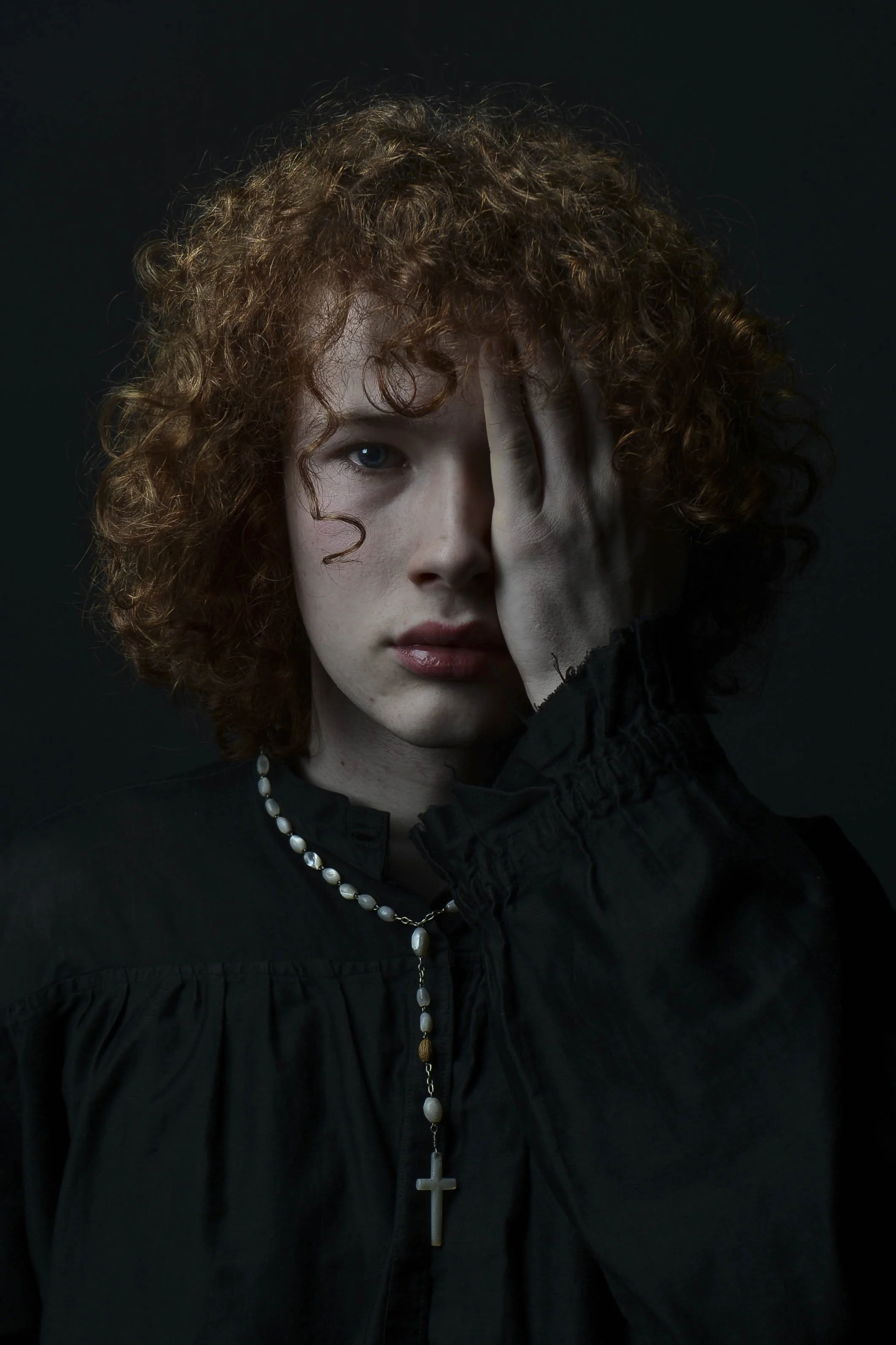
II
The eye is covered now,
not by shame
but by a vision too complete
or half-shattered.
A hand, sharp as a bone kept too long,
deconstructs the gaze that framed him:
gesture of the condemned before the lash,
their silence, the sentence.
Behind the palm: a world
trying to bloom
or rot.
III. Believe 2
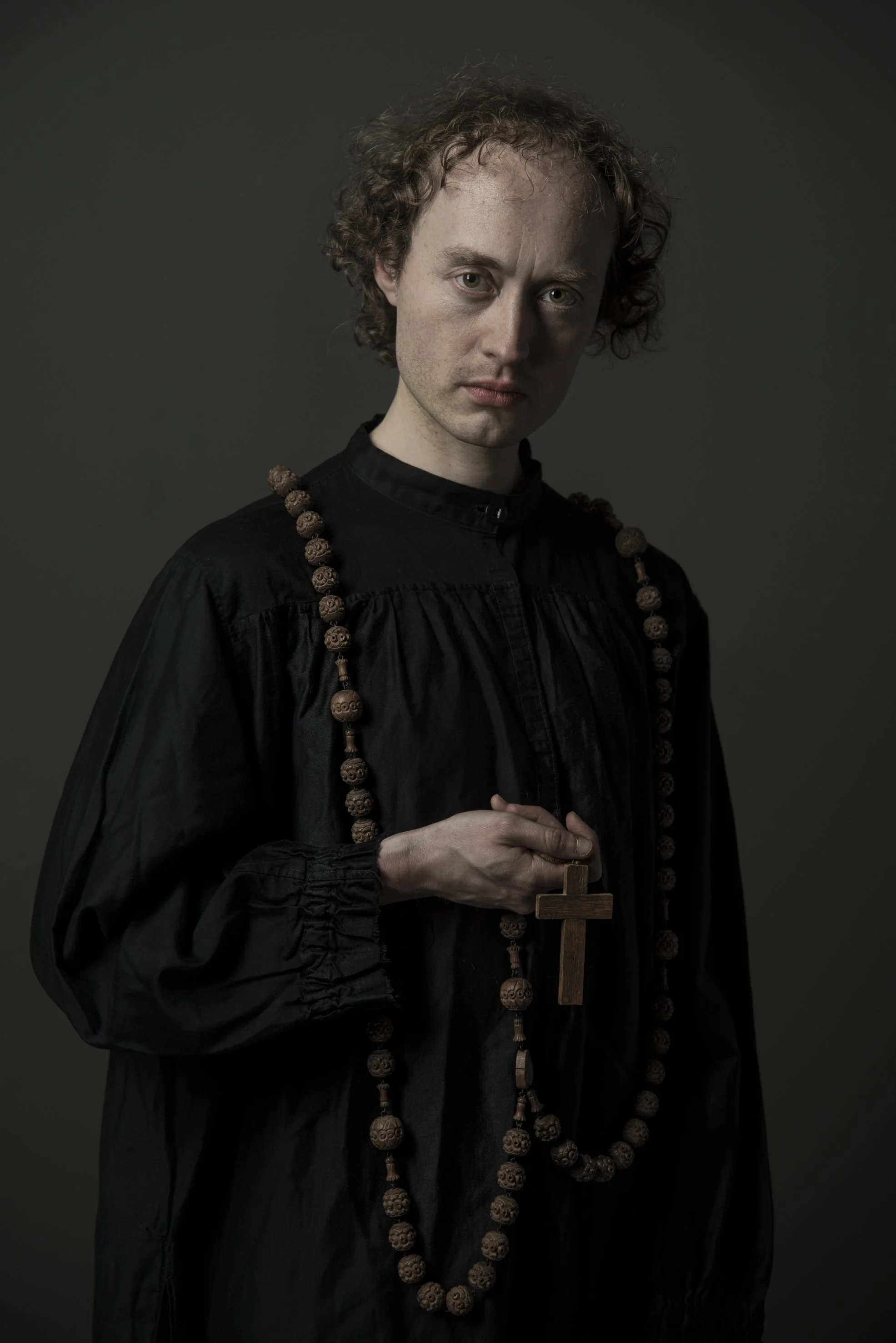
III
The priest clutches the cross
as one emerging after drowning.
Beads bulge,
swollen with prayers beyond speech.
His face frames a question
no dogma answers.
Dressed for mourning without a corpse,
he may be the missing body.
Tinsel
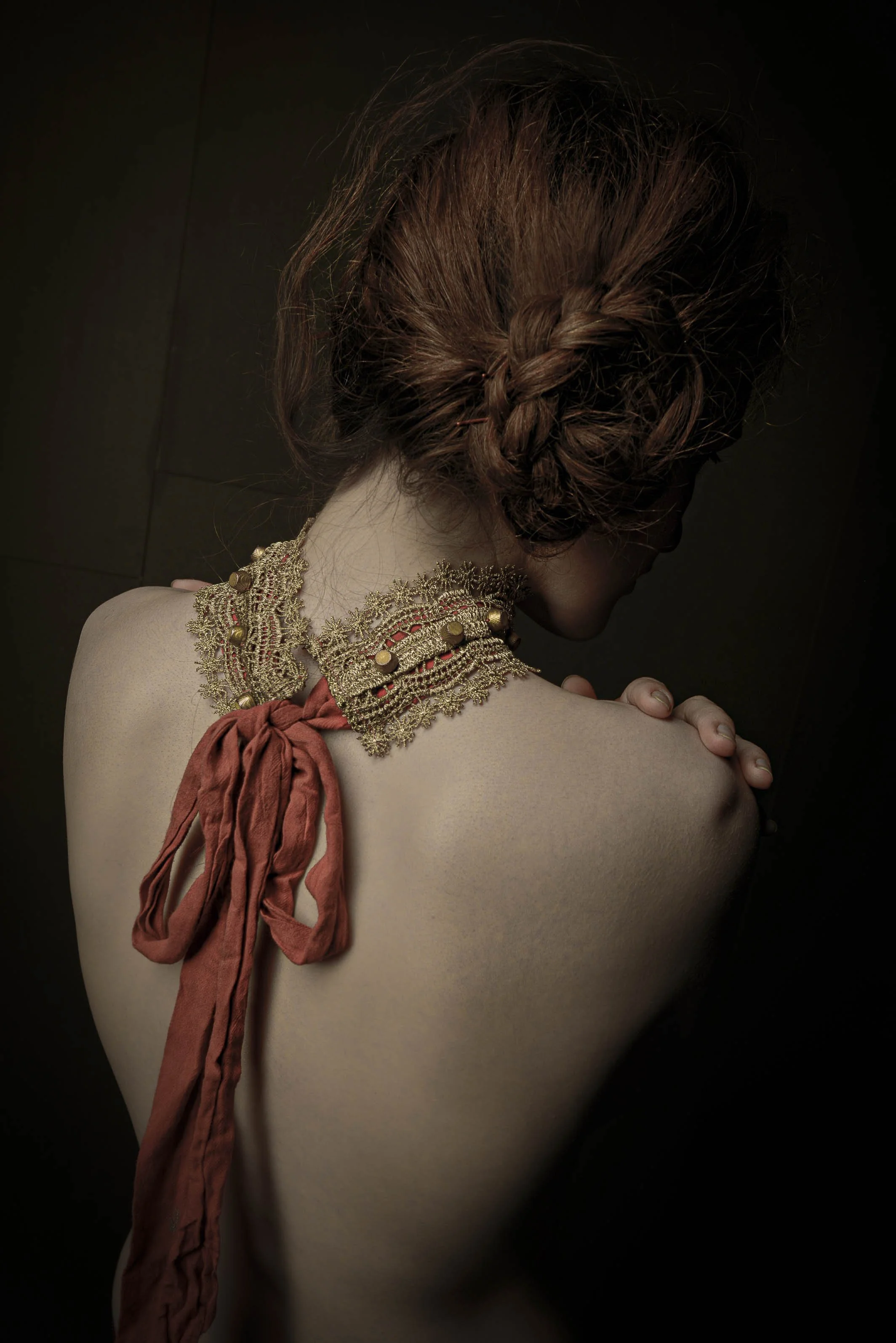
Tinsel
A turned red head.
Not as refusal, nor as invitation.
Gold at the throat,
dense, deliberate,
resting where skin is thinnest.
Pale skin holds the light
and does not return it.
A coral ribbon hangs loose,
wrinkled, unfinished,
its knot remembering another neck.
The braid is tight, then less so.
Order thinning into touch.
Hair accepting gravity.
Hands rest on shoulders.
Fingernails jagged,
edges unfiled,
as belonging to another rhythm.
Skin holds what gold insists on.
The ribbon vacillates.
Darkness gathers around the body,
not quite closing,
not quite opening.
What is fastened stays visible.
What loosens is not corrected anymore.
Timeless
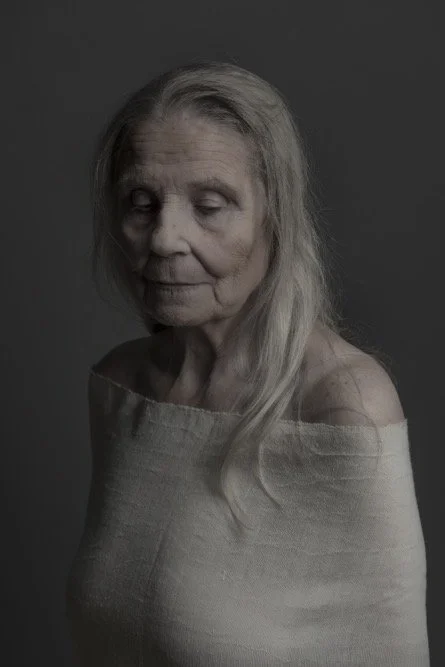
Timeless
Head inclined,
not denying, nor inviting.
Hair falls
the way it has learned.
Skin carries time
the way stone carries wind.
No correction.
No insistence.
Cloth rests on the shoulders,
light, provisional,
as if covering were only a courtesy.
A quiet face.
Lowered eyes,
not in shame,
not in offering.
Time has passed through the body
without asking permission.
leaving marks
without intent.
Nothing here reaches outward
any longer.
And still,
from where I stand,
there is heat.
Not hers.
Mine.
A body done with negotiation,
and a gaze
still trying to hold it.
CORPUS
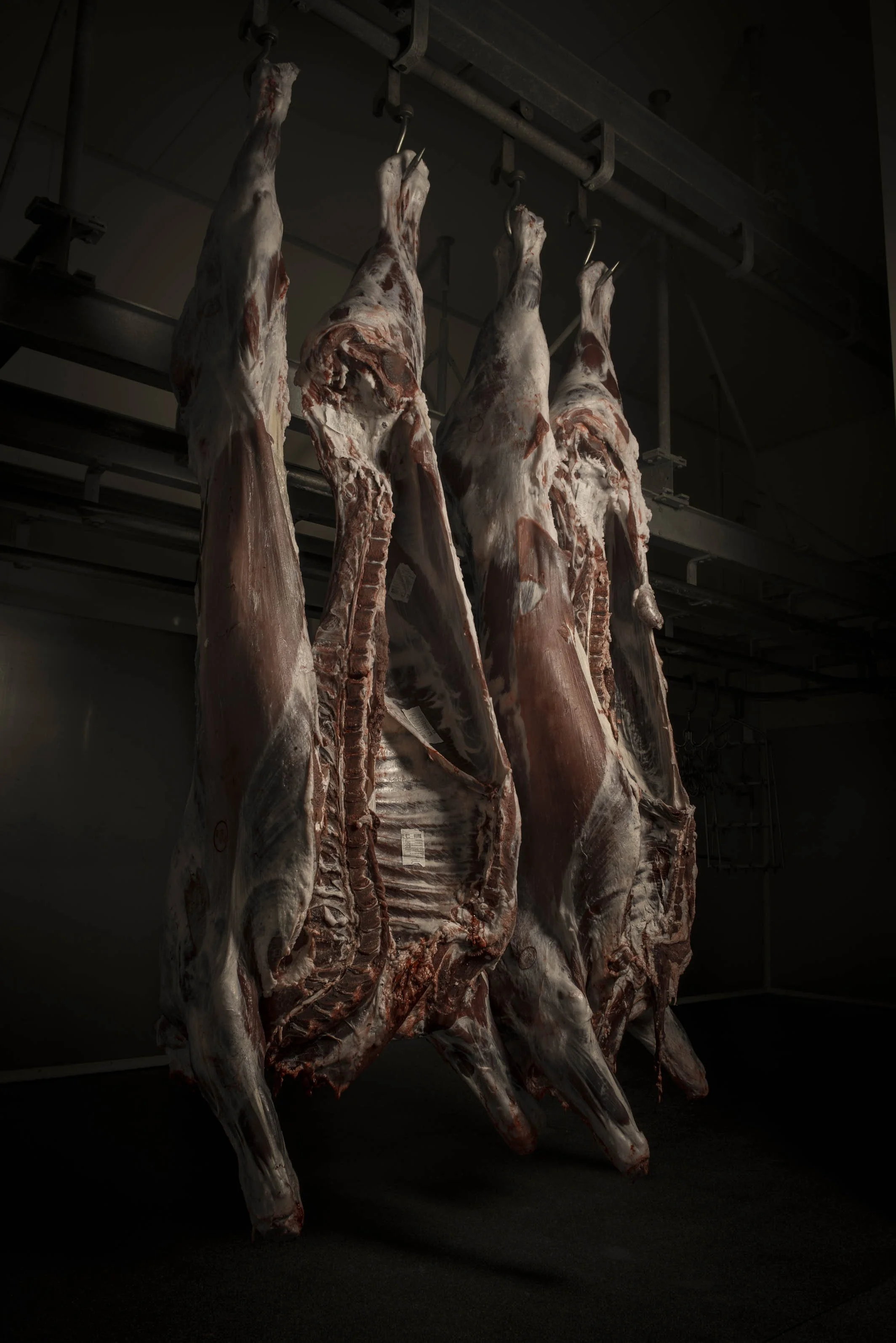
CORPUS
They hang by the hind legs, evenly spaced, identical in posture if not in size. The hooks enter where joints were made to bend. Gravity completes the sentence. What once moved now waits.
Skin removed in places, left in others. Muscle exposed, pale where air reaches it, darker where blood settled before it was drained. Each body carries a tag. Not a name. A number. Weight. Date. Destination.
There is no face. No gaze to return. Nothing here returns the look.
The room is clean. The system works. Nothing is here is improvised. This is not structural violence in progress, but concluded, organized, rendered efficient. The bodies are no longer asked to mean anything. They are asked to be processed.
The body priced by its usefulness. Flesh separated from life without ceremony.
Not martyrdom. Not sacrifice.
Product.
What hangs is not death.
It reads as completion.
© All Works by Daniëlle Van Zadelhoff
© All Texts by Jorge R. G. Sagastume
Artists & Writers in This Issue
In alphabetical order by the first name
