EDITORIAL
February 2026
Who Is That? On Self-Portraiture and the Making of the Self
A woman enters an empty church with store-bought coffee. She tries on metaphors: mountain, bird, river, wind. None fit. God laughs and points to the glass door. In the reflection she sees what she already knows: grass-stained sneakers, a pimple near the nose, the irreducible fact of herself. Neither fish nor meat, neither mountain nor bird. Just this. "You are", God says. And his laughter spins like the sun on its axis.
Anna Zhuk's poem doesn't resolve the self. It accumulates it: sour cranberry, broken faucet, crooked bangs, foolish longing, twelve-year-old smell of the stove. The list refuses hierarchy. The list refuses metaphor. What remains isn't essence but inventory, not revelation but the patient labor of naming what appears when you stop pretending you already know what you are.
This is the premise of the issue you hold. Self-portraiture doesn't promise discovery. It permits rehearsal. The self isn't waiting to be found. It comes into being through the act of appearing, through the risk of remaining visible long enough for something uncertain to emerge.
Across the history of art and thought, the self-portrait has stood at a threshold. Between seeing and being seen. Between intention and exposure. Between the one who composes and the one who is composed. The genre has never been simple resemblance. It is performance and translation. It is a way of thinking with the body. A way of testing how much of the self survives the pressure of being looked at.
January's issue recognized the self as plural, inherited, multiply inhabited. It traced identity as a genealogy of doubles and echoes, internal figures who refuse to collapse into a single voice. That earlier issue understood the self as archive.
February shifts the question. If January asked who inhabits me, February asks how do I become at all. Here, the self isn't confession but method. Not revelation but work in progress. Not archive but event.
Alyssa Monks sets the tone with a body that insists and resists at once. Working in oil paint, water, and glass, she returns the figure through layers of mediation. Faces press against shower doors. Mouths open into steam. The virtuosity is exacting, but what holds is residue. The body is present and withheld, visible and obstructed. Grief hardens into gesture. Loss takes form through repetition and labor. The self persists not as essence but as what remains after something has been taken away.
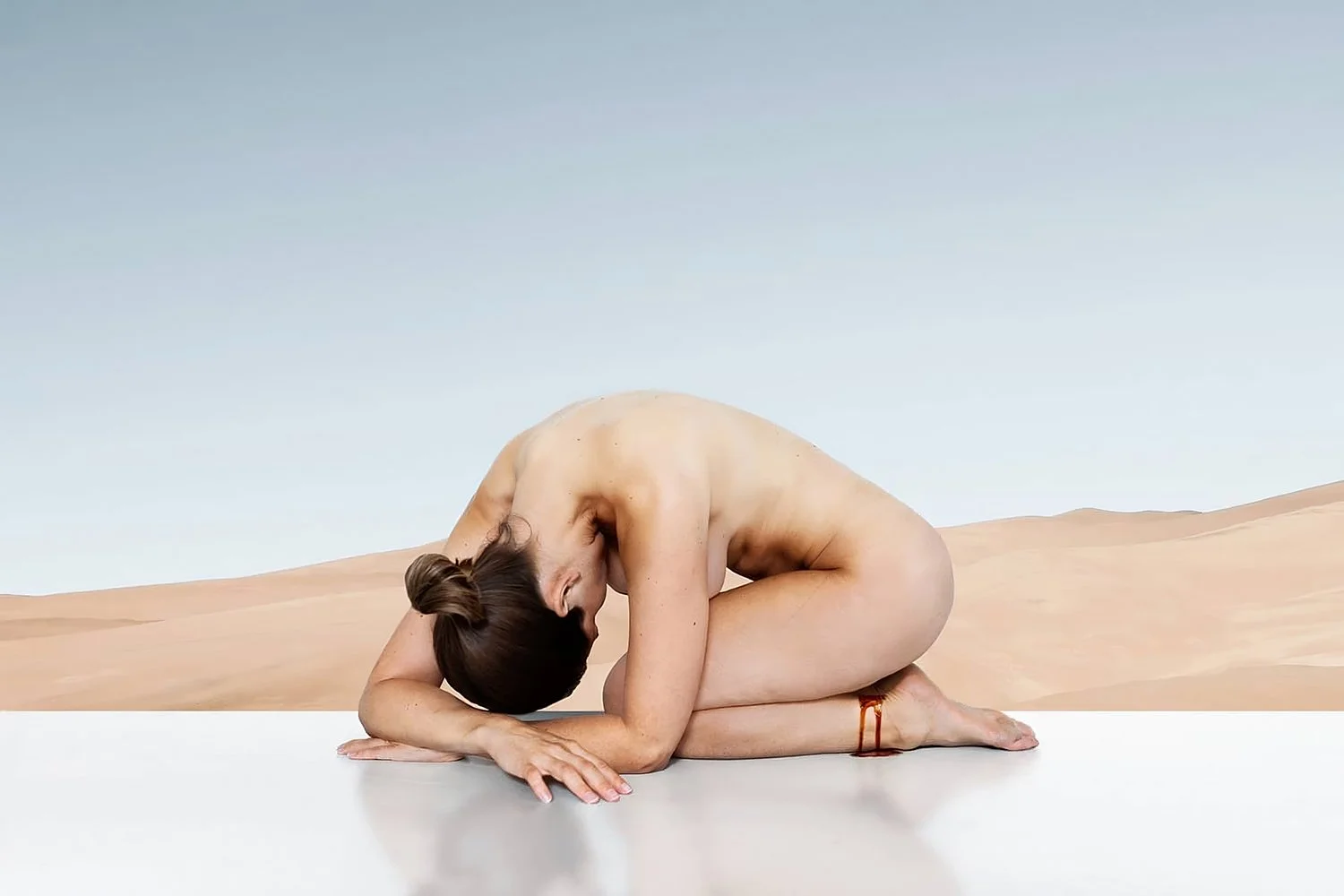
From that pressure, Laura Zalenga moves in another direction. Unable to summon mental images, she constructs her self-portraits from concepts that must pass through the body before they can appear. The self arrives as invention rather than memory. Figures curl among bare branches, dissolve into water, kneel against desert horizons. Blood appears without spectacle. The body becomes porous, atmospheric, something that happens rather than something that is. Identity is enacted through exposure, constraint, and contact with element.
Elina Brotherus situates the body within systems that preexist it: architecture, landscape, institutions of care. Sanatoriums, modernist houses, a rowboat near a sinking ship. Often the figure turns away from us. Posture replaces expression. The self thinks through placement rather than confession. Identity emerges as relation: to space, to structure, to what exceeds the body's control.
If Brotherus frames the self through space, Brenda Zlamany extends it through time. Her serial self-portraits span decades, allowing duration itself to become method. From early woodcuts to recent paintings, from pregnancy to age, from performance to quiet persistence, her work refuses closure. Roles accumulate. The face changes. The question stays open. To see what is really on the end of the fork requires endurance. Becoming isn't an episode. It is a sustained practice.
Around these core practices gather other modes of inquiry. Chantal Convertini works through contingency, using analog film, mirrors, and the slow chemistry of light to court accident rather than control. Her self-portraits move through bathrooms, beaches, and domestic interiors, spaces where reflection multiplies the body into frames within frames. Grain, delay, and imperfect exposure allow meaning to arrive after the fact. Emotion appears before it names itself. Aneta Grzeszykowska multiplies and negates the self until identity survives only as variation. Alena Solomonova treats the photograph as material to be cut, stitched, and damaged, the self rendered as artifact. Jenny Woods anchors identity in care and labor, the body divided and redistributed through youth, motherhood, and what is to come. Mela Kalf approaches self-portraiture as ontological experiment. Beginning from illness, when pain and physical weakness destabilized the body, her work tests what remains of the self under conditions of fragility. The forest enters these images not as symbol or refuge but as a second consciousness, a site where the body negotiates finitude and the impulse toward transcendence. Her self-portraits hold the figure at the threshold between persistence and disappearance, asking whether the self, pressed hard enough, can imagine transformation rather than collapse.
Clementine Hanbury draws the self at the edge of articulation. Trained in classical ateliers, she uses charcoal to hold the face in suspension, allowing likeness to become inquiry. Each mark commits. Each erasure leaves a trace. Her portraits don't perform emotion. They wait. What appears isn't identity but attention itself, the self overheard rather than declared.
Christine Buchmann closes the visual sequence by observing the moment when privacy thins into attention and the self hesitates under the weight of being seen. Nothing is asserted. Nothing is resolved. The body remains present, alert to the risk of appearing.
The literary works return the question to language. Anna Zhuk's poetry inventories the self without hierarchy, letting accumulation replace metaphor. Marty Newman fractures the first person through surreal displacement, staging the "I" as something provisional, unstable, and oddly tender. In both, the self isn't revealed but rehearsed.
What binds these practices isn't autobiography. Not confession. Not the demand for revelation. It is a shared insistence that the self must be enacted. These works allow identity to appear, alter, withdraw, and return without claiming finality. They understand that to ask Who is that? is to begin a gesture without knowing how it will end. To enter the frame. To accept that the image or the word may resist completion.
Anna's sparrow beats against glass, then rests on a beam, too exhausted to fly even when the doors open. "How easy it is to miss open doors", she writes. "How hard it is to fly where strong wings are required / when the only strong thing is the heart. / Can the heart lift a body into flight?"
Each work in this issue leaves that question deliberately unanswered. Not as failure. Not as refusal. But as fidelity to the way the self actually comes into being: through attempts, through repetition, through return, through the sustained act of attention that allows something to appear without demanding that it remain.
Fall in love with me, Anna writes. Will you?
The question hangs.
The self waits.
The image holds.
Jorge R. G. Sagastume
Editor-in-Chief
Who is that?: Self-Portraiture in Art, Literature, and Philosophy
Forthcoming, January 30, 2026
“Everyone thinks [my photographs] are self-portraits, but they are not meant to be. If I photograph myself it’s because I can push my own limits to the extreme.” — Cindy Sherman
“The self is not something ready-made, but something in continuous formation through choice of action.” — John Dewey
“To see is to forget the name of the thing one sees.” — Paul Valéry
Artists & writers in alphabetical order by the first name:
Artists & Writers in This Issue
In alphabetical order by the first name
